The sermon text provided below is derived from the sermon audio recording making use of generative tools. It has not been manually edited. While transcription tools have a high degree of accuracy, the output may include generative textual, punctuation, and/or formatting errors.
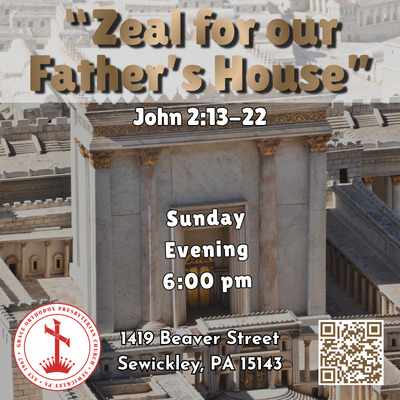
The reading of God’s Word. This evening’s passage is from John chapter 2, and we will be reading from verses 13 through 22. You can find this on page 1054 in your pew Bibles. John chapter 2, verses 13 through 22. Hear now the word of the Lord. The Passover of the Jews was at hand, and Jesus went up to Jerusalem. In the temple he found those who were selling oxen and sheep and pigeons, and the moneychangers sitting there. And making a whip of cords, he drove them all out of the temple, along with the sheep and oxen. He poured out the coins of the moneychangers and overturned their tables. And he told those who sold the pigeons, “Take these things away. Do not make my Father’s house a house of trade.”
His disciples remembered that it was written, “Zeal for your house will consume me.” So the Jews said to him, “What sign do you show us for doing these things?” And Jesus answered them, “Destroy this temple, and in three days I will raise it up.” The Jews then said, “It has taken 46 years to build this temple, and will you raise it up in three days?” But he was speaking about the temple of his body. When therefore he was raised from the dead, his disciples remembered that he had said this, and they believed the Scriptures and the word that Jesus had spoken.”
Let us pray. Heavenly Father, we thank you that you have preserved your Word for us, and that through your Word we can come to know you and come to know more about your Son, Jesus Christ. We pray, O Lord, that through the Holy Spirit you would strengthen me as I expound your Word this evening. We pray that you would give me the strength to do so and the words to do so faithfully before you. We pray, O Lord, that the Holy Spirit will work in each one of us, that through your Word you would cause us to be more like your Son, Jesus Christ, and that you would cause us to love one another more. And we pray all this in your Son’s name. Amen. You may be seated.
One of the most well-known expressions in the Christian world over the past thirty years is the question, “What would Jesus do?” Many of us have at some point worn T-shirts or bracelets with the letters WWJD written on them, which stands for “What would Jesus do?” This question and slogan are intended to encourage believers to ask themselves, in any given situation, how Jesus would act if He were present in that place.
Interestingly, I learned that the first recorded appearance of this expression in Christian literature was in a sermon delivered by Charles Spurgeon in 1891. However, the idea of imitating Christ is a long-standing ethical principle that Christians have followed for many years. Perhaps the most famous expression of this idea is found in the book *The Imitation of Christ*, which some of you may have heard of. More directly relevant to us, the Apostle Paul writes in 1 Corinthians, “Be imitators of me, as I am of Christ.” Nevertheless, when we consider this widely accepted principle of “What would Jesus do?” it can sometimes be difficult to apply consistently.
Because the reality that many broadly evangelical believers and youth pastors may not emphasize is that Jesus Christ was unique in his role as Messiah in the history of redemption. Jesus Christ came to this earth as the eternal Son of God, to become man, to live a perfect life, and to die on the cross for our sins, only to be raised three days later and ascend to the heavens to intercede on our behalf. In case it is not clear, Jesus’ nature and his role are completely unique in the history of mankind. There are things that Jesus did that we cannot do, and there are things that Jesus did as the fulfillment of Old Testament prophecy that we should not even attempt to do. So when we consider what Jesus did while he was on this earth, we ought not to think that we are empowered to imitate everything that he did. In many ways, the precise reason why there are so many differing views in our churches today, and there are even some who call themselves modern-day apostles, is precisely because we fail to see and consider the idea that Jesus and the apostles play a completely unique role that no one will ever fill again.
So when we consider the idea of imitating Christ, this is, of course, a good and necessary principle. But we must do so understanding the context in which Jesus said the things that he said and did the things that he did. One such passage that we must understand with discernment is our passage this evening. In our modern times, those who seek to justify their extreme actions or their extreme rhetoric will often go to passages like this, and they claim that they are just following in the footsteps of Jesus.
The problem, of course, is that they are not the Lord of the universe, and the temple is not their Father’s house in the same way that it was Jesus’ Father’s house. When Jesus came to this earth, he was fulfilling the role of Messiah, as prophesied from long ago. This short passage that we will examine this evening is about the fulfillment of the Messianic prophecy and the Son of God identifying as the true temple to which the Old Covenant pointed.
We will consider this passage in two parts. First, we will look at Jesus’ zeal for his Father’s house in verses 13 through 17. Second, we will examine the sign that is to come, as described in verses 18 through 22. Let us begin with Jesus’ zeal for his Father’s house in verses 13 through 17.
Since the beginning of the gospel narrative in John, one of the central questions that John has emphasized repeatedly is the question of authority. On what authority did John the Baptist teach? On what authority did John the Baptist baptize? On what authority did Jesus come to preach and to perform miracles? A recurring theme throughout the Gospel of John is that the Jewish leaders continually come to Jesus to challenge and question his authority, in order to avoid confronting the content of his teaching.
In our passage this evening, we again find this familiar theme. Jesus performs a sign, and the Jews immediately respond by asking, “What sign do you show us to justify these actions?” In other words, what authority do you have to do such things? Who authorized you to come here and disrupt the practice of the Passover, which the leaders of the Jews themselves had approved? And what sign do you bring to demonstrate that you have the authority to do such things?
Now, this is actually not a terrible question to ask in theory. If someone walked into our church right now and began overturning tables, we might ask a similar question. The problem, of course, is that these Jewish leaders have completely missed the sign that they themselves are asking for. Jesus had just performed a sign that demonstrated the authority with which he carried out these actions. But what was the sign?
John records for us in our passage this evening that, sometime after the wedding in Cana, when the time for the Passover came, Jesus and his disciples traveled down to Jerusalem to celebrate the Holy Day. This was the first of four times that John records for us the Passover. According to the custom of the Jews in that day, in accordance with the law of Moses, all adult males were required to come to Jerusalem and celebrate the Passover at the temple. These adult males were required to sacrifice a Passover lamb, both to commemorate the blood of the lamb that covered their houses in Egypt and to serve as a continual reminder of the need for a substitutionary atonement. However, we read that the road to Jerusalem was long and difficult for many of them. For some, it would take days or even weeks to reach Jerusalem. Therefore, bringing oxen and sheep was completely impractical.
So instead, the temple allowed merchants to come to the temple and to sell sheep, pigeons, and oxen so that the Jews would not have to herd animals for days. Likewise, there were money changers who were set up at the temple in order to convert Roman coins into the currency that the temple would accept. This money was then used to pay the yearly temple tax. However, as you can imagine, these merchants were not merely selling animals to worshipers to help them on their journey. They also took advantage of them and sold these animals at excessive prices. In other words, these merchants and sellers exploited those who needed a specific animal or a particular kind of currency, using this need as an opportunity to make money and to defraud these people.
And Jesus saw this, and he responded in a decisive manner. John records that Jesus made a whip of cords and drove all of them out of the temple, along with the sheep and oxen. Jesus used this whip to drive the animals out of the temple. This must have caused considerable chaos. Imagine sheep and cattle running through the courtyard. And considering the large number of Jews who would have been present each year, there must have been hundreds of animals running through the temple. But notice that it was not only the animals that Jesus drove out of the temple. John writes that Jesus drove them all out with the sheep and oxen.
This means that Jesus used the whip to drive out not only the animals, but also the people who were selling the animals. After all, ultimately, what was defiling the temple was not the animals themselves, but the sinful actions of those who were selling the animals.
This is a completely different picture of Jesus than the one portrayed in today’s culture. The Jesus described in our culture is always calm and kind, never speaking harshly, and never condemning anyone. But when we see the full picture of Jesus presented in the gospels, we see that this is not accurate.
Jesus, as we have learned, is the eternal Son of God. He is the same God who in the Old Testament consumed Nadab and Abihu for offering strange fire before the Lord. He is the same God revealed in the Old Testament as requiring worship to be conducted with the utmost care and reverence. God is holy, and he requires his people to be holy when they come before his presence. Therefore, such actions were a complete abomination to Jesus.
And John continues, saying that Jesus told those who sold the pigeons, “Take these things away. Do not make my Father’s house a house of trade.” His disciples remembered that it was written, “Zeal for your house will consume me.” Here, Jesus makes an exclusive authority claim: this temple is his Father’s house, and therefore he has the authority to command the merchants to leave. He claimed that this temple is his Father’s house, and thus he could drive out the animals and cause disruption.
Jesus has the authority to tell people how they must act in the house of God because God is his Father. While the Jews were completely astonished by Jesus’s actions, the disciples—though considered uneducated—understood what was happening. They recognized that Jesus was fulfilling the role of the Messiah foretold in ancient prophecy. John records for us that the disciples remembered a passage from the Messianic Psalm we read earlier, Psalm 69. They applied this passage to Jesus, seeing it as fulfilled in him.
They may have also thought of passages like Malachi chapter three, verses one through four, where Malachi prophesies of this very day. Please turn there with me to Malachi chapter three. We will read verses one through four. Malachi chapter three, verses one through four. Behold, I send my messenger, and he will prepare the way before me.
And the Lord whom you seek will suddenly come to his temple. And the messenger of the covenant in whom you delight, behold, he is coming, says the Lord of hosts. But who can endure the day of his coming? And who can stand when he appears? For he is like a refiner’s fire and like fuller’s soap. He will sit as a refiner and purify silver. And he will purify the sons of Levi and refine them like gold and silver. And they will bring offerings and righteousness to the Lord. Then the offerings of Judah and Jerusalem will be pleasing to the Lord as in the days of old and as in the former years.”
Hundreds of years before Jesus came, Malachi prophesied that the Messiah would indeed come to his temple. And that when he did, he would come to purify. The actions that Jesus took in driving out the merchants and money changers were not merely those of an ordinary believer. He was acting in his role as Messiah. This act was in and of itself a sign that pointed to Jesus being that very Messiah.
But the Jewish leaders, as we read, completely missed this sign. They were blinded by their unbelief and had forgotten the very scriptures which they had spent years learning. And thus they responded by saying, “What sign do you show for us to do these things?” These leaders missed the sign right before their eyes and instead asked for another sign to establish the authority by which Jesus did these things. But instead of giving them a sign, Jesus gave them a promise—a promise of a sign that was to come. To the sign to come, the sign to come in verses eighteen through twenty-two.
Now at this point it may be helpful to note that there is a significant discussion among scholars, even today, about how many times Jesus actually cleansed the temple. In Matthew, Mark, and Luke, these Gospels record for us that the cleansing of the temple occurred toward the end of Jesus’ ministry. However, John records that it took place at the very beginning of his ministry.
Some explain these differences by arguing that there was only one cleansing of the temple. They suggest that Matthew, Mark, and Luke were focused on the historical timeline, which is why they placed it at the end of Jesus’ ministry. In contrast, John was not concerned with the historical timeline but rather with theological meaning, which is why he placed the event at the beginning of Jesus’ ministry. While I do not consider this interpretation impossible, I propose that there is a simpler explanation. That is, there are two accounts because there were in fact two distinct occasions when Jesus cleansed the temple—once at the beginning of his ministry and once at the end.
One of the strongest reasons for understanding these as separate events is the words that John records in verses 19 through 20. Although it is not impossible that the Gospel writers omitted these words, it seems unlikely that none of the other writers would have referenced them, given their significance. Let us read verses 19 through 22 again.
Jesus answered them, “Destroy this temple, and in three days I will raise it up.” The Jews then said, “It has taken forty-six years to build this temple, and will you raise it up in three days?” But he was speaking about the temple of his body. And therefore, he was raised from the dead. His disciples remembered that he had said this, and they believed the scriptures and the word that Jesus had spoken. At this time, according to the text, both the Jews and the disciples did not understand Jesus’ words. Jesus is using the imperative verb. In the Greek, he says not “if this temple is destroyed,” but “destroy this temple,” and when you do, I will raise it up on the third day. Once again, this completely goes over the leaders’ heads.
The leaders respond, “It has taken forty-six years to build this temple, and will you raise it up in three days?” They thought that Jesus was speaking of the physical temple in which they stood. Naturally, they scoffed at the idea that one man could raise up a temple that had taken forty-six years to build. But of course, we know that Jesus is not speaking of the physical temple. As the disciples realized later, Jesus was speaking of his own body and not the physical temple.
Once again, these Jewish rulers had failed to remember the Old Testament prophecies that foretold of the new covenant, which would bring a new temple. And this temple, according to the Old Testament, would be an everlasting temple, where the glory of God would dwell more gloriously, from everlasting to everlasting. The temple in the Old Testament was never meant to be permanent. It merely pointed to the truly permanent temple, which is Jesus Christ.
Paul says this regarding Jesus in Colossians chapter 1. He is the image of the invisible God, the firstborn of all creation. For by him all things were created in heaven and on earth, visible and invisible, whether thrones or dominions or rulers or authorities, all things were created through him and for him. And he is before all things, and in him all things hold together. And he is the head of the body, the church. He is the beginning, the firstborn from the dead, and in everything he might be preeminent. For in him all of the fullness of God was pleased to dwell, and through him to reconcile to himself all things, whether in heaven or on earth, making peace by the blood of the cross.
In the Old Testament, under the Old Covenant, the glory of God filled the temple, and that showed the people of God that God was truly with them. But now that Jesus has come, the physical building of the temple is no longer necessary. The fullness of the glory of God dwelled in the person of Jesus Christ and walked among men. While the Jewish leaders were concerned about Jesus’ actions in driving out the animals and merchants from the temple, Jesus was focused on this greater sign: the passing away of the temple, to be replaced by the true temple, which is Jesus Christ.
The writer of Hebrews puts it this way, in Hebrews 9, verses 11–14. Please turn there with me to Hebrews 9, verses 11–14. But when Christ appeared as a high priest of the good things that have come, then through the greater and more perfect tent, not made with hands, that is, not of this creation, he entered once for all into the holy place, not by means of the blood of goats and calves, but by means of his own blood, thus securing an eternal redemption. For if the blood of goats and bulls and the sprinkling of defiled persons with the ashes of a heifer sanctify for the purification of the flesh, how much more will the blood of Christ, who through the eternal spirit offered himself without blemish to God, purify our conscience from dead works to serve the living God?
The very holy day that these men were celebrating, that is the Passover, was merely a type of the greater lamb of Jesus. The writer of Hebrews is saying not only is Jesus the temple, he is also the means through which the people of God are able to enter the presence of God.
Because it was never about the blood of lambs or goats or pigeons. None of these things actually brought purification from sins. None of these animals that were slaughtered were able to cleanse sinful man so that he could dwell in the presence of their creator. Only the blood of the true Lamb of God, only the blood of the true Passover, which is Jesus Christ, will suffice.
And this sacrifice would be carried out when they destroyed the true temple’s body, and when he took up that body for himself again three days later. When he died on that cross, Jesus took upon himself the sins of you and me. And when he was raised from the dead, we rose with him to newness of life. And by faith, you and I are united to our Savior, such that we too are called the temple of the Holy Spirit. But this temple that we worship in is unlike the temple of the Old Covenant. This temple has no end.
In our union with Christ, we have been given access to all the benefits of His work. We no longer bring sacrifices before the Lord to worship Him, because He has already paid the debt. We no longer rely on physical buildings to worship God, but are blessed with His presence in the corporate body of believers. And we no longer go through a human priest to access the throne of grace, because Jesus Christ is the ultimate and final mediator between man and God. He mediates for us at the right hand of the Father. Thanks be to God that we have access to the throne of grace through the blood of Jesus Christ. Thanks be to God that we can worship Him with confidence, knowing that the Savior of the universe accomplished our redemption two thousand years ago. Therefore, we can come before Him this evening to worship Him in grace and in truth. Let us pray.
Heavenly Father, we praise You and we worship You for who You are. O Lord, Your grace and Your kindness and Your love for us are immeasurable. O Lord, we cannot even begin to comprehend the grace that You have shown us. O Lord, we were sinners and we were rebels against You, and yet You sent Your only begotten Son, Jesus Christ, to this earth so that we may have new life in You. So that we may once again come before Your throne and worship You, so that we may be restored before Your sight, and so that we may call You Father, so that we may come before You in prayer and in praise.
And so I pray, O Lord, that as we go forth from this place this week, we would remember these truths, that we would remember the gospel of Jesus Christ, and that we would faithfully live before You in thanksgiving for what You have done for us. And we pray all this in Your Son’s name. Amen. Let us stand and sing our closing hymn. Closing Psalm, Psalm 27. Psalm 27, the Lord’s my light. Please stand as we sing Psalm 27.