
About this sermon
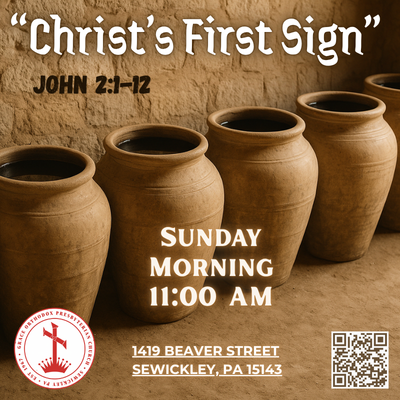
Ascetics taught that holiness means denying earthly pleasures, but God made man to enjoy the fruit of his labor as well as to worship. Jesus attends a wedding at Cana, and when the wine runs out, Mary brings the need to him in faith. Jesus acts on his Father’s authority and in his own time, and he turns about 150 gallons of water into the best wine without a word or a touch. That first sign reveals his glory as Creator, and his disciples believe in him, because God gives good gifts in abundance.
Sermon transcript
For the reading of God’s Word. This morning’s passage is from John chapter 2, and we will be reading from verses 1 through 12. John chapter 2, verses 1 through 12. You can find this on page 1054. Hear now the word of the Lord.
On the third day, there was a wedding at Cana in Galilee, and the mother of Jesus was there. Jesus also was invited to the wedding with his disciples. When the wine had run out, the mother of Jesus said to him, “They have no wine.” And Jesus said to her, “Woman, what does this have to do with me? My hour has not yet come.” His mother said to the servants, “Do whatever he tells you.”
Now there were six stone water jars there for the Jewish rites of purification, each holding twenty or thirty gallons. Jesus said to the servants, “Fill the jars with water.” And they filled them up to the brim. And he said to them, “Now draw some out and take it to the master of the feast.” So they took it.
When the master of the feast tasted the water, now become wine, he did not know where it came from, though the servants who had drawn the water knew. The master of the feast called the bridegroom and said to him, “Everyone serves the good wine first, and when people have drunk freely, then the poorer wine. But you have saved the good wine until now.” This, the first of his signs, Jesus did at Cana in Galilee, and he manifested his glory, and his disciples believed in him. After this, he went down to Capernaum with his mother and his brothers and his disciples, and they stayed there for a few days.
Let’s pray for the blessing upon the word expounded. Lord, we thank you once again that you have preserved your word for us, and that through your word we can come to know you, that we can know the one true God, and that we can worship you. And we thank you, O Lord, that you provide for us abundantly, and that through your Son, Jesus Christ, we have access to the throne of grace. And I pray, O Lord, that as we read your word and hear it expounded, your Spirit may draw our hearts closer to you, that we may love you more, and that we may love one another more. And I pray all this in your Son’s name, amen. Please be seated.
John Cassian was a well-known ascetic monk of the early church. He once wrote that the primary goal of the solitary monk, and his entire aim, is to be granted, even while still in this body, a reflection of future blessedness, and to begin in this life to experience something of the heavenly life and glory. This, I say, is the goal of all perfection: that the mind, cleansed from all fleshly desires, may be lifted up daily toward spiritual things, until a person’s whole life and every thought of the heart become one continuous prayer.
Asceticism, for those who may not be familiar with the term, is the practice of denying things that are considered to be earthly desires. This could include food and drink beyond what is necessary for health. They denied these things because they believed that they should focus solely on spiritual matters, on prayer, and on meditating on God’s Word. They believed that the things the flesh desires distract us from the true meaning of life, which is to know God.
In a way, this sounds noble at first. We all agree that man’s chief end is to glorify God and to enjoy Him. Surely the greatest way to live is to deny all distractions in this life and to focus solely on worshiping Him in public and in private. However, this seemingly noble goal is not actually what Scripture calls us to. From the beginning, when God created man good—without sin or defect—He not only gave him work to do, but He also gave him an abundant garden from which he was able to enjoy the fruits of his labor. That is to say, God made man to glorify Him and to enjoy Him, not only in corporate or private worship, but also in working and creating good things, and in enjoying the fruit of the labor that God graciously gave to man.
In the modern Catholic Church, there is still a tendency to view things such as celibacy or abstinence from alcohol and other worldly desires as being more holy or godly than participating in these things. In a sense, of course, we must agree, to some extent, with the ascetics, that there is a danger in abusing these good things from God.
And we see the results of this in our culture today. But the answer is not what they say—that we should avoid all of these good gifts altogether. Rather, we should view these things from a scriptural lens. We should eat and drink in moderation, and do so not merely to fill our physical bodies, but ultimately for the glory of God. When we deny so much of this earthly life and try to reject all the good gifts that God has truly given us, we are missing a great part of what it means to be human. One of the passages that we can find this in is our passage this morning.
Jesus and his disciples are invited to a wedding celebration, the purpose of which is to honor what God established at the beginning of creation between a man and a woman. Jesus does not refuse the invitation, even though participating in such events might seem to distract him from a life of religious devotion. Instead, he attends and not only joins in the celebration but enhances it by turning water into wine, allowing the celebration to continue without interruption. The point of this passage is not that we should spend our time in constant celebration. Rather, it is to show that Jesus rejects strict asceticism and affirms that the good gifts God has given are not to be rejected. The significance of this passage and this miracle, which we are considering this morning, is not only that Jesus provides physical blessings, but that Christ bestows upon the Church, his Bride, the riches of his glorious grace. As Paul writes, according to the riches of his glory, he may strengthen you with power through his Spirit in your inner being. In our passage this morning, John reveals not only the glory of God in Christ, demonstrated by his power to transform physical matter from water into wine, but also his love for those who trust in him, as he fulfills the request of his mother and gives good gifts in abundance. We will consider our passage this morning by first examining the authority of Jesus, as shown in verses 1 through 5, and then the sign of Jesus, as revealed in verses 6 through 11. Let us now turn to the authority of Jesus in verses 1 through 5. Throughout the history of the church, there have been many extreme allegorical interpretations of our text this morning. If we read the writings of some of the Church Fathers on this passage, for example, they find allegorical meaning in nearly every word.
In more recent times, however, theologians from the Catholic Church have based their doctrine of Mary as co-mediator and co-redeemer on our text this morning. They argue that just as Mary asked Jesus to turn water into wine, and they claim that Jesus did this even though it was not part of his plan, so too can Mary mediate on behalf of sinful mankind and cause Jesus to bring salvation to humanity. We know that such interpretations take allegory to an extreme, but they also completely miss the point of the interaction between Mary and Jesus. The point of this interaction is not the role of Mary, but Jesus’ complete independence from human authority.
Let us read the passage again, from verses 2 through 5. Jesus was also invited to the wedding with his disciples. When the wine ran out, the mother of Jesus said to him, “They have no wine.” Jesus replied to her, “Woman, what does this have to do with me? My hour has not yet come.” His mother then said to the servants, “Do whatever he tells you.” We are not certain exactly where Cana was located, but it was somewhere in the region of Galilee.
A man and a woman whom Jesus and his mother knew were getting married, and both were invited. Jesus and his disciples went to celebrate the ceremony, commemorating the couple and their solemn vows before the Lord. In those days, Jewish wedding ceremonies lasted much longer than they do today.
And often these wedding festivities would last a whole week. As a side note, as a soon-to-be father of a little girl, I am glad I am in a culture where, even though I am responsible for paying for the wedding, I do not have to pay for the entire week. But back then, according to historians, the groom was responsible for ensuring that the guests were cared for throughout the entire week. One part of caring for the guests was making sure that their wine did not run out.
However, in verse 3 we see that at this particular wedding, the groom had not prepared adequately for the celebration, and at some point during the week, the wine had indeed run out. In our time, this might be equivalent to not having enough food prepared for the wedding reception. Imagine being a bride or groom, and all of these family and friends have come from across America to celebrate your wedding. There is not enough food to feed everyone. For some people, this could cause so much stress that it would ruin the memory of this special day, which you are meant to remember for a lifetime. So Mary, understanding the situation and the stress it would cause, went to Jesus and said simply, “They have no wine.” Jesus replied, “Woman, what does this have to do with me? My hour has not yet come.”
Here I think Mary shows that she already has some understanding of who Jesus is. She comes to Jesus because she knows that He has the power and authority to resolve the situation and to prevent the groom from experiencing shame. This does not mean that she knew the full extent of Jesus’ glory and power, but she had clear faith in Him.
Jesus’s response to his mother is quite frank. However, I do not think it is rude, as some commentators argue. Some suggest that Jesus was upset and angry with his mother because she was overstepping her role. However, there is nothing to indicate that Jesus would be upset by such a request. It is not as though Mary is acting out of a lack of faith. Mary is acting in faith. She is coming to Christ in faith, asking him to provide for the need. Therefore, Jesus is not being harsh.
He is not short with his mother because he is angry at her, but because he is establishing the authority by which he acts. Jesus says in John 5, “I can do nothing on my own. As I hear, I judge, and my judgment is just, because I seek not my own will, but the will of him who sent me.” The testimony that I have is greater than that of John, for the works that the Father has given me to accomplish, that very work I am doing, and that bears witness about me that the Father has sent me. The Father sent the Son into the world to accomplish the plan of redemption. His work and his signs that he would perform were ordained beforehand by the Father. Thus, in his ministry, Jesus must establish that he is no longer under the authority of his mother. He is no longer at her command, but is independent of her and of any human authority, acting only by the will of his Father in heaven.
And Jesus emphasizes this point when He says, “My hour has not yet come.” This is common language for Jesus, and we can find it in many passages throughout the Gospel of John. Some examples are John 7:30, 8:20, and 12:23. Jesus often uses this expression to indicate that it was not yet time for Him to go to the cross. But here, what He means is simply that it was not yet the appointed time by the Father for Him to perform the miracle. In these words, He is establishing that, as the Word of God, He cannot act according to the timing or request of human beings, but only according to the will of the Father.
And Mary responds in faith. She no longer approaches Jesus with further requests, but instead goes to the servants and tells them, “Do whatever He tells you.” Whether Mary fully understood Jesus’s response or not, she clearly did not regard it as a rebuke for her faithful request, because immediately she returns to the servants and instructs them to obey Him. Mary was not being rebellious against what Jesus said.
Rather, she trusted that her Son would indeed provide in His time. And she acted in faith by placing the servants at Jesus’s command. Mary was practicing what the writer of Lamentations teaches us: “It is good that one should wait quietly for the salvation of the Lord.” To the soul who seeks, it is good that one should wait quietly for the salvation of the Lord. And this should be a great encouragement to us. We pray for things in our lives and do so earnestly. We often pray for the same requests over and over again. And these requests are good and commendable.
But when we do not receive a positive response on the timeline that we expect, we lose hope and despair, thinking that our Savior has not heard us. But this is not the case. As Calvin writes regarding Mary’s exchange with Jesus, whatever the Lord holds us in suspense and delays his aid, he is not therefore asleep. On the contrary, Jesus regulates all his works in such a manner that he does nothing but at the proper time. Because our God is not like the gods of other nations. Our God does not act based on our desires or the whims of man. He does not act because we repeat our prayers over and over again or because we give enough money to the temple. No, our God hears our prayers and answers all of our prayers in his good timing.
And our job is to, like Mary, wait and act in faith, believing that our Savior will indeed provide his children with all the good gifts that they need. And we can be confident and trust in this good timing because of who Jesus is. He is the eternal Son of God who has become man to live a perfect life on our behalf and to die a death on our behalf so that we can be spared from eternal death and dwell with him in eternity. And thus Mary acted in faith, trusting that Jesus would provide. And he did so in abundance, as we will see. And this brings us to the sign of Jesus, the sign of Jesus. Let’s read it once again, verses six through eleven.
Now there were six stone water jars there for Jewish rites of purification, each holding twenty or thirty gallons. And Jesus said to the servants, “Fill the jars with water.” And they filled them up to the brim. And he said to them, “Now draw some out and take it to the master of the feast.” So they took it.
When the master of the feast tasted the water that had become wine, and did not know where it came from, though the servants who had drawn the water knew, the master of the feast called the bridegroom and said to him, “Everyone serves the good wine first, and when people have drunk freely, then the poor wine. But you have saved the good wine until now.”
This is the first of his signs that Jesus did at Cana in Galilee, and he manifested his glory, and his disciples believed in him. When we looked at the very beginning of John’s gospel several weeks ago, we briefly also considered the purpose statement that John gave for writing the gospel.
By way of reminder, John writes in chapter 20, verse 30: “Now Jesus did many other signs in the presence of his disciples, which are not written in this book, but these are written so that you may believe that Jesus is the Christ, the Son of God, and that by believing you may have life in his name.” In other words, John recorded what Jesus did and the signs that Jesus gave so that those who would come later would have a historical record of his ministry and could believe in Jesus. And John, as we will see as we go through the gospel, records for us seven signs that point us to who Jesus is. And John uses this word “sign” because he wants us to realize that these miracles that Jesus performs are not just a display of his power. Jesus is not merely a great prophet. Rather, his miracles point to a deeper reality about who Christ is. And the first sign that Jesus gives us, that John records for us in the Gospel of John, is in our passage this morning.
It is Jesus turning water into wine. When the appointed time had come, Jesus instructed the servants to take the jars and fill them with water. To give you an idea of the quantity, these jars would have held approximately 600 to 700 bottles of wine. The servants, as the text says, obediently took the jars and filled them with water. Then Jesus told them to take some of the water to the master of the feast, the one in charge of the banquet. When the man overseeing the reception tasted it, the water had already become wine. I want you to notice several things about the account that John records.
First, Jesus did not touch the water or the jars. There was no way he could have switched the water and the wine. Second, the jars were empty, and the servants filled them with fresh water. Therefore, no one can claim that the jars had previously contained wine.
Lastly, the one who tasted the water, the one who tasted the wine, was completely unaware of what Jesus had done. He serves as an independent witness to confirm that the water had truly been transformed into wine. Thus, Jesus transformed the substance of water into a wholly different substance—wine—without touching it and without speaking any words. The only one who possesses such power and authority is the one who created that substance in the first place—the creator of the universe. The eternal God had indeed become a man. And what is the result?
John records for us in verse 11, this is the first of the signs Jesus did at Cana in Galilee, and it manifested his glory, and his disciples believed in him. If you look back at chapter one, towards the end of chapter one, you will see that Jesus had said to Nathaniel just three days earlier, “Because I said to you, I saw you under the fig tree, do you believe me? You will see greater things than this.” And sure enough, just three days later, the disciples saw the glory which John spoke about in John chapter one, verse 14—that is, the glory of the Father shining through the Son in this glorious act of turning water into wine.
Now did they understand everything about Jesus at that moment? No, but little by little, John shows us that the disciples’ eyes were being opened. They were gradually coming to understand the identity of who Jesus is. But is this sign that Jesus gave only pointing to his divinity? Or is the sign pointing to something more than his divine power? While much allegory regarding this passage has gone far beyond the text, I submit to you that there is something more going on.
The passage that we read earlier from Isaiah and many other passages in the Old Testament connect the new covenant with the Lord providing new wine and new sustenance for his people. Let us look together at one passage—Jeremiah 31. Please turn there with me to Jeremiah 31, and let us read verses 10 through 14. Jeremiah chapter 31, verses 10 through 14. This is perhaps the most famous passage in the Old Testament foretelling the new covenant through Jesus. Jeremiah chapter 31, verses 10 through 14.
Hear the word of the Lord, O nations, and declare it in the distant lands far away. Say, he who scattered Israel will gather him, and will keep him as a shepherd keeps his flock. For the Lord has ransomed Jacob, and has redeemed him from the hands too strong for him.
They shall come and sing aloud on the height of Zion, and they shall be radiant over the goodness of the Lord—over the grain, over the wine and the oil, and over the young of the flock and the herd. Their life shall be like a watered garden, and they shall languish no more. Then the young women shall rejoice in the dance, and the young men and the old shall be merry, and they shall turn their mourning into joy. I will comfort them and give them gladness for sorrow. I will feast the soul of the priests with abundance, and my people shall be satisfied with my goodness.
Throughout the Old Testament, we find this connection between the New Covenant and the imagery of the Lord providing wine and blessings that represent the coming New Covenant. There are several indications in our passage this morning that point to this. First, we see that John draws our attention to the original purpose of the jars of water. He says that they were there because they were used in accordance with the old covenant laws of purification to cleanse the impurity on the outside so that people could participate in the ceremony.
As we saw when we looked at the profession of John the Baptist in the previous chapter, the Messiah has come to do what the ritual purification of the law could not. The law provided ways to clean the outer body, but it could not clean the inner heart. But Christ came to take away not the outer uncleanliness, but the inner sin of man. And he came to take away the sins of the world.
And second, we see that the whole scene is set at a wedding. This is a picture found throughout the scriptures, that Christ is the bridegroom of the church, a picture also found in the very next chapter. Please turn with me to John chapter 3, and we will read verses 25 through 36. Now a discussion arose between some of John’s disciples and a Jew over purification. They came to John and said to him, “Rabbi, he who is with you across the Jordan, to whom you bore witness, look, he is baptizing, and all are going to him.” John answered, “A person cannot receive even one thing unless it is given from heaven. You yourselves bear me witness that I said, I am not the Christ, but I have been sent before him.”
The one who has the bride is the bridegroom. The friend of the bridegroom, who stands and hears him, rejoices greatly at the bridegroom’s voice. Therefore, this joy of mine is now complete. He must increase, but I must decrease. He who comes from above is above all. He who is of the earth belongs to the earth and speaks in an earthly way. He who comes from heaven is above all.
He bears witness to what he has seen and heard, yet no one receives his testimony. Whoever receives his testimony sets his seal to this, that God is true. For he whom God has sent utters the words of God, for he gives the Spirit without measure. The Father loves the Son and has given all things into his hand. Whoever believes in the Son has eternal life. Whoever does not obey the Son shall not see life. But the wrath of God remains on him.”
I do not know about you, but I have been to many weddings, and I have never seen 600 to 700 bottles of wine. Not only was the wine that Jesus produced in great quantity, it was also the best wine. The head waiter, when he tasted it, was surprised, because the wine was so good. He believed it should have been served first, not at the end.
The gifts that Christ bestows upon His people are the best gifts, and they are given in abundance. As John the Baptist says, whoever receives this testimony sets a seal to this, that God is true, for he whom God has seen utters the words of God, for He gives the Spirit in abundance, without measure. The greatest gift that God has given us is eternal life in Him. It is intimate knowledge, worship, communion, and perfect peace in the presence of the throne of His grace.
You and I deserve death. Daily we forget Him and what He has done for us. Daily we seek to fill our hearts with useless idols that only draw us away from our Savior. Yet our Father has seen fit to send His only begotten Son so that we can be free from sin and death. That same Father who chose you, that same Son who chose to redeem you, and that same Holy Spirit who gives without measure and sustains us every day.
He listens to our prayers, and He desires to give us every good gift. So rest in this reality, as Mary did, that the Lord provides in His good pleasure. When the time is right, He provides all that we need. And He provides so much more than we need. He provides in abundance, and He provides what is best for us, what His people truly need.
So come to Him. Come to our Savior. Lay your burdens and your sins at His feet, and trust that you are forgiven, because He has provided the forgiveness for your sins. Trust that He will provide all that you need to live the good life which He has called you to live this week. Let us pray. Lord, we thank You that You have not left us alone. That You have sent the Holy Spirit to dwell in us, and that You have given us the Holy Spirit in abundance, and that Your Holy Spirit sustains us, convicts us of sin, and leads us to repentance, and gives us the confidence that You do in fact love us, that we are in fact saved. We pray, O Lord, that as we live our lives this week, that we would remember the gospel of Jesus Christ, that while we were yet sinners, You sent Your Son, Jesus Christ, to die for us, that we could have life in abundance in You, that we could once again worship You, that we could communion with You, that we could pray to You, and that You would once again speak to us, care for us, and love us. And we thank You, O Lord, for what You have done for us. And I pray all this in Your Son’s name. Amen. Please rise as we sing our closing hymn, hymn 196. Hymn 196, At the Lamb’s High Feast, we sing. Please rise.
The sermon text provided above is derived from the sermon audio recording making use of generative tools. It has not been manually edited. While transcription tools have a high degree of accuracy, the output may include generative textual, punctuation, and/or formatting errors.