
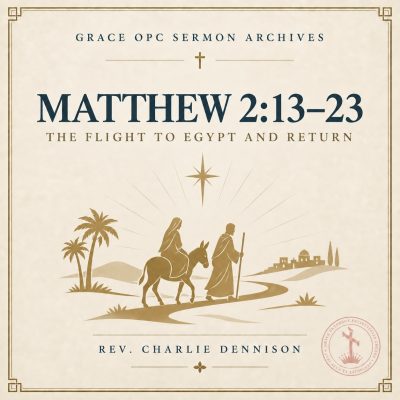
This sermon is from the Rev. Charles G. Dennison sermon archive, part of the “Matthew 2:13-23” series, and was preached at Grace Orthodox Presbyterian Church in Sewickley, PA, during a worship service on Sunday, January 21, 1996.
About this sermon
Every passage in the Bible is finally about Christ, this review insists, and Matthew’s Herod is deliberately read as a new Pharaoh, opposing a new Moses. The deliverances of Moses and of Christ are set side by side here as a single, continuous act of God rather than as two loosely related events. Galatians 4 supplies Paul’s own theological reading of exactly this pattern.
Sermon transcript
This morning we begin our reading of the scripture in Galatians chapter 4, and we are beginning with verse 21. Give your attention to God’s holy word. Tell me, ye that desire to be under the law, do ye not hear the law? For it is written that Abraham had two sons, the one by a bondmaid, the other by a free But he who was of the bombed woman was born after the flesh, but he of the free woman was by promise.
Which things are an allegory? For these are the two covenants, the one from the Mount Sinai which gendereth to bondage, which is Hagar. For this Hagar is Mount Sinai. in Arabia, and answereth to Jerusalem which now is, and is in bondage with her children. But Jerusalem which is above is free, which is the mother of us all.
For it is written, Rejoice thou barren that bearest not, break forth and cry thou that for the desolate hath many more children than she that hath a husband. Now we, brethren, as Isaac was, are the children of promise. But as then he that was born after the flesh persecuted him that was born after the Spirit, even so it is now. Nevertheless, what saith the scripture? Cast out the bombed woman and her son. for the son of the bondwoman shall not be heir with the son of the free woman. So then, brethren, we are not children of the bondwoman, but of the free.”
At verse 13, Matthew 2, verse 13, And when the wise men were departed, behold, the angel of the Lord appeareth to Joseph in a dream, saying, Rise, and take the young child and his mother, and flee into Egypt, and be thou there until I bring thee word. For Herod will seek the young child to destroy him. When he arose, he took the young child and his mother by night. and departed into Egypt, and was there until the death of Herod, that it might be fulfilled which was spoken of the Lord by the prophet, saying, Out of Egypt have I called my son.”
Lord, your word has come out of heaven, we believe this. And Lord, it has meant life to us and it has meant provision. And Father, as you teach our hearts, we are convicted that our desire must be for the benefit of this word to your people throughout the world, even as you call your own by that word this day. Father, may we hear of the mighty workings of your word as the word itself increases in its power and effectiveness for the gathering of the elect to the ends of the earth.
We pray this in Jesus’ name. Amen. We have been spending our time of late in these morning messages, considering the very fundamental question, how might we better hear, read, and study our Bibles? And in these messages, we have been using Matthew 2, verses 13 through 23, as a text to help us along our way. Last week, I concluded the message by suggesting to you that when you consider a passage in Scripture, that you let your mind go.
I call this the open-mind principle. Now, of course, my comment about letting your mind go was a bit of an overstatement. It was hyperbolic. In letting your mind go the way I have in mind, I certainly do not mean letting your mind go beyond the clear limits of the story of salvation which the Bible presents to us. I certainly do not mean letting your mind go beyond the tried and true positions of our precious Reformed faith that have been thoroughly tested by the Word of God. Letting your mind go improperly is the fast track into a cult. At the same time, I am very serious when I say that I want you to let your minds go when you hear, read and study your Bibles. I want you to be alert, as you let your mind go, to the possibilities of the text.
Matthew 2, verses 13 through 23, is a very opportune test for helping us see the possibilities in Scripture passages. Let me remind you of some of the possibilities we have picked up on. You will recall my treatment of the prophecies that are cited here by Matthew as we make our way through this text. You see them once more, verses 15, 18, and 23. And you will recall what observations we made of the proclamation of those prophecies set forth there. We observe in them a pattern, while when we consider them, it seems as if they move deliberately in a chronological fashion. They move deliberately, chronologically, through the important events of Israel’s past history.
Thus, verse 15, and the citation of prophecy there, the Exodus. Verse 18, and Matthew’s citation of Jeremiah at that point, the Exodus. And verse 23, although we cannot find a specific Old Testament text that has these words in it, nevertheless, this citation by Matthew serves as a cumulative assembly of prophecies indicating reference to the time of restoration in the preservation of a remnant in the righteous branch. promised by God. Now, in giving explanation to Matthew’s use of these Old Testament texts, we call attention to the gospel truth, that the Lord’s Christ, the Lord’s Messiah, was given over to a thorough identification with his people’s prior history, living through it as it were with them.
You see how that worked out. All of these events are now being applied to the Christ, and it says, By looking at the life of the Christ, we see a recapitulation of the life of Israel in its prior history. The Christ giving himself over to an identification with his people actually living through that history in his person. The lesson we took from this was this.
Just as Jesus in his early life, his infant life, was identified with the people of God in their infant life, so in his later life he would be identified with us, his Church, to the full extent of our existence. In other words, there is no circumstance which we as Christ’s Church face, that Christ does not face with us. Even more, there is no part of our history that Christ has not taken to himself. Before we live it, Christ has experienced it.
He’s already been there. He’s already done that. This, of course, is what makes ours THE religion of grace. Before you lift your little finger religiously, Christ has already been there and done it. You merely enter into his accomplishment, which is complete and lacks nothing. As the Apostle Paul can so emphatically declare, Christ is all and in all.
Now just how much this is the case was suggested to us by our consideration, you may recall, of the dreaming Joseph in Matthew 2. The dreaming Joseph of Matthew 2, now along the lines of the principle of the open mind, along the lines of letting your mind go, made us think about another dreaming Joseph. Joseph from the book of Genesis.
And when we compared and contrasted the story of these two Josephs, we realized that neither of them was the main character in the story in which they appeared. The main character was the child, the seed of promise. who now appears so prominently in the Matthew story. He is actually the main character in both stories.
But do you see what this means? Do you see how such a consideration deepens our understanding of what is going on in what Matthew writes, particularly as he quotes those Old Testament prophecies in verses 15, 18, and 23. These Old Testament prophecies beautifully summarize Israel’s past history and powerfully preach to us the love of God as Jesus is identified with his people, but they also declare that the events that transpired in Israel’s past history are actually about Jesus Christ. Look once more at verse 15, and the quotation here that Matthew makes of the prophecy of Hosea, chapter 11, verse 1. You may even want to check out that text in the Old Testament.
You will find that it reads this way, “‘When Israel was a youth, I loved him, and out of Egypt I called my son.’” This statement, as we have already pointed out, refers, does it not, to the exodus from Egypt under Moses. But connect this with what we have said now about the two Josephs. particularly to what we have said about the Old Testament Joseph from the book of Genesis.
If his story is about not himself, but Jesus Christ, then the story of the Exodus is not ultimately about the Israelites or about their leader Moses. Rather, it is a story about Jesus Christ. That is its intention. So when Hosea writes, out of Egypt I have called my son, even though he has specifically in mind the exodus from Egypt under Moses, he is truly writing about Jesus Christ and the salvation that would be accomplished in there. is about Jesus. You might also note how Jesus himself, a mature man now, teaching in Jerusalem, plays upon this reality so beautifully when he argues with the Jews. I direct your attention to John’s Gospel, the forty-sixth verse.
Here, Jesus says to the Jews, who are refuting him, who are disputing with him, here he says to them, if you believed Moses, you would believe me, for he wrote of me. Now, you might think to yourself, well sure, Moses wrote a few passages that are about Jesus. That’s not what he has in mind when he makes that statement to the Jews. He is saying that the entirety of the Torah is about him, that everything that Moses wrote was about him.
And of course we can make the same statements about the other quotations. that Matthew cites in that Matthew 2 passage. Indeed, the exile, the restoration through the remnant are about Jesus Christ as well. And again, to confirm this from the lips of Jesus himself, once more in John 5, Jesus will make this comprehensive and sweeping claim. Verse 39 of that fifth chapter in John, Jesus says this to his Jewish distractors.
You search the scriptures because you think in them you have eternal life. It is these that testify of me. All scripture is about Jesus Christ. Every story, every prophecy, every piece of teaching and wisdom, every biblical hymn or psalm must finally be related to Jesus Christ if you are to appreciate it fully and properly. That, my friends, is the passion of this pulpit.
Now the reason why you are disinterested here this morning, and a million miles away, is a condition that you have to scrutinize very carefully. The death of Alan Yeager is very real to me right now. I do not want to be orating at your funeral with a suspicion that you never did understand.
But now, looking again, at Matthew 2, verses 13-24. And this once more, in terms of the open mind that I have been preaching to you, that is, in terms of this principle of letting your mind go properly when you approach your Bibles. Let us focus on the figure of Herod. Now, before we get into this, let me warn you. You think that river out there is deep. We are all about to go in over our heads. So hold on. I’m confident we can come through, but I’m just warning you at the outset. Let’s consider the figure of Herod.
Of whom does he remind you? Think about it. Let your mind go. Of whom does he remind you? In verse 13, the angel tells Joseph that Herod will search for the child to destroy them. In verse 16, Matthew relates Herod’s rage at the betrayal of the wise men, so that now he sends his henchmen to Bethlehem to slay the male babies. Again, I ask you, of whom does Herod remind you? Let your mind go. Does he not remind you of Pharaoh? Does not Exodus 1 come to your mind? You remember that opening chapter in Exodus, the story of Pharaoh’s edict.
The male children of the Hebrew slaves were to be executed. In fact, they were. In that story, a child was rescued who would prove to be a savior to his people. In the story in Matthew 2, the same line is followed, is it not? And to what end? Is it not to tell you that in the story about the rescued child of Matthew 2, a new exodus for the people of God is unfolding? Even the ultimate, the final exodus, the exodus about which even the first exodus was about. Do you not see in the rescued child of Matthew 2 a Savior of whom Moses was but a faint glimpse, this Savior being God’s unique and very own Son? But you must also observe the difference between the opening chapter of Exodus and Matthew 2. the pharaoh of Matthew 2 does not live in Egypt. He lives in Israel. Now we’re getting to it. And the deliverance in Matthew 2 doesn’t come by leaving Egypt for Israel, but by leaving Israel for Egypt. What’s the point? The point is this.
Although the people of Israel had escaped the bondage of Egypt and entered the promised land, they are in bondage still, and subject to a cruel taskmaster. The people of God, despite the past exodus and liberation, despite now their dwelling within the promised land, are in need of a liberation, a further liberation. In the old exodus, God’s people must escape bondage and be brought to the land of Israel by way of Sinai and by way of the giving of the law. In the new exodus, they must be freed from the land of Israel, where the law itself, because of their sin, has become bondage to them. And they must be brought into the liberty of the sons of God by the Son of God Himself, who is caused to fulfill their life by reliving their history with them and for them.
The Apostle Paul in Galatians 4—if the waters aren’t deep enough yet for you—the Apostle Paul in Galatians 4 builds upon this truth. For here, in this fourth chapter of Galatians, he relates being under the tyranny of Pharaoh with being under the law. And in verse 25, he connects slavery to the Egyptian Hagar. to Mount Sinai, to the law, and to the city of Jerusalem, and says that those who want to live under the law are giving themselves over to bondage.
Paul, therefore, equates Jerusalem and the land of Israel with Egypt. Jerusalem and Israel become the Egypt. from which the people of God themselves must be delivered. John, the apostle, in his great book, the Revelation, chapter 11, verse 8, does the same thing that Paul did in Galatians 4. In describing the place of death for the two Christlike witnesses, John calls the city where the two witnesses were slain that great city, spiritually called Sodom and Egypt. But then he goes on to say that this place, Egypt, is the place where the Lord was crucified. In other words, Jerusalem and the land of Israel with it equals Egypt, from which the people now—the people of God—must be delivered.
They must be delivered from the bondage to land and law, into the glorious liberty of the children of God. Matthew, therefore, tells the story. of the Christ child, inspired by the Holy Spirit as he is. In order that we might understand that the real meaning of the exodus, the Old Testament exodus, is found in Jesus and in the redemption accomplished in and through him. That we cannot stop at the land of Palestine or the city of Jerusalem, we cannot stop, even with the provisions of the law. For if we do, they become bondage and oppression to us, just as they did to the Jews of Jesus’ day. The liberation, then, that is being proclaimed for us even in this new exodus, telegraphed for us here as we open our minds to what is transpiring in Matthew 2. The liberation that is being set before us takes us out of the deadly and improper attachment to land and law, whatever that land and law may be. I don’t care if it’s the good old U.S. of A. and the American Constitution. and into the glories of the kingdom of heaven.
With the principle of the open mind, by letting your mind go, even by faith, worked in you by the Holy Spirit. Despite the fact that you may not see all of this yet, you appreciate it, and you believe it, don’t you? Your hope isn’t a house in the suburbs, Your hope is not living under the legal securities of a nation of this world, or even the legal securities of a religious system. Your hope is heaven and glory. And Christ himself is it not.
Bless us, O God, that we may not only understand that we are the children of the free woman, and that for freedom we have been set free. But oh father let us understand. That such freedom binds us. To live in keeping. With the kingdom. Of which we have been made apart.
We pray therefore oh God that we would live wonderfully and powerfully as the children of the King, having been made free through the greater, liberating work of Jesus Christ, our Savior. And Father, we ask that we would do nothing that would contradict that we are in fact the children of God. We pray it in Jesus’ name, Amen.
The sermon text provided above is derived from the sermon audio recording making use of generative tools. It has not been manually edited. While transcription tools have a high degree of accuracy, the output may include generative textual, punctuation, and/or formatting errors.