
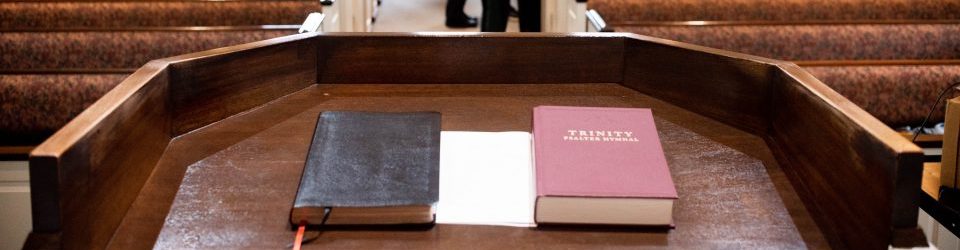

This sermon is from the Rev. Charles G. Dennison sermon archive, part of the “Ephesians 5-6” series, and was preached at Grace Orthodox Presbyterian Church in Sewickley, PA, during a worship service on Sunday, January 12, 1997.
We are reading from Ephesians chapter 5 and 6, and we begin in the 21st verse of the 5th chapter. This is Ephesians 5 verse 21. Give your attention to the word of God. Submit yourselves one to another in the fear of Christ. Wives, submit yourselves unto your own husbands as unto the Lord.
The husband is the head of the wife, even as Christ is the head of the Church, and he is the Savior of the body. Therefore, as the Church is subject unto Christ, so let the wives be to their own husbands in everything. Husbands, love your wives, even as Christ also loved the Church and gave himself for it. that he might sanctify and cleanse it with the washing of water by the word, that he might present it to himself, a glorious church, not having spot or wrinkle or any such thing, but that it should be holy and without blemish. So watch men to love their wives as their own bodies. He that loveth his wife loveth himself, for no man ever yet tainted his own flesh, yet nourisheth and cherisheth it, even as the Lord the Church. For we are members of his body, of his flesh, and of his bones. For this cause shall a man leave his father and mother, and shall be joined unto his wife, and they too shall be one flesh. This is a great mystery, but I speak concerning Christ and the Church.
Nevertheless, let every one of you, in particular, so love his wife even as himself, and the wife see that she reverence her husband. Children, obey your parents and the Lord, for this is right. Honor thy father and mother, which is the first commandment with promise, that it may be well with thee, and thou mayest live long on the earth. And, ye fathers, provoke not your children to wrath, but bring them up in the nurture and admonition of the Lord. Slaves, be obedient to them that are your masters according to the flesh, with fear and trembling, in singleness of your heart as unto Christ, not with eye service as men pleasers, but as the servants of Christ, doing the will of God from the heart, with good will, doing service as to the Lord and not to men, knowing that whatsoever good thing any man doeth, the same shall he receive of the Lord, whether he be bond or free. And ye masters, do the same things unto them, forbearing threatening, knowing that your master also is in heaven, neither is there any respect of persons with him.”
As you minister to us, O God, by your word, we are concerned that this word which you have given to us would minister to others. And, Father, you have called us to pray, and we do so, that you would raise up laborers for your harvest. and that they would be many who bring your word to the world.
And even now, this day, as that word is brought, there would be transformation. Those who are dead would be brought to life. Those who are lost in corruption would be found and revived in righteousness, even the righteousness of Jesus Christ. We pray, Lord, these things. as we continue to look to you for the ministry of your work in our lives. Amen.
It should be clear to us by now, given this series on living the Christian life, it should be clear to us by now the way in which Paul, the Apostle, directs us to see Christian living. This made particularly evident to us with one more reading of the text that has been before us in this series. in Ephesians 5 and 6.
Putting it simply, according to the Apostle Paul, the Christian life is a supernaturalized existence. It is a supernaturalized existence. Now, it is important for us to realize in saying this that Such an approach to Christian living is not concerned among us, much less the Ephesians, with what some might have thought. That is, the supernaturalized life is not concerned with the interjection of the miraculous, as if we might continue to expect rose and fish multiplied, men walking on water, herds of swine cascading demon-possessed into the sea, and bodies raised after four days dead in the tomb. I might also say that the supernaturalized life for the Ephesians and for us, is not looking toward those special endowments, those special gifts of the Spirit which Paul had spoken about earlier in his ministry to the Corinthian church, particularly 1 Corinthians, chapters 12 through 14. Actually, Paul’s concern here with the supernaturalized life is to impress upon his hearers, impress upon his readers, the fact that they always live in the presence of the living Christ, in the presence of the resurrected living Lord. here principally is that supernaturalized existence Paul has in mind.
Not the occasional miraculous occurrence, nor the experience of part of the Church in those periodic and selective visitations of the gifts of the Spirit, but in the constant environment which has been established for the Church in Christ, in which now the Church is to live. And by mentioning constant with regard to this environment, certainly eternity is brought into view.
Paul’s point in this regard is apparent from the latter part of the text we’ve read this morning, from Ephesians 6, verses 5 through 9. In verse 5, the apostle tells the slaves to be obedient to their masters as to Christ. He addresses them as slaves of Christ in verse 6. He implores them to render service as unto the Lord, that is, as unto the Lord Jesus Christ, in verse 7. Verse 8 finds the slaves receiving their wages even from the Lord, that is, the Lord Jesus Christ.
In verse 9, without spelling out all the details, the Apostle calls those who are masters to the same sort of considerations. That’s the force of Paul’s word to the masters. Do the same things to your slaves, or better possibly, pursue the same kind of life with them that I have asked the slaves to pursue with you, that is, pursue the supernaturalized life.
But what is this supernaturalized life specifically? We have said that it’s life in the presence of the risen Christ, but can we be more specific about it? Such a life is the direct consequence of the saving work of God in Christ. This means that it has nothing to do with the nondescript, mindless mysticism that informs much religiosity of our time. Likewise, it has nothing to do with a retreatist monasticism. Much less does it have anything to do with that philosophical bent of mind which believes in an invisible world behind the visible, and commends itself as inherently superior to all materialistic competitors and worldviews.
This supernaturalized life has everything to do with the specific reality of the heaven which the Bible describes, that place which has become resident for the once-crucified, now-risen Christ, who is at the Father’s right hand, the true and only destiny of the saints in glory. Even though the saints have not as yet been raised in their bodies to it, has been described earlier by Paul in Ephesians as the realm in which they already live.
This is the place of their residence because of the choice and predestination of God. Ephesians 1, verses 4, 5, and 11. This is their residence because of their inclusion. through that choice and predestination in Christ, by whom they have been blessed with every spiritual blessing in the heavenly places. Chapter 1, verse 3. This participation in things heavenly does not belong exclusively to the future, as Paul makes it clear in Ephesians 2, verses 5 and 6.
Even when we were dead in our sins, God made us alive together with Christ and raised us up with him. and yes, even seated us with him in the heavenly places in Christ as a done deal. Because of God’s eternal will and due to the effectual working of Jesus Christ in keeping with that will, our lives have been subjected to a change of venue. As Paul says in Philippians 3 verse 20, our citizenship is in heaven. And as he says also in Colossians 1 verse 13, we have been translated out of the domain of darkness into the kingdom of God’s own dear Son. Because our living Lord lives in heaven, we live with him and in him there.
And this is all of grace. not of worse. Our faith, if genuine, being the confirmation of our election and God’s predestination of us, such faith the means by which God has been pleased to seal our union with Christ in our heavenly life, since that faith in no way, if rightly understood, contradicts or challenges His sovereign grace by which we have been brought to glory. The supernaturalized life, therefore, according to the Scriptures, is the heavenly life in Christ, the doing of God for which we can take no credit.
As it shall be in the day in which we and our bodies shall be brought before the face of God, so it is now. Can you imagine yourself in that day suggesting to God that you are there because of something good in you or something that you have accomplished? I challenge the Arminians. to conjure in his mind his presence before God in the great day, and I ask him if he can generate from within himself any form of suggestion that the reason that he is there is because of him in any respect.
Now it is this supernaturalized life of heaven which informs all our actions and all our relationships. No, even more, it is this supernaturalized life in the risen Christ, life in and from the heavenly places, which is our life now. We have no other life. I dare say, I want no other life. And if we want to get into testimonies, this is mine. Consider the text again.
The relationship of a slave to a master is no mere matter of an inferior’s relationship to a superior in the social scale of things, although in the social scale of things there are inferiors and there are superiors. Nor is it a mere matter of citing law codes with regard to the relationship between slaves and masters. For those blessed with heavenly life, are called to see this relationship, even the relationship of slaves and masters, in the light of glory itself. My relationship as a slave to my master is informed by the fact that my labor is not simply for the sake of Christ here on earth, that is, to the end that I might please him and be rewarded by him one day in glory, much more, my labor is to Christ, before Christ, in Christ, as if performed in his very presence in glory already.
It’s as if I’m there, working before him. That’s the effect. of what Paul is stating here in Ephesians 6. Your labor is performed before him. Now, how are you going to work? Paul, who describes himself as Christ’s bond slave, none lower, has this very perspective in view with respect to his own labors in the ministry. He says about his preaching ministry, I speak in Christ in the sight of God. That’s how he conceives of his preaching ministry.
2 Corinthians 2.17. It’s as if he’s there. And what might we say about the circumstances of the Apostle? he’s presently a prisoner of Rome. He makes mention of that repeatedly, but is he really a prisoner of Rome?
According to Ephesians 3.1 and 4.1, he’s the prisoner of Christ.
You see, all relationships and circumstances are subjected to this supernaturalizing vision with respect to life. And if this is the perspective The supernaturalized life brings the slaves, what about masters? Is not their position likewise affected by their office considered in the full view of Christ in glory? Slaves motivated and disciplined by Christ and the environment of heaven have their counterpart in masters motivated and disciplined in the very same way. But I judge for you It is now blatantly evident that Paul has been prosecuting the case for this supernaturalized life all along, in everything that he has been saying, whether it is with respect to masters or slaves, parents or children, husbands or wives.
Paul subjects each of the relationships from Ephesians 5.22 to Ephesians 6.9 to the identical scrutiny. Parents, for example, in the supernaturalized life. must see the children of God in front of their Heavenly Father, in their own children, standing before them. Husbands, according to the supernaturalized life, must see the bride of Christ, the Church, standing before her Lord, in their own wives, standing before them.
That’s what’s happening. These relationships, then, are part of a total life view, thoroughly, completely informed by the work of Christ, his present position, and by heaven itself. being raised with Christ, how do I treat my wife? How do I treat my children? How do I treat my employer? It’s all different. I’m telling you about another world. But now I must add to this in conclusion. This view of life further helps us to appreciate the positive force of the law. Now I know it may sound as if I’m pulling something out of the air here. And you’re thinking to yourself, how did he get to the law from where he is presently?
But I want to remind you that we started this series in an effort to consider Paul’s imperatives. Now, we are convinced, are we not, that we can never disassociate the indicatives of the apostle from his imperatives. The accomplishment of redemption from its application to us and our responsibility to God with respect to that salvation. But now, here, at the conclusion of the series, we must return to the issue of the imperatives, even the issue of commandment and law.
I said the positive force of law, commandment, of imperative. We are all aware of the way in which the apostle negatively assesses the law and the commandment. We are not under law, so says the apostle. But now there is this positive assessment of things.
Paul, here, to the Ephesians, is laying down the law in a series of imperatives. And such is the nature of our life in this world that we are not going to be able to escape imperatives. We are not going to be able to escape commandment and law. In fact, you will note that he specifically quotes from the law the Fifth Commandment in Ephesians 6, 2 and 3.
Although Paul’s perspective has in view more than motivation and discipline from the law, that is to be sure, the law maintains its usefulness for us. in our present situation. Yes, heaven is a place in which the constraint upon our moral and spiritual obedience is not by external command, neither is heaven a place in which we will need the plotting of the apostles’ imperatives and reminders. Still, the commandments, like the apostles’ imperatives, are testimony to the present paradox of our current existence.
On the one hand, we are placed in glory in Christ. On the other hand, because we still live here in this world and must do so until we leave this world at death or at Christ’s return, we have to be reminded, we must be reminded, about our true home and about our proper orientation and the way in which we are to appropriate that home and that orientation and be faithful to them. Therefore, we cannot dismiss, much less do we want to neglect, We must remember that they themselves render service to our goal in which they will have exhausted their purpose. It could well be that at Ephesus there were many in need of this reminder, many in need of the commandment.
Possibly they had so caught the bug of heaven that they imagined themselves free from all moral and ordinary relationships and responsibilities in this world. Possibly they even imagined that the world had ended, or that it was about to end. Paul puts the record straight.
True heavenly-mindedness and proper living out of the heavenly life now does not run from relationships and responsibilities, but sees them and pursues them in full, brilliant, gracious, supernatural life. Such an outlook does not abominate the law. or the reminders that are given to us with respect to the law, but see them serving their proper function as servants to the full possession of our inheritance above our heavenly goal. Won’t you take to heart, then, the nature of our true life in Christ, the supernaturalized life of glory already in your possession of which you are hereby reminded in the gospel and its commandments.
And although yours is a heaven in life, one by which you are made to share in Christ’s very own exalted life and glory, remember that this one, to whom you are united, loved you according to Ephesians 5.2, gave himself for you in offering any sacrifice of God, not only so that you might be granted life in heaven, so that you might live a heavenly life here, even as you submit yourself to one another in the fear of Christ.
And having worked our way back to Ephesians 5.21, we bring this series to a close. Our Father would never be a matter of us conjuring up or inventing the world into which Christ has ascended, the world to which we are destined, even predestined. Father, as we have not invented it, as we have not manufactured it as it stands, and that even in keeping with the work which he has performed at the present rule and session from that realm, we glory, O God, that by our union with him, we are brought to that world already. Father, we pray that in keeping with the imperatives, with the commandments, with the law itself, we would persevere in our responsibilities, in our obligations, in our duties But Father, as we do so, may it be a matter of us seeing that this great blessing and gift which has been given to us informs us in all of our actions and relationships. Here then, O God, is a fulfilling of the law and the commandments in us, and we pray our that we might live with a full consciousness of our reign with Christ and our service in this world to him. Bless us as your people. Amen.
The sermon text provided above is derived from the sermon audio recording making use of generative tools. It has not been manually edited. While transcription tools have a high degree of accuracy, the output may include generative textual, punctuation, and/or formatting errors.