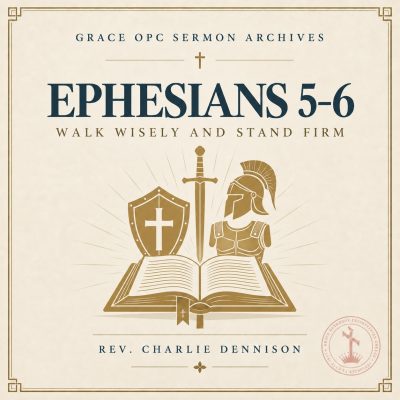
This sermon is from the Rev. Charles G. Dennison sermon archive, part of the “Ephesians 5-6” series, and was preached at Grace Orthodox Presbyterian Church in Sewickley, PA, during a worship service on Sunday, November 24, 1996.
We are reading from Ephesians chapter 2. Ephesians chapter 2 beginning in verse 1. Ephesians 2 verse 1. Give your attention now to the reading of God’s word. And you were dead in trespasses and sins, wherein in time past ye walked according to the course of this world, according to the prints of the power of the air, the spirit now worketh in the children of disobedience, among whom also we all had our conversation in times past in the lusts of our flesh, fulfilling the desires of the flesh and of the mind, and were by nature the children of wrath, even as others.
But God, who is rich in mercy for his great love, wherewith he loved us, even when we were dead in sins, hath quickened us together with Christ. By grace ye are saved, and hath raised us up together, and made us sit together in heavenly places in Christ Jesus, that in the ages to come he might show the exceeding riches of his grace in his kindness toward us through Christ Jesus. For by grace are ye saved through faith, and that not of yourselves it is the gift of God, not of works, lest any man should boast. For we are his workmanship created in Christ Jesus unto good works, which God hath before ordained that we should walk in them.”
Then turning over to chapter 6 in Ephesians, verse 1. Children, obey your parents in the Lord, for this is right. Honor thy father and mother, which is the first commandment with promise, that it may be well with thee and thou mayest live long on the earth. Lord, may it please you to help your people in their hearing, that they may be helped in their doing. And Father, may it please you also to help me in my preaching, that indeed, by your Spirit, your people may be ministered to. Father, may it be my desire to minister to your people, and may it be your people’s desire to receive your word, that gladly that they might obey. We pray this in Jesus’ name. Amen.
It has been my contention in preaching to you on Ephesians 5.22-6.9, and now as we focus on the opening verses of chapter 6, it has been my contention that in living the Christian life, we must begin with the gift.
This is that common confession that has come down to us through the ages, testifying to us that when this truth has been grasped, there has been an explosion of piety and righteous spirituality. from Augustine, to Luther and Calvin, to the Westminster Divines, in their company by century, John Bunyan, John Newton, in our own time, J. Gresham Machen. When there has been a grasp of this truth, there has been an explosion of piety and righteous spirituality. In our own lives, can you not yourself testify to the fact, when grace struck you, there was an internal explosion for you? We cannot, therefore, begin with our own efforts, with our own strivings, with our own merit.
We must begin with the gift of God. This gift, as I have said to you throughout the course of these messages, is the most amazing gift. Indeed, amazing grace. For it is a gift into which we enter, into which we have been placed, more like a house than a present presented to us, a treasured item wrapped that we unwrap, then appreciate and keep by us. But this gift is even more marvelous than a house in which we might live, for it is actually a person whose life has been given to us and for us, in which the totality and the completion of our existence now finds orientation and expression. Simply put, the gift is Christ. We live in Him and in His perfect, complete life for us.
When Paul, therefore, tells the wives of Ephesus, submit yourself to your own husbands as to the Lord, as he does in chapter 5, verse 22, he has in mind nothing less than these women living in the gift, living in Christ, who has been given for them and to them, while this Christ, in all the superlative nature of his perfect and complete submissiveness, lives in them. And when Paul tells the husbands of Ephesus to love your wives even as Christ loved the church and gave himself for her, as he does in chapter 5, verse 25 of Ephesians. He has in mind nothing less than these men living in the gift, living in Christ himself, who has been given for them and to them, while this Christ, in all the spectacular radiance of his own perfect and complete sacrifice for his bride lives in them. And when Paul tells the children of Ephesus to obey your parents and the Lord, for this is right, as he does in the first verse of the sixth chapter, he has in mind nothing less than these children living in the gift, living in Christ. who has been given to them and for them, while this Christ, in all the wonderful beauty of his own perfect and complete obedience as a child to his Father, lives in them.”
So yes, I cannot say it too emphatically. or underscore it too much with my emotion. We must begin with the gift, with grace, with Christ himself in living the Christian life. And equally obvious to us by now, I trust, is this collateral truth. For me to progress in the Christian life I must continue with and abide in that gift, which is nothing less than Christ my Lord. Now, as glorious, as great, as compelling, refreshing, assuring, as positive as this It has this overwhelming brilliance for us precisely because of a truth of similar magnitude, but one as distressingly dark and awful as this truth is bright and hopeful.
And in order that we might understand this better, I have read to you this morning from Ephesians chapter 2, and I ask you to look at the beginning of that chapter at verse 1. Here Paul says, and you were dead in your trespasses and sins. I want you to consider the importance of this statement, and that in context with respect to what has preceded, but especially this morning, with respect to what follows. For it is precisely against the background of this statement that Paul will now build, by contrast, his presentation of the gift of grace. For into this desperate darkness of our transgressions and sins, God’s luminous love shines. Consider, then, the death of which Paul speaks, this death which is ours.
This death in which we lived left us intimately bound, not to God, but to our sin. And as the dead have no power to escape their condition, so we have no power to escape our condition. And how comprehensive, how complete our circumstance and situation not simply weighted down thoroughly by my own personal offenses against God, but as Paul goes on to say, we were dead in an age of sin, an age that is characterized by him as this world, in which every molecule of the atmosphere is dominated by the prince of sin, the prince of the power of the air. who exercises his authority over all his servants, not just the sons who disobey, but the children born to disobedience, born into the family of disobedience. I believe that you will agree with me. It is difficult to imagine a more devastating and depressing description as this. I am dead to God because of my personal sin, living in an age of sin, enveloped in an atmosphere of sin, ruled over by the prince of sin, with a family tree belonging to the line of sin.” But as Paul goes on to say in the third verse of the second chapter, This devastating and depressing description doesn’t apply simply to those that he’s addressing here presently in this Gentile congregation in Ephesus.
It is not something that applies merely to the nations, separated as they are from Israel. For Paul could not be more forthright and brutally frank in his description of himself and his fellow Jews. Verse 3, Among whom, that is, among these sons of disobedience that he has just described, these sons of disobedience of Gentile stock As if from the same family tree, we Jews, all of us, also formerly lived in the lusts of our transgressions and sins, giving ourselves over to the spirit of this age in the flesh, the thoughts of our minds likewise subject to the ruinous air we breathe. So that we, the Jews, must be reckoned by our own very nature. since our lineage has provided us no escape as children of wrath. Not children born to wrath, but for wrath, for condemnation, just as all the Gentiles.
I tell you that the distressingly dark and awful description of the human condition could not be more complete. All, Gentile and Jew, sealed within a tomb-like existence, transgressions and sins our coffin in which we by nature are born, that coffin belonging to the world of the flesh and its desires, that coffin filled with the stifling air of Paul as if it had come from the very lungs of Satan himself, our minds deprived then of spiritual oxygen, and we buried in the deepest depth With the marker over our grave reading, here lies a son of disobedience, a child of wrath, hellbound just like everyone else. No escape, no exit, no possibility of anything any different, because, after all, the dead can do nothing.
Unless you get the point, you can’t go on. Unless you get the point, you don’t have the gift. You haven’t received a gift. You don’t understand. But Paul goes on, marvelously, wonderfully. He goes on. The description that I have just given is not the conclusion. It is prelude. And now comes the symphony. Hearing what has just been declared, you are able better to appreciate what Paul has said in the first chapter of this epistle, and especially now what comes next. Particularly what he says at the opening of verse four.
But God. But God. I do not know a more sublime transition in all of Scripture. So powerful, so profound, so concentrated is it, over against the utter hopelessness and helplessness of humanity. Jew, Gentile, black, white, Asian, Indian, stands God himself, the only one who can bring the dead to life.
And this he has done, says Paul, as the expression of his rich mercy, a holy compassion, a holy pity, which he has directed towards us in our miserable estate. But you must not think that this holy compassion, this pity, for us in our misery, the sole and sufficient ground for moving God to do that which is impossible, respecting us.
For to suggest such a thing allows His action, then, to rest in a sort of negative merit. In other words, because of the magnitude of my misery, God, in His pity, has counted me worthy of His kindness. Furthermore, to leave God’s action rest in His compassion and His pity suggests that when our misery is removed and resolved, He has no further ground for His affections toward us. Is love being only to the extent of our misery? But Paul will have none of us. To be sure, he doesn’t dismiss God’s compassion and His pity for us in our miserable estate, but he sees that compassion and pity grounded in God’s great love. This means, then, that the pity is neither the ground nor the extent of that love, but rather the cause of that pity and compassion which he demonstrates.
He is rich in mercy because of His great love with which He has loved us. This love is inscrutable, the reasons for it being specifically directed toward us, being directed toward you or toward me, being hidden in God Himself and in His counsels of eternity from before the foundation of the world. God shows the riches of his mercy then because of his eternal love for his elect, known to him from all eternity. But now, while the elect are dead in their sins, they are given life, the gift of life from the dead, through the action of God in raising them with Christ in Christ’s own resurrection. Verse 5 spells out the way in which he has done this.
Such is the gift that is not the type to be unwrapped, examined, depreciated, and set on the table beside us. This gift is one in which we find ourselves. Such is its nature that we are placed inside of it. This gift is Christ himself, the one in whom we have been made alive, raised with him from the dead. the very one whose life is perfect and complete and even secure in glory. For by grace, for by the gift of God, for by Jesus Christ, you have been saved.
But now let me return to Ephesians chapter 6, the opening verses. and say a few things against the background of what has been stated concerning what Paul has to say here. First of all, the full lesson about our spiritual deadness and the transition to life through and in Christ’s resurrection must be appropriated by all of us, even by you children. Paul has not forgot what he has stated earlier when he comes to the sixth chapter to make his points with regard to the children. What he has to say assumes all that he has said before.
This means that even though you, a child, have been raised in a Christian home, and never known a time when you didn’t believe in Jesus, you must decidedly acknowledge that you too were dead in your transgressions and sins, and that one with a common humanity in the most desperate of spiritual conditions. You dare not presume upon your position within a Christian family. You dare not presume upon a Christian upbringing.
You must rest in Christ. as all must rest in Christ. And therefore, you must decidedly acknowledge that you too were dead in your sins, and at one with a common humanity in the most desperate of spiritual conditions. You children must acknowledge Paul’s description of human depravity to be a description of you in order for his description of God’s grace in Christ to include you. It behooves us as parents, with respect to our children, to labor with them that they understand this, and that they understand it clearly. Grace, be it for an adult or child, makes no sense except against the background of our unworthiness and our hopelessness.
Secondly, and finally, there is no justification for you, a child, to think that because you now have the gift that you can ignore God’s commandments. Just as God’s law must not be used as a shield for self-righteousness, God’s grace must not be used as an excuse for license. I’m in, and therefore I’m at liberty to disregard the law of God. I’m at liberty to disregard His commandments. For even if I break them, I am in.”
Paul reminds the children of Ephesus of this very thing in quoting to them the fifth commandment in verses 2 and 3 of that sixth chapter. Therefore, as children of the great King, through Jesus Christ, you children Even the children of this church must grow up understanding more and more perfectly the nature and the extent of God’s grace, His gift to you, and your privilege to live by His law.
Father, we ask for a strong fellowship in this congregation, one in which parents and children are agreed. They are agreed about your grace. They are agreed about their own depravity and sinfulness. They are agreed about the greatness of Jesus Christ, the hope of salvation to be found in him, and they are agreed that they must live by your commandments.
Father, grant us mercy even as we consider these things, and as we do, may we be proved your children. Lord, in our love for you, may we obey. and that in gratitude for the salvation which you have brought to us. You have given us a gift. You have heaped upon us your mercy and that because of your great love for us. Hear us, O God. We ask this in Jesus name, in the name of the one who is
The sermon text provided above is derived from the sermon audio recording making use of generative tools. It has not been manually edited. While transcription tools have a high degree of accuracy, the output may include generative textual, punctuation, and/or formatting errors.