
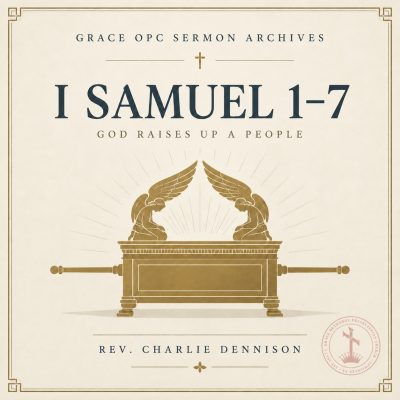
This sermon is from the Rev. Charles G. Dennison sermon archive, part of the “I Samuel 1-7” series, and was preached at Grace Orthodox Presbyterian Church in Sewickley, PA, during a worship service on Sunday, April 6, 1997.
About this sermon
Hannah builds her song with real poetic structure, even a chiasm, and that craft serves a larger point. True prayer grows out of events, as Moses’ song does, proclaiming God’s great acts in place of abstract truths about him. Both songs place the praying believer inside those events, crucified and raised with Christ.
Sermon transcript
and said, My heart rejoiceth in the Lord, my horn is exalted in the Lord, my mouth is enlarged over mine enemies because I rejoice in my salvation. There is none holy as the Lord, for there is none beside thee, neither is there any rock like our God. Talk no more so exceeding proudly, let not arrogancy come out of your mouth. For the Lord is a God of knowledge, and by Him actions are weighed.
The bones of the mighty men are broken, and they that stumbled are girded with strength. They that were full have hired out themselves for bread, and they that were hungry cease. So that the barren have born seven, and she that hath many children is waxed feeble. The Lord killeth and maketh alive. The Lord maketh poor and maketh rich. He bringeth low and lifteth up. He raiseth up the poor out of the dust, and lifteth up the beggar from the bend hill, to set them among princes, and to make them inherit the throne of glory.
For the pillars of the earth are the Lord’s, and He hath set the world upon them. He will keep the feet of His saints, and the wicked shall be silent in darkness. For by strength shall no man prevail. The adversaries of the Lord shall be broken to pieces, out of heaven shall be thunder upon them. The Lord shall judge the ends of the earth, and he shall give strength unto his king and exalt the form of his anointed.” Okay. Hannah’s prayer is powerful poetry. Now, that may not interest you a great deal. You may not be into poetry, but I trust that you may be able to get into Hannah’s prayer, nonetheless. And his prayer is powerful poetry.
And verses one through three in this prayer form a unit, and in themselves provide us also with powerful poetry. These three verses opening up this marvelous hymn-like prayer. are composed of three sections corresponding to the three verses. If you have a Bible version that lines out the verses in poetic form, things will be made a bit easier for you as you look at this text. You will notice the balance of the three verses. Four lines in verse one, three lines in verse two, and then four lines again in verse three. It is this pattern which organizes the unit of these opening verses. As we will see, the two four-line verses, verses one and three, do in fact match up. leading then verse two, the three-line verse, at the center, the dead center.
The interior movement then of these verses, poetic style then, pushes us to that center, and particularly to the middle line of that second verse. the verse or the line that reads, “‘For there is none besides thee,’ in the King James, or as the New American Standard has it, “‘Indeed, there is no one besides you.’” We sense then the focus upon that middle line in the second verse, and we do so even as we hear this prayer read, or we are reading it ourselves. because Hannah here uses the most familiar and direct form of address when referring to God. Her words are emphatic, as the New American Standard puts it. Indeed, there is no one besides you. The familiar pronoun at the end of that line.
Verses 1 through 3, then, of this opening to the prayer, therefore converge on that middle line in the second verse. But notice now also the development of the unit that we have in view here, as that development reinforces the movement that we have observed thus far. The four lines of verse one.
The four lines of verse one begin with comment from Hannah about her heart, and conclude with comment from her about her mouth. My heart rejoices in the Lord, she begins, my form and my strength is exalted in the Lord. My mouth, she goes on, speaks boldly against my enemies, because I rejoice in your salvation. From Hannah’s heart to Hannah’s mouth. But now, the four lines of verse three. Look at them. They begin with Hera speaking about the mouths of her enemies, and conclude with comment from her about their hearts. Are you with me? Do you see the pattern of the unit? to that third verse.
Boast no more very proudly, do not let your arrogance come out of your mouth. The beginning of verse three, For the Lord is a God of knowledge, that is, he knows the thoughts and conditions and the intentions of the heart, a theme, by the way, central to the entirety of the books of Samuel and Kings. He knows the thoughts, the condition, and the intentions of the heart, and with him actions, that is, the consequences of the thoughts of the heart in externities, are raised. So then, in verse 3, we have the reverse of verse 1, not from heart to mouth, but from mouth to heart.
If you were to organize, then, verses 1 and 3 in poetic fashion, you would place the letter A beside the first two lines of verse 1, the lines about Hannah’s heart, and the letter B beside the second two lines of that verse, the ones about her mouth. And then you would go on to verse three and place the letter B beside the first two lines of that third verse, the lines about her enemy’s mouth, and the letter A beside the last two lines of that third verse, the ones about her enemy’s heart.
You therefore have this structure. A, B, B, A. Two verses, one and three. an order that is intended to provide you with a sense of completeness and closure. You have taken steps only to retrace them, and have provided for you the answer to Hannah’s heart and voice in her enemy’s heart and voice.
Verse 2 simply underscores what we have observed thus far. It is composed of three parallel lines, but with the middle line a unique and central line. If we are to assign to verse 2 a letter, it would be the letter C, understanding the centrality of that middle line. Indeed, there is no one beside you.
This being the case, then, we have the poetic ordering for this opening unit, verses 1 through 3, this way. A, B, C, D, A. A perfectly symmetrical, aesthetically balanced, metrical statement juxtaposing believer and unbeliever, heart and mouth. at the center of which stands the expressed confession, verse 2, of striking faith in the singular, exclusive, holy One, the Rock, the One who is acknowledged to be the world, and only He. Verses 1, 2, 3 of Hannah’s hymn-like prayer are powerful and even sublime poetry. They are even more powerful and sublime theology.
Now, in the theology presented to you here, You are not confronted with the interior condition or the external expression of thought so much, much less the internal condition and the external expression of the enemies of whom she speaks. But true to the structure of this unit, you are confronted with the one who stands central to the political organization, you are confronted with God himself. Now, you must appreciate the precise way in which you are being confronted with that God. the precise manner in which he is being presented to you here in this second verse. That verse reads, one more time, New American Standard Version, There is no one wholly like the Lord, and indeed there is no one beside you, nor is there any rock like our rock.
Now, we might be likely to think that all Hannah is doing here is upholding the Israelite monotheistic faith in pure and true form, commenting here at this point upon a few appropriate attributes that she latches onto. You might read this verse as if Hannah were merely stating her belief that her God, Israel’s God, is the only God, and that this God is holy in character. That is to say, he is, in his very essence, separated from evil. In the same vein, the fact that God is confessed to be the Rock, in the last line of the second verse, is liable to be understood as a reference merely to God’s steadfastness and his faithfulness. That in a very abstract fashion. Again, an acknowledgment, a somewhat detached acknowledgment of one of God’s many attributes, one of the features of His character, as if those features were being contemplated and meditated upon.
But this is not Tenna’s approach. This is not what she has in mind. This is not what the Spirit has in mind for her as she expresses herself. In fact, and please understand me in this, she has no terapeutical formulation and view such as we, as Presbyterians, have expressed, say in questions and answers in the short of Catechism, particularly the question that asks, What is God?
God is a spirit, infinite, eternal, and unchangeable, and is being, wisdom, power, holiness, justice, goodness, and truth. We reveal this statement and this summary, and we are drowned to it. and surely it is reflective of the things which Hannah confesses this day in which she prays. But that does not provide the precise entrance into the words that are used by Hannah here in 1 Samuel 2. For we have here something of a different orientation theology-wise. than the summary statements that come to us in catechetical form. Hannah’s prayer is not engaged with the idea of God and what characteristics might be His. Hannah’s prayer is not engaged with the idea of God and what characteristics might be His.
Rather, her prayer is engaged with what God has done and what His actions declare about it. I will repeat that. Hannah’s prayer is not engaged with the idea of God. and what characteristics might be his, rather her prayer is engaged with what God has done and what these actions say about him.
With regard to the holiness that is mentioned in the first line of verse 2, Hannah is drawing upon the religious reality that informs her consciousness as an Israelite, such as that is expressed in many places. throughout the Old Testament, and particularly previously in Exodus 15, verse 11. Here, in acknowledgment of, and in full participation in, the great work of God in delivering Israel from Pharaoh and his chariots, Moses and the sons of Israel sing, Who is like you among the gods, O Lord? Who is like you, majestic in holiness? often in praises working wonders. You see, mention of God’s holiness here is no technical definition like contemplation of God. but the specific declaration of God’s exalted nature, His separateness, His singular exclusivity, made plain specifically in the concrete act, in the concrete event of the Exodus, and in the destruction of the people who opposed His own, and that in the deluge of the collapsing walls from the Red Sea. The ascription of holiness to God His proven divine character is inextricably bound to his action. Before which now Moses and the children of Israel stand.
They are in the presence of his action. They see it, and they say in response, there is no one but you. You are completely distinct, you are completely separated. No one like you, and there is no one but you. Moses, the children of Israel then, do not stand unattached somewhere else, contemplating God and His nature. who God is and what attributes might be His. They are standing right in the event, and they are saying, there is no God like you, for I see the evidence is here. You remember Mount Carmel? The fire coming down on Elijah’s altar, consuming everything in sight, and the people shouting out, The Lord, He is God! The Lord, He is God!
Now, we see the same things in Hannah’s youth. not just of the word holy, but of the word rock, for God in the third line of that second verse. For if Exodus 15 is an early song of Moses, Deuteronomy 32 is a latter song of Moses. And you might recall how many times Moses uses the word rock to describe God in that latter song. He calls God the rock of Israel’s salvation, verse 15, Deuteronomy 32. He says in verse 18, it was the rock who begot Israel.
But again, these references, by Moses or by Hannah, have no technical, abstract definition like contemplation of God in view, but are the acknowledgment of the full participation in God’s very own person who has revealed himself as that abiding habitation for his people by creating them as his people when he saved them.
A curious thing, a curious thing in this grand theology. expressed by Hannah in her hymn-like prayer is that she draws so heavily in her confession now on the language rising out of the experience of the people of Israel when they were saved by God. It is as if she is consciously seeking to incorporate the language that comes from the great saving works of God into her prayer. But even more, it is as if she is subordinating her own recent blessing, the resolution to her barrenness, the provision to her of a son. It is as if she is subordinating her own recent blessing, to the categories of that definitive redemption that undergirds her life as one who belongs to the people of God, those who have been redeemed.
As if her own life is lost in a life absorbed into the great saving act of God. by which he redeemed his people. That is why, you see, she makes no reference, she makes no reference to her own particular individual situation. She makes no reference specifically to her own barrenness. She makes no reference to the birth of her own child Samuel, or any other particular feature of her experience.
She is drawn, she is thrown into the great drama of redemption. She gives up her life And as she does, she stands, her face before the God who redeemed Israel. It is as if she now stands in the presence of God’s very act in redeeming his people from Egypt.
And that action now begins to define her in all of her consciousness. She thinks in these terms. She has no other terms to think in. The redemption of God gives great action, consumes her. She has no life left but that life. This is the heart, the soul, and the concession of a godly woman. Not a woman who’s turning every situation around. So it is one more occasion for her to consider herself, and her value, and her importance.
This woman, like the true people of God, loses herself in God and His redemption, and her language proves it. Her prayer proves it. She stands then full faith before the God, taking this little event and seeing it in light of the great event, and she says, God is the Lord, He is the only one, He’s the only one, I know it, in confirmation of all that He’s done for His people. He alone is, He alone abides.
And here is the language of your prayers, for you see, Hannah is an Old Testament embodiment of all of the people of God. They are all in her. Here is the language of your prayers, and the very substance of your life. As you are drawn, not so much into the events of the Exodus, In order there, on the other side of the Red Sea, to affirm and know God’s exclusive sacredness and rock-like permanence, but into the great events, at Jerusalem and outside, into Christ’s very own death and resurrection, which now defines you and informs the substance of your prayers, and even provides the substance for your life.
I am crucified with Christ. Nevertheless, I live. Yet not I, but Christ lives in me. And the life that I now live in the flesh, I live by the faith of the Son of God, who loved me and gave himself for me. There is no other God. He is holy, exalted. shelter and abiding place. Here truly is the definition of your existence. For me, to live is Christ. Let’s pray.
Our God, show us Lord, how we do then live in Christ’s death and in his resurrection, how we are not only acquainted with but participate in the great saving act which you have performed, from which then comes forth the confessions and acclamations You alone are God, you are the Holy One, you are the Rock, and there is no one besides you. Father, as we come to the table today, may this too be impressed upon us, that by this meal we are reminded of our participation with Christ. in the great saving act which has been performed by you for us. May we give glory to you, O God, rejoice in your provision, knowing that we are unworthy of your least consideration, but have been blessed because of your inexplicable love with which you have loved us from before the foundation of the world.
The sermon text provided above is derived from the sermon audio recording making use of generative tools. It has not been manually edited. While transcription tools have a high degree of accuracy, the output may include generative textual, punctuation, and/or formatting errors.