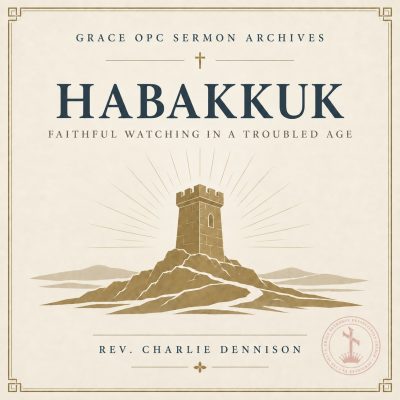
This sermon is from the Rev. Charles G. Dennison sermon archive, part of the “Habakkuk” series, and was preached at Grace Orthodox Presbyterian Church in Sewickley, PA, during a worship service on Sunday, May 14, 1995.
This morning we are beginning our scripture reading in 1 John chapter 2. And we are beginning with verse 12. Let’s give our attention to the reading of God’s holy words. This is 1 John, chapter 2, verse 12. I am writing to you, little children, because your sins are forgiven for his name’s sake. I am writing to you, fathers, because you know him who has been from the beginning. I am writing to you, young men, because you have overcome the evil one. I have written to you, children, because you know the Father. I have written to you, fathers, because you know Him who has been from the beginning. I have written to you, young men, because you are strong, and the word of God abides in you, and you have overcome the evil one.
Do not love the world, nor the things in the world. If anyone loves the world, the love of the Father is not in him. For all that is in the world, the lust of the flesh, and the lust of the eyes, and the boastful pride of life, is not from the Father, but is from the world. And the world is passing away, and also its lusts, but the one who does the will of God abides forever.”
And then turning back to Habakkuk chapter 2, Then the Lord answered me and said, Record the vision, and inscribe it on tablets, that the one who reads it may run. For the vision is yet for the appointed time, it hastens toward the goal, and it will not fail. Though it tarries, wait for it, for it will certainly come, it will not delay.
Behold, as for the proud one, his soul is not right within him, but the righteous will live by his faith. Furthermore, wine betrays the haughty man. so that he does not stay at home. He enlarges his appetite like shielding, and he is like death, never satisfied. He also gathers to himself all nations and collects to himself all peoples.
We cannot overestimate the importance of Habakkuk 2, verse 4, particularly the last part of it, that the righteous shall live by his faith. For this text stands at the center of our religious consciousness. It stands at the center of our religious heritage, as we claim the Protestant Reformation as our own, and say, in effect, that the legacy of Martin Luther and John Calvin is ours. But granting this text such prominence should not leave us merely listening to the text and then moving on, as if we might take it for granted. For this text demands from us concentration, even meditation, if it is to open up for us its depth and its power.
Now the depth and the power of this text is certainly set there in its original Hebrew context, as it is written down by this 7th century B.C. prophet of the Lord. But the depth and power of this text is increased, multiplied, as we see the uses of the text throughout the history of God’s people. Four centuries after Habakkuk wrote, a group of Jews in northern Africa got together and translated the Hebrew Bible into Greek. We know this translation as the Septuagint.
The Septuagint translation of Habakkuk 2.4 will bring its own nuances for understanding of this text, opening for us again the depth and the wonder of the verse. But we don’t stop with the Hebrew original or with the Greek translation in the Septuagint. For we also know that this text figures very prominently in the writings of the New Testament.
It is quoted directly in three instances. The first quotation of it from Paul in Romans, chapter 1, verse 17. Later on in his canonical epistles, Galatians 3, verse 11. And then finally, Hebrews 10, verse 38. Each of these settings, the original Hebrew, the Septuagint setting, the quotations of this text in Paul and also in Hebrews, draws us ever more deeply into the treasury of God’s Word. For an increasingly profound grasp of the mind of our God, when it comes to such subjects the righteous person, righteousness itself, justification, faith, and life lived by an infant.
This morning we want to begin our consideration of this text by looking at its original setting in the Hebrew as it was written down by Habakkuk. The verse in the Hebrew begins with an exclamation, the word, behold. Now, some have suggested that This word is meant to call attention to the fact that God has spoken in the previous verses about a vision that he has given to Habakkuk, and as the vision comes, Habakkuk now is told, Behold, as that vision dazzles before his eyes. But I see this word, Behold, as an exclamation point at the beginning of the sentence. It’s as if, with a word, the prophet provides his own punctuation, and that at the outset of the sentence, rather than at its conclusion. This word is an attention-getter, a deliberate attention-getter, a lapel-grabber.
Behold, says the Lord, because, you see, he has something of greatest importance to say now to the prophet. The Lord had made mention of the fact that he is going to provide Habakkuk with a particular, a special vision, a revelation, verses 2 and 3. But now, the Lord moves on. Having commanded the prophet to write down the vision, the Lord moves on. with a word specifically appropriate to the Prophet, and to all who would hear what he has to say through the Prophet.
And that word functions as something of a sermon—a sermon about attitude. A sermon about attitude. The suggestion being, if you don’t get your attitude right, you are not going to profit from this vision. If your attitude is wrong, you are not going to profit from this vision. The Lord begins his sermon with his exclamation point then. But then he jumps right in and says, as for the proud one, his soul is not right within him.
Now the word that is used here for the proud one comes from a Hebrew root meaning to be swollen, maybe even inflated. We might extract from that puffed up, puffed out. The image behind the word is hardly anything but The image behind the word has in view infection, the swelling that takes place when there is an infection. It has in view even a tumorous growth. The suggestion is that Tide is a spiritual cancer. It cannot be detected by any physician. but its effects are obvious and clear.
Pride, then, is a spiritual disease that attacks the soul. When the Lord, therefore, goes on to say that the soul—note how the verse progresses—that the soul of the proud is not right within him, He means the soul, the very center of this person’s existence, is contorted, crooked, twisted, perverse, and laboring under delusion, by and large, self-inflicted, if not self-satisfied. So deadly is the sin of pride that Scripture calls it an abomination. Now, I think that you’re aware that usually Scripture reserves that word for the most heinous and hideous of actions or characters. Scripture calls pride an abomination.
It also associates pride with the high look. I’m quoting out of Proverbs there, the 21st chapter. How would you understand the high look? There is a very powerful scene in the beautiful film Searching for Bobby Fischer. I don’t usually recommend films from the pulpit, but I will put in a good word for that one. There is a very, very powerful scene in that film.
The film is about seven-year-old chess genius by the name of Josh Waitzkin. But he is told by his teacher that he must hold his opponents in contempt. If he is to excel at chess, he must consider his opponents unworthy to be in the same room with him. Such advice from Josh’s teacher illustrates what the Bible calls the high look.
Content. Such arrogance that others are not worthy. Now we could all wish that the answer to pride was as simple as making a movie. Or, it was as simple as the solution that this very fine film suggests. All we need do is find an innocent child somewhere. One that isn’t sullied by pride and arrogance or the high look.
One that has the presence of mind, in fact, to come back at his teacher when his teacher is encouraging him to have contempt for all of his opponents and say to that teacher, I don’t feel that way. Well, the sad truth is that most of us, if not all of us, do feel that way. In fact, we battle that feeling constantly.
I have come to the conclusion that the reason so very few genuine Christians become high-profile successes in this world has nothing to do with ability. Absolutely nothing to do with ability. It has everything to do with ambivalence. You see, Christian parents are always struggling within themselves and with themselves, even for their children, because they know that the kind of intense competitive contempt that is actually accepted and encouraged by the world, the kind of aggressive arrogance, the vain high look demanded by the world in order to achieve acknowledgment in this world is something that is out of bounds for them.
Christians are aware of the great evils of pride. They are aware of the magnitude of sin. They know how naturally feelings of pride rise up within the human soul. They know how easy it is to be victimized by such suggestions as Josh’s teacher made to him. how easy it is for those feelings that he wanted to encourage to come to expression.
Therefore, despite ability, despite even great potential, we who believe in Jesus Christ, we who are committed to the gospel, find ourselves in a different kind of battle altogether. Not with the person on the other side of the chessboard, Not with a person on the other side of the boardroom, but with ourselves and with great and ominous spiritual powers.
We struggle against wickedness, against sin, against evil, the magnitude of which—yes, the magnitude of which impresses itself upon us unmistakably. For those we love, for ourselves, for our children, we struggle for godliness, we struggle, yes, for humility, that humility that stands ever against pride, the high look, arrogance, presumption.
We struggle then for those things for which the world has little time or even respect. As it were, going in two directions at once. On the one hand, we want to excel, we want to do well, do we not? We want the same for our children, that we are aware at the same time that we cannot encourage in ourselves or in them what God condemns. And therefore, we’re stuck.
For the spirit wars against the flesh, and the flesh against the spirit. And that’s the nature of our lives. I might suggest to you that our growth in Christ depends much upon our understanding of these very things. You ain’t gonna grow unless you figure it out. Disregard the bad grammar there. That’s my exclamation mark.
But now if pride had only to do with personal interior foolish conceit. If it was only a private thing that I cultivated while I was alone, you know, a private sense of superiority to others. If it was all as harmless as a little whimsical daydream about what I might be or who I really am if the world would only sit up and take notice. If pride were merely a matter to be considered along those lines, we would be content in placing it much lower in the list of offenses and sins that offend God. We would put it a little lower down in the list of the deadly sins that the Church has spoken of throughout her history.
But as it is, pride has topped place. It’s the most serious. And this century, this century should give some evidence to all of us as to why that is the case. This century has been a monument to the pride of moral. It is not without reason that Barbara Tuchman entitled her history of Europe covering the 25 years before the outbreak of World War I, The Proud Tower. An allusion to Babel, I’m sure. She chronicled in her study the collective European pride that was productive of a devastation the likes of which the world had never seen, only to be topped later by further devastation beyond our comprehension.
And when we’re face-to-face with these atrocities, Monument to pride. We begin to realize that when we take up the subject of pride, we are dealing with more than mind games, something that can be settled by some artistic production like a film, something that can’t be settled, in fact, by a visit to your psychoanalyst. For pride is evil, it is sin in epic proportions, and it even marches on. to wickedness that is catastrophic when its strength is multiplied, multiplied through the foolishness of men, as the individual becomes multiplied by gathering others to himself that agree with him in his prideful and boastful attitude, whether it be on the basis of nationhood, whether it be on the basis of race, or some theory of social cohesiveness. Pride has ravenous possibilities that bring to expression the darkest side of human depravity.
1 John chapter 2 verse 16 is to the point. Here, the Apostle John speaks about the character of the world. He describes it in a threefold fashion. It is filled with the lust of the flesh, the lust of the eyes, and the pride of life. That last phrase is what interests us. The thought behind those words, the pride of life, is that arrogance particularly associated with the possession, the acquisition of things from this created order, as if they belonged to us. But it’s more heinous than that, for the pride of life against which the Apostle John speaks at this point even presumes to claim life itself as its prerogative.
It is not merely the things of life that belong to me, it is life itself that is mine, that is my possession. And if I am saying things like that, then it is obvious. Life and the possessions of life in this present evil age, these things belong to me, they most certainly don’t belong to anyone else. They don’t even belong to God. Because you see, I, in my pride, have already decided who God is. And it’s me.
The Lord’s words to Habakkuk also set before us the deep, dark, ominous character of pride. It’s drawn out for us as we move past the fourth verse into the fifth, and we see that there is a parallel thought presented there. Yes, the proud one is mentioned at the beginning of verse four, but he’s also mentioned at the beginning of verse five. The Lord says, wine betrays the proud man, the haughty man, the arrogant man. The wine here is meant symbolically, metaphorically. It’s that tablist that brings out what’s inside, the true character of the individual. And as you read that verse, you are introduced to the true character of the individual.
One who considers himself to be superior, yes, but so superior that he not merely understands his life to be his own possession, but your life to be his possession. Do you see how dangerous it is? It’s more than just a mental shadow game, something personally that we cultivate within ourselves, something that we must personally deal with. If you get other people who believe the same thing, and you have one of them standing over all of them, describing that life is his, even your life is his, you see the potential of pride. the kind of evil that it can unleash upon the world.
There is no one as important as I. There is no one superior to me. I am the greatest. Everyone in this world is here to serve me, and my superiority means that I need not serve anyone. Should not all be compelled to acknowledge what I declare? Shouldn’t everyone be clued in to my importance?
Now, as we read this text, we may be tempted to conclude that those that are particularly in view are those wicked Babylonians that Habakkuk is so agitated about at the end of chapter one. Here, in the Babylonians, are the particularly boastful, prideful people, arrogant, self-assured, Well, of course, the Babylonians are arrogant and they are proud. But the point at them only as guilty of pride smacks itself of pride, do you not understand? And it is that pride that is a liability to the people of God, even to Habakkuk the prophet, that the Lord now is endeavoring to root out of his people and out of the man. Babylonians, of course, but remember that Habakkuk began his prophecy, verses two through four of that first chapter, speaking not about Babylonians and their wickedness, but about Jews and their wickedness.
The proud man of Habakkuk 2.4, therefore, is not just the Babylonian, but also the Jew. And that’s the message of God’s sermon to the Prophet. But even more, this pride that is intruded upon the consciousness of Babylonians and Jews has intruded upon the consciousness of the Prophet himself. He has already given himself away. Do you remember verse 13 of that first chapter, the conclusion of it? He has already declared to the Lord that he’s more righteous than any Babylonian. The Babylonians are coming. I know they’re wicked, but they’re much more wicked than us. We are more righteous than they.
The prophet Habakkuk has a quantitative view of righteousness. The prophet and the Jews, then, in the prophet’s estimation, are more righteous in his eyes than the invading Chaldeans. So when the Lord now tells the prophet that the proud man’s soul is not right within him, he means Habakkuk to hear that message and to take it to heart himself. And if Habakkuk is in view, the prophet of God is assured, you are in view also. Only by taking this message to heart will Habakkuk and others like him, those whom the Lord is pleased to reveal himself to, only by this message will they be prompted to benefit fully from the vision that the Lord is communicating through his servant. While the full benefit of that vision may not be perfectly clear to us as we read through Habakkuk, try to make our way through it and make sense of it, it does become clear, does it not?
When we hear from a latter day the Apostle Paul telling us that God’s purpose all along, Romans 3.19, was that every mouth may be stopped. and all the world become accountable to him.
Even if you are a prophet, you cannot claim a superior righteousness. Even if you are a Jew, you cannot claim a superior righteousness. Pride will force you drive you to do just that. But you must not in light of the full benefit that comes through the vision.
And truly that vision to Habakkuk reveals its full benefit in answer to our own pride, does it not? We have presented before us our Savior, Jesus Christ, who was so wonderfully humble, and stood perfectly opposite all pride and vainful boasting. Jesus himself, without any pride or arrogance whatsoever, punctuates his ministry with these words. Come unto me, O ye that are weak and heavy laden, and I will give you rest. Take my yoke upon you, and learn of me, for I am weak and lowly in heart, and you shall find rest for your souls. For my yoke is easy, and my burden is light. Amen.
Father, our arrogance eats away at us, our pride destroys us. You are the Lord of life, and Christ our Savior has been victorious over sin, even this sin of pride. And we can look to this one who is perfectly humble, this one who became a servant for us. And Lord, in faith, true union with Him, we know that the righteousness that we long for is given to us because He is righteous, and that perfectly. May it please you, Father, to cultivate within us the meekness and humility of Jesus, our Savior. That we who are justified divide might live meekly before you and humbly before the world. We pray this in Jesus’ name. Amen.
The sermon text provided above is derived from the sermon audio recording making use of generative tools. It has not been manually edited. While transcription tools have a high degree of accuracy, the output may include generative textual, punctuation, and/or formatting errors.