
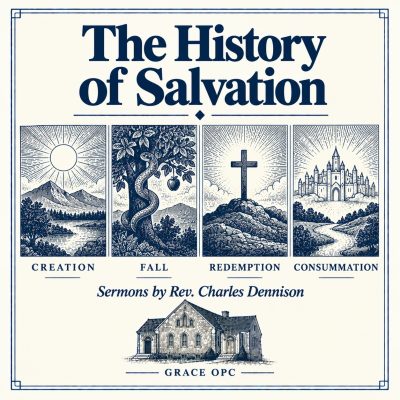
This sermon is from the Rev. Charles G. Dennison sermon archive, part of “The History of Salvation” series, and was preached at Grace Orthodox Presbyterian Church in Sewickley, PA, during a worship service on Sunday, August 26, 1990.
About this sermon
Naturalistic and humanistic accounts treat Israel’s religion as one more ancient Near Eastern cult, and Van Til’s view of revelation shows why it is unique. God’s sheer grace toward Israel in Deuteronomy 7:6-8 is the two-sided key to understanding it.
Sermon transcript
Tonight we are reading from the book of Deuteronomy, chapter 4. Deuteronomy chapter 4. The first 24 verses. And now, O Israel, listen to the statutes and the judgments which I am teaching you to perform. In order that you may live and go in and take possession of the land which the Lord, the God of your fathers, is giving you, you shall not add to the word which I am commanding you, nor take away from it, that you may keep the commandments of the Lord your God which I command you.
Your eyes have seen what the Lord has done in the case of Baal-peor. For all the men who followed they appear or the Lord your God has destroyed them from among you. But you who held fast to the Lord your God are alive today. Every one of you. See I have taught you statutes and judgments just as the Lord my God commanded me that you should do thus in the land where you are entering to possess it. So keep and do them.
For that is your wisdom and your understanding in the sight of the peoples who will hear all these statutes and say, Surely this great nation is a wise and understanding people. For what great nation is there that has a God so near to it as is the Lord our God whenever we call on him? For what great nation is there that has statutes and commandments as righteous as this whole law which I am setting before you today. Only give heed to yourself and keep your soul diligently, lest you forget the things which your eyes have seen, and lest they depart from your heart all the days of your life. But make them known to your sons and to your grandsons.
Remember the day you stood before the Lord your God at Horeb. When the Lord said to me, Assemble the people to me, that I may let them hear my words, so they may learn to fear me all the days they live on the earth, and that they may teach their children.
And he came near and stood at the foot of the mountain, and the mountain burned with fire to the very heart of the heavens, darkness, cloud, and thick gloom. Then the Lord spoke to you from the midst of the fire, You heard the sound of words, but you saw no form, only a voice. So he declared to you his covenant which he commanded you to perform, that is, the Ten Commandments, and he wrote them on two tablets of stone. And the Lord commanded me at that time to teach you statutes and judgments, that you might perform them in the land where you’re going over to possess it.”
So watch yourselves carefully. Since you did not see any form on the day the Lord spoke to you at Horeb from the midst of the fire, lest you act corruptly and make a graven image for yourselves in the form of any figure, the likeness of male or female, the likeness of any animal that is on the earth, the likeness of any winged bird that flies in the sky, the likeness of anything that creeps on the ground, the likeness of any fish that is in the water below the earth. And beware, lest you lift up your eyes to heaven and see the sun and the moon and the stars and all the hosts of heaven, and be drawn away and worship them and serve them, those which the Lord your God has allotted to all the peoples under the whole heaven. But the Lord has taken you and brought you out of the iron furnace from Egypt to be a people for his own possession as today.
Now the Lord was angry with me on your account. and swore that I should not cross the Jordan, and that I should not enter the good land which the Lord your God is giving you as an inheritance. For I shall die in this land, I shall not cross the Jordan, but you shall cross and take possession of this good land. So watch yourselves, lest you forget the covenant of the Lord your God which he made with you, and make for yourselves a graven image in the form of anything against which the Lord your God has commanded you, for the Lord your God is a consuming fire, a jealous God.”
We ask, Father, that we would be encouraged by your word in the certainty that your word gives life. Surely your word has the power to transform lives, our lives. And you have made that plain to us. And Lord, we would ask that the word that goes forth from this place would powerfully confront others with the knowledge of the Lord Jesus Christ. And may it be that there would be those who would come and understand better, or even for the first time, the glorious things of the gospel of Jesus Christ. Bless the message tonight and bless the messengers throughout your church who bring your word to the world.
We ask this in Christ’s name. Amen. We have come to the next to the last message in this series on Old Testament times. Next week we will be considering the theme of the Messiah, or Israel’s hope. That to which she looked, that for which she longed. But as we build up to our consideration of Israel’s hope, and the figure of the Messiah next week, we take up this evening the general features of Israel’s religion.
Now it has been said that the Greeks gave to the world arts and letters. that being their contribution to world civilization. It has been said that Rome gave to the world law and order, that being their contribution to world civilization. And for those who are interested in world civilization, It has been said that Israel’s contribution is in the area of religion and ethics. So, in good humanistic style, in fine humanistic perspective, all you need do is to combine the contributions of these great civilizations for what we have now as the underpinnings for our civilization in our time.
If we are interested in the arts, we look to the Greeks. If we are interested in law, if we are interested in government, we look to the Romans. If we are interested in religion, we look to Israel. We throw all of these elements into a big pot, we stir it up, and out comes the perfect mix for a proper civilization, a good and proper society.
Well, if you were attending college at the turn of the century. When professors were still of the habit of trying to find a place for Israel and Israel’s contribution religiously to the world order, you would be likely to hear a presentation like this from some world cultures teacher, from someone who may be teaching you about world civilization. It may well be that that professor does not have himself a biblical faith. It may well be that he is only tangentially related to either Jewish or Christian orthodoxy. His real interest is civilization, culture. And therefore, as he presents his material, it’s in the interests of seeing that culture, that civilization promoted and enhanced. Well, it wasn’t very long into this century when there were fewer and fewer professors and teachers in colleges and in universities who were actually saying good things about the religion of Israel at least in any orthodox sense of the word. You see, these individuals, as were their institutions, were committed to a naturalistic and humanistic approach to the problems of culture and civilization.
When they surveyed world history, they were looking for genius, And genius promoted itself. So what was the genius of the Greeks? What was the genius of the Romans? What was the genius of the Hebrews? Why, the Hebrew people had a special propensity for religion and religious understanding.
Did they? Not necessarily from my reading of the Old Testament. Wasn’t it sort of forced on them? It wasn’t because they had some sort of special natural propensity for religious things. that they have this deposit which has been given to them that is now seemingly exploited by naturalistic humanists in this century, in the interests of better society and grander civilization. The Jews, then, were not naturally religious. in the sense that the Greeks were naturally artistic, and the Romans were naturally interested in government, law and order in society.
Well, there are dangers, then, when we start investigating this whole area of religion. Because there is, out there in the world, a whole and entire network, the educational establishment, that sees religion along naturalistic lines. Religion is something that arises from within yourself. It’s developed It’s fine-tuned, it’s cultivated, but it is something that basically arises from within yourself. You conceive it. Your society, your tribe, or your nation develops that religion, and then that religion, if things go well for it, and you, has an impact directly upon the world and world culture.
When we come to the Bible, though, The Bible is presenting to us a religious phenomenon that is extraordinary in the extreme. It is presenting to us a religious phenomenon that is completely and utterly unique. This is not something that arises from within man. This isn’t the product of someone who has a bright new religious idea, as if Moses were some sort of religious innovator, as if he was about the business of creating a new world religion, and then finding a people that might be willing to accept it. Now we might say that about Muhammad, because that is definitely what happened in his case. The man actually did hatch a religion in his brain. The man went around collecting detached Arabs, congregating them around his ideas and religious philosophy, and voila!
A world religion. And there are a number of other instances of that. What do you make of Joseph Smith? Utterly fantastic! Bizarre! Mormonism, a religion that truly is the product of a nut. Charles Taze Russell is buried on the north side. He was the founder of the Jehovah’s Witnesses. Again, a man who took some religious stuff with his own manipulation created a religion all his own. But a million light years removed from the biblical religion. The religions of the world. Buddha. Confucius. The same thing observed there. Truly, men of genius. I’m not denying the fact that Joseph Smith was a genius. A crazy genius, but a genius.
When we come to the Bible, we are confronted with something that is truly exceptional, unique. The religion that stands apart, not so much to make you proud, not so much to cause you to boast about your position, your standing, your relationship to this book or to the faith that it espouses. For you see, the presupposition of this religion is the ruination of the world, the inability of man according to his own lights, to come to a knowledge of the truth, left to myself, I never arrived. The great professor that I had in seminary was named Cornelius Van Til.
He used to say to us, there is natural revelation, but all natural theology is apostate. Do you understand what he meant? God reveals Himself in nature, but anybody who goes to work on nature in order to conceive the knowledge of the true God ends up in apostasy. Look at nature and you end up in the wrong place. Why? Because you need a supernatural revelation.
And the basis of Israel’s religion is a supernatural intervention by God Himself, the only God. So how do we know the truth? How do we know God? How do we come to embrace the right religion with the right religious spirit only by way of a revelation, a self-revelation of and from God?
You understand, God is outside the created order. He is above the heavens. He is transcendent. In order to save, in order to reveal, savingly, He intervenes. He interjects Himself into the space-time world that you know. And in that, He makes Himself known to His people. Because they’re so deserving? Because they’re so worthy? Because they’re so eminent? Because they have a natural religious genius? Because they’re likely to accept it when no one else will? You know better. You know better.
So, the supernatural work of God God intervening, God graciously coming and revealing himself and presenting himself as the center of this religious movement that now grabs hold of Israel. And Israel then becoming by grace, not because she is worthy, by grace, God’s unmerited love and favor, the custodian in the world of this revelation that has come from God. Deposited with Israel is the record of God’s saving works. Deposited with Israel is God’s righteous law. So if you want to think of the substance, then, of that religion that belongs to Israel, not because of her own genius, but because of the Lord’s gift, here it is. The substance of it is, truly, this record given to her of God’s saving words and his righteous law, as he himself personally has communicated that to these people. Now to that we are bound. Interestingly, that’s what the word religion means. It means to bind. We are bound by that at root. That’s why I read for you Deuteronomy 4 tonight.
You have the presentation there of the exceptional deposit that belongs now to Israel as the recipients of this revelatory communication from heaven on high, from God himself. And the verse 6, Surely this great nation is wise and an understanding people. That’s what the peoples of the world now are saying. For what great nation is there that has a God so near to it as is the Lord our God whenever He calls on Him? We call on Him. Or what great nation is there that has statutes and judgments as righteous as this whole law which I am setting before you today?
Verses six through eight of that fourth chapter in Deuteronomy. And if there is any remain lingering questions in your mind about the gracious character of God’s approach to these people. I want you just to turn a few pages of Deuteronomy and look at chapter 7. Here is a classic text, and one that may be well to memorize, imprint upon your consciousness in some way. so as to remind you of the gracious character of God’s dealings with Israel. Here’s what is said. Deuteronomy 7 now, verses 6 through 8.
For you are a holy people to the Lord your God. The Lord your God has chosen you to be a people for his own possession out of all the peoples who are on the face of the earth. There it is, God’s graciousness. But also, you see, God’s choice is sovereign election.
The Lord did not set his love on you, nor chose you, because you were more in number than any of the peoples, for you were the fewest of all peoples. But because the Lord loved you and kept the oath which he swore to your forefathers, the Lord brought you out by a mighty hand and redeemed you from the house of slavery and from the hand of Pharaoh, king of Egypt.” He goes on, Therefore, know therefore that the Lord your God, He is God, the faithful God, who keeps His covenant, et cetera.” Well, I’m not telling you anything new. You, in your heart of hearts, know these things.
But it is well, is it not, for us to rehearse them, to remind ourselves of these truths. No natural phenomenon, a supernatural phenomenon. Not something that we deserve, a gift. Not something whereby we commend ourselves, but something whereby God is commended. Even before there is even any commendation of us.
We’re talking then about the heart and soul of what has been called Hebrew religion. Utterly unique. And how preparatory it is for that which is yet to come. For all the patterns are laid there, are they not? As God has dealt with Israel, so he will deal with his church which he assembles from all the nations and from the four corners of the earth so all the tribes all the nations all the tongues all the races will be assembled finally not just Jews not just Middle Easterners but from all over the world congregated by this great God, who so reveals himself. So, it’s relevant materialism. It’s relevant. Meaningful.
Now there are some features, some characteristics that are worth considering as we think a little bit further about Israel’s religion. There is, for instance, in Israel’s religion an internal side and also an external side. Now, you may be able to find counterparts in all of the religions of the world with regard to these matters. And in this there is a commonality between Israel and other world nations that have produced religions. Truly there is an internal side and an external side. As to the internal, We’ve talked a lot about God’s revealing activity.
We’ve talked about things that touch upon history and upon an interpretation of the origins of Israel as a nation, etc. But now we’re turning our attention to the whole matter of the heart. In Israel’s religion, things of which we have spoken have their impact, first of all, ideally, upon the heart. Israel’s religion is to the end that the heart may be one. Oh, to have a heart for God, to love God with your whole Is the religion that you embrace an emotionless religion? A religion without passion, without zeal?
How is that possible? Is not your heart stirred by the things you hear concerning God’s gracious activity? Is not the Spirit alive within you to quicken your heart, that your heart might be attached to these things in a vital way? Your heart set upon God’s love, inexplicable love for people, God’s gracious dealings with them. Oh, how I love that God! my heart set upon him.” A heart that in its affection is set upon him, but a heart also that trusts the one who is loved. Isn’t this the secret of love?
Have you watched love disintegrate? Have you watched it evaporate? Oh, there are emotions that continue. There are affections that seemingly survive. But if that trust, if that faith is crippled or destroyed, attacked, impaired, damaged, the Oedipus collapses. There certainly may well be some attractiveness that remains, some attraction that persists. But once that matter of faith and trust is gone, the edifice collapses.
Thus it is in our relationship with God. The heart that is affectionately set upon God then entrusts itself to the one love embraced. You see why your love for God must go on and express itself in faith and in trust. There are many people who confess some affection for God, they hardly know of what they’re speaking. For in that affection, that love of which they speak, there is nothing of an informed faith and trust by which they are willing to commit themselves wholeheartedly to this one they say they love. How often in Scripture then you hear the admonition coming again and again. You heard it in Psalm 37 that we sang at the opening of our service tonight, verse 3.
Trust in the Lord. Trust in the Lord. If you love Him, trust Him. Trust Him. If you don’t trust Him, the edifice of affection will become meaningless. all the vocabulary of love for God will crumble. He takes you down hard paths. He tries you, and you feel desperate in the midst of that trial. If you So it is with the religion that is coming to expression within Israel, and that not naturally.
Why do you think it’s necessary for the prophets, Moses himself, the psalmists, to continually encourage the people to trust in the Lord? Because it doesn’t come naturally. Why should I trust someone I can’t see? How can I commit myself to the invisible God? He asked me to live by faith. I can’t! That’s the truth. You can’t! In your own power, you can’t do it.
It is a supernatural work within you. You are utterly dependent upon the Spirit. Give yourself to Him and let Him perfect your faith. He said there’s an external side. That’s also in view in that 37th Psalm, the third verse. You know how it goes. It says, trust in the Lord and do good. Part and parcel of Hebrew religion is not then merely having right affections for God and cultivating a faith towards Him. It’s acting upon it. in such a way that pleases the one who has revealed himself graciously to you. Trust the Lord and do good. So there are concrete acts of obedience. Do we need to reread Deuteronomy 4? There it is. How do we have it in the good old gospel song? and obey. There is no other way to be happy in Jesus, but to trust and obey.
It’s great distress in the Christian Reformed Church right now. I heard a remarkable sermon when I was in California from a distraught Christian Reformed pastor who was reviewing the recent acts of Synod. You know what some of those acts were. What disturbed him most were the reports in the Banner, the Christian Reformed magazine, that told the readership that the decision of the Synod had been bathed in prayer.
That was the language they used. It had been bathed in prayer. So how could anyone doubt the outcome? We bathed it in prayer. Our piousness in this regard has sanctified our actions. You talk about an irate minister. This guy was chewing the cord on his microphone. He was practically leaping over the pulpit trying to get at the congregation, pleading with them. He says, if I have to put it in the extreme, don’t pray, obey. And when God’s word is clear, you don’t justify an act of disobedience by silly, pious language and activity.
There is an external side that we can’t avoid, we can’t get away from. Of course, there are liabilities to that external side, are there not? For part of the external side of the religion of Israel will be focused in a tabernacle, in a temple, in religious rites and festivals. Part of the external side of that religion of Israel will seemingly be focused in, well, if you obey, then you will prosper. And we all want to prosper, don’t we? So let’s get on with prosperity.
The external side can always be a trap. Even outward obedience conformity, compliance, can be a trap, a shield, something behind which people hide. So in the latter prophets you have language like, not sacrifice, you haven’t desired it, You have language coming from Malachi, shut up the temple, close the doors, bolt them, don’t let anybody in. I’m tired of all of this feigned religiosity, all this feigned piety. So the intern seemingly manages the extern. the heart affectionately bound to the God who has revealed himself, a faith that is alive and vibrant, trusting, then able to see those externals and judge them rightly, appropriately, in terms of what God has said and done. Retaking no delight in hiding behind things, camouflaging our case, acting as if we’re righteous when we’re not, playing the hypocrite? No. The religion of Israel then pushes, prods, pokes, goes, so that you will not be content with near externality. Rather, you will be content only with perfect conformity to God himself. I am holy, says the Lord. Therefore, be ye holy.
Well, there are other dimensions, of course, to Israel’s religion that we could look at this evening. We’ve run out of time. It’s a big subject. But I think I’ve laid before you this evening some chief features. Ending on a note that brings before you now the matter, the subject, of hope. The hope of these people, what they long for, what yet may be realized in their case, the perfection of that religion which has been given to them, and that perfection then becoming the true light that shines in the world for the salvation of God’s elect to the ends of the earth. And you’re part of the company. You’re part of the assembly that has been brought together. Amen.
The sermon text provided above is derived from the sermon audio recording making use of generative tools. It has not been manually edited. While transcription tools have a high degree of accuracy, the output may include generative textual, punctuation, and/or formatting errors.