
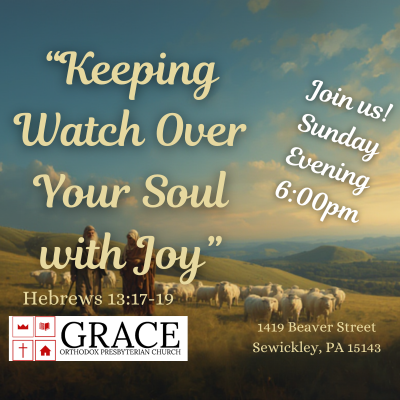
About this sermon
Hebrews 13 calls believers to obey their leaders and submit to them, for they keep watch over souls as those who will give an account. The word translated “obey” carries the sense of being persuaded and trusting, and “submit” the sense of deferring. Leaders have no independent authority; as the Westminster Confession teaches, the Holy Spirit speaking in Scripture judges all decrees and opinions. Believers should follow faithful leaders so that the leaders may do their work with joy, not groaning. The writer also asks the congregation to pray for its leaders.
Sermon transcript
Our text this evening is taken from the book of Hebrews chapter 13 and we’ll be looking at verses 17 through 19 of chapter 13. Hear now the word of God from Hebrews 13. Say your leaders and submit to them for they are keeping watch over your souls as those who will have to give an account. Let them do this with joy and not with groaning for that would be of no advantage to you. Pray for us for we are sure that we have a clear conscience desiring to act honorably in all things. I urge you the more earnestly to do this in order that I may be restored to you the sooner. Amen. Let’s pray. Father in heaven, we need you. We need your spirit. We need your help. Lord, you have by your spirit inspired this written word and preserved it for us and now we ask the Lord we need your spirit to make us alive to its truth, to its life.
We ask the Lord that you would be present in the preaching and in the hearing. You might be glorified. We might be blessed. We ask this in Jesus’ name. Amen. You may be seated. Last weekend, Callie and I stayed at my cousin’s farm where they had a small flock of sheep. I think about seven or eight. These were low-maintenance kind of sheep, I was told by my cousin, because they didn’t require the shearing that we so commonly associate with some sheep, but I noticed they were quite speckled and spotted, so I think maybe Jacob would have claimed them as his wages if he had been around rather than Laban. I didn’t get a lot of time to spend with them or look at them since we were mostly in and out and only sleeping there, spending the day at the rest of the time with my family, Seeing those sheep last weekend reminds me that the leaders of God’s people have often been called shepherds, whether it was kings like David, leaders that we read about in Ezekiel, or the apostles in the New Testament, and even the elders that we have today in our church.
God is described as the shepherd of his people, and Jesus says he is the true shepherd. And then Jesus in John 10 makes a comparison between shepherds and hired hands there. Jesus, the good shepherd, lays down his life for his sheep while the hired hands run at the first sign of trouble. They apparently don’t think they get paid to risk their lives. They didn’t sign up to fight for wolves, to fight wolves. But the shepherd, Jesus says, cannot leave his sheep no matter how much it costs, because the difference between a shepherd and the hired hand is the reason that they are in it. The shepherd is in it for his joy. He wants to be there. He loves it. The hired hand is there for a paycheck, so he won’t tolerate the personal cost and threat of wolves.
Now, as we get close to the end of our study in the book of Hebrews, the author is closing with some words about the leaders among his audience, whether it’s a congregation or several congregations. He’s been driving home the point of Christ’s superiority and supremacy and the importance of keeping the faith and staying the course. But he’s about out of influence, about out of words. Someone else is going to have to continue the work that he has been doing in this letter. And true shepherds who are in it for the right reasons, the local leaders, that’s who he turns his attention to. They’re going to be the ones continuing the teaching, setting the example, caring for the congregation in the coming days. And so, as he prepares to close out his letter, he has a few words focused on the leaders.
This evening, we’ll consider three things from this passage, the aim of faithful leadership, the means of faithful leadership, and the response to faithful leadership. Number one, the aim of faithful leadership. In verse 17, it says, obey your leaders and submit to them, for they are keeping watch over your souls as those who will have to give an account. Let them do this with joy and not with groaning, for that would be of no advantage to you. And we have here at the beginning, at the end of verse 17, a negative statement of outcome. If things are not working right, then the spiritual leadership won’t be useful to the people. This term advantage is often used to refer to economic profit in other situations in which the word is used. But in this case, the author is referring to spiritual benefit.
The aim of spiritual leadership is for the people’s good, for their ultimate good, for people to be saved and to stay saved. In previous chapter in Hebrews 6 verses 7 through 8, we saw the writer using the analogy of farmland that’s profitable versus unprofitable. He said, for land that is drunk, the rain which often falls on it and produces a crop useful to those whose sake it is cultivated receives a blessing from God, but if it bears thorns and thistles, it is worthless and near to being cursed and its end is to be burned. The writer of Hebrews is speaking of salvation. Land which bears fruit, which is profitable, are those who experience salvation while the land which bears no fruit and is unprofitable refers to those who are not saved. The Bible describes salvation in many different ways, but ultimately it is about being restored to a right relationship with God.
Because of our sin, every man and woman, you and I are separated from God, spiritually filthy, deserving of eternal judgment. For God, of course, out of his great love and mercy, did not leave us like that, commissioned his own son Jesus Christ to make an exchange with sinful men and women so that he would be punished and they would be made clean and free to commune with God. The sacrifice that Jesus made, though completed in history thousands of years ago, of course, is applied by the Holy Spirit to individuals today, producing repentance, a hatred of sin and its evil, and faith, a belief that Christ is perfectly willing and able to be all that they need. At the root level, of course, this is a heart change, not just behavior, but an entirely new disposition towards sin and towards God.
It’s a moving from death to life, a spiritual resurrection. The aim of faithful leadership in the church is for this change to happen in people’s lives, which will be to their eternal advantage. Faithful leaders in God’s church are not aiming for temporary behavior fixes or tweaks, but permanent, lasting change. And the Christian life, of course, is an ongoing reality. It must continue year after year. It’s a lifelong commitment. We call this the perseverance of the saints. The reality of faith is not judged on the sincerity expressed in a given moment, although that is important. The genuineness of faith is determined by its staying power, by its perseverance through time and trouble. This means that the goal of spiritual leadership is not simply getting people to make one-time decisions, but to persevere in lifelong commitments. Spiritual leadership is aiming at the end game, the final score for which the leaders will give an account.
But, of course, spiritual leaders in the church are ultimately aiming at a goal which they cannot accomplish. The power to give men and women spiritual, eternal life, to give them faith, to keep them in the faith, is not within the power of the most powerful preacher or the most godly and wise elders. The power to bring about faith and repentance lies with God alone, and yet this does not mean that faithful leaders in the church throw up their hands or lower their expectations or ambitions. Being faithful to God, to God’s calling, is about aiming for something that only God can do. Church leaders are content with only checking a box, doing their part, without concern for the final outcome or not being faithful. But at the same time, faithful leaders understand that they’re involved in a task that they have no power to accomplish on their own, in their own strength.
And that’s actually on purpose, because it’s meant to lead and to drive the leaders to prayer. Because prayer is not just an additional task for church leaders, something they also have to do. It’s a foundational attitude, and when prayer ceases in the lives of church leaders, the aim is not far behind, falters quickly. A prayerless leader will be relying on his own strength, and he’ll either become proud in his presumed accomplishments or burnt out and discouraged for miserably failing. But either way, there will be a tendency for the aim of spiritual leadership to shift, to drop away from that which is to be the aim. A properly aimed leadership will guide towards prayer, and a properly praying leadership will maintain a biblical aim. And if you think about it, this is the place that godly parents find themselves in as well.
Parents are tasked with faithfully raising their children in the Lord. The goal of Christian parenting is not to produce rich, smart, social, successful or influential children, it’s to produce godly children. And yet, this more than anything else is especially outside of a parent’s ability to accomplish. Without the converting power of the Holy Spirit, a parent can do everything right every minute of the day, which we never do, and their child will still remain a rebellious sinner to the day of his or her death. Only God can grant a new heart to rebellious sinners. Apart from God’s work, all human effort is worthless. Psalm 127 verse 1 famously reminds us that human effort apart from divine efficaciousness is useless. Unless the Lord builds the house, those who build it labor in vain. Unless the Lord watches over the city, the watchman stays awake in vain.
Unless the Lord works in the hearts of the people, the faithful leaders serve in vain. And this is true in matters of parenting and matters of church leadership, but it does not diminish the aim of either one. It is still the aim of saving souls. Christian parents, godly leaders within the church are aiming at nothing less than salvation. Because despite the fact that salvation is not within our power as humans, anything less is of no advantage eternally. It will not matter how many years someone went to church, how many sermons they sat through, how successful or smart or rich a person they were if they do not have eternal life. Jesus famously asked the question in Matthew 16 26, for what will it profit a man if he gains the whole world and forfeits his soul?
For what shall a man give in return for his soul? So the aim of faithful leadership is the salvation of people’s souls. But then how do they do that? So number two, the means of faithful leadership. Verse 17 talks about faithful leaders keeping watch over souls. And I think that as we look back over the rest of the book of Hebrews, in conjunction with our passage, we see perhaps at least four things, four things that we’ll look at tonight that faithful leaders in the church are to watch. So the means of faithful leadership is to watch four things. Faithful leaders, number one, watch the word of God. Chapter 13, verse seven, remember your leaders, those who spoke to you the word of God. When we look back at verse seven of chapter 13, there’s a reference to the leaders who came before and they’re described as the ones who spoke the word of God to the people.
Faithful leaders watch the word of God because they serve as those who are under authority. We here at Grace Church are part of a denomination called the OPC, the Orthodox Presbyterian Church and in our book called the Book of Church Order. It says this about church authority. It says in form of government, chapter three, paragraph three, all church power is only ministerial and declarative. For the holy scriptures are the only infallible rule of faith and practice. No church judiciary may presume to bind the conscience by making laws on the basis of its own authority. All decisions should be founded on the word of God. We do not believe in the OPC that the church has been given delegated authority to impose rules of faith and practice according to their own judgment. Despite what other denominations may believe, we believe we are bound to the word of God alone.
The first chapter, the Westminster Confession of Faith, which of course all the church leaders in our denomination hold as a faithful summary of the Bible’s teaching in the areas it addresses, says this in paragraph 10, the supreme judge by which all controversies of religion are to be determined and all decrees of councils, opinions of ancient writers, doctrines of men and private spirits are to be examined and in whose sentence we are to rest can be no other but the Holy Spirit speaking in the scriptures. Church leaders are not by their own authority given a pass, but they may all be examined regularly by the word of God. We do not believe church leaders have independent authority to declare things right or wrong based on themselves. Church leaders are to be obeyed to the extent that they are following the word of God.
We don’t believe that the Bible delegates its authority to church leaders who may then make whatever decisions they see fit. This means that faithful leaders in God’s church watch closely the word of God. They watch the word of God so that they can speak and teach it faithfully to the people. James, the brother of Jesus, writes in James chapter 3, not many of you should become teachers, my brothers, for you know that we who teach will be judged with greater strictness. Faithful leaders watch the word of God by studying it so that they know it well. This applies especially to those who teach and preach, but to all of God’s, the leaders in God’s church, they watch the word of God, but secondly, they watch Christ. Hebrews chapter 3 verse 1, therefore, holy brothers, you who share in a heavenly calling, consider Jesus.
Or chapter 12 verse 2, looking to Jesus, the founder and perfecter of our faith. Christ is the focal point of our faith. We could sum up the message of the book of Hebrews as, consider Jesus. In chapter 1, Jesus is God’s final revelation. He is the word of God in person form. There have been people all throughout history who have, and still today, want to define Christianity apart from Christ. Jehovah’s Witnesses, for example, they want to have God without Christ. Muslims are arguably doing something similar with their attempt to hold on to a supreme God while relegating Jesus to the position of a lesser prophet, but the book of Hebrews vehemently precludes any of those notions in the very first chapter. Chapter 1 verse 1, long ago at many times and in many ways, God spoke to our fathers by the prophets, but in these last days, he has spoken to us by his son, whom he appointed the heir of all things and through whom he also created the world.
And Jesus also precludes any ideas. Himself in John chapter 14 verses 8 and 9, Philip said to Jesus, Lord show us the Father and it is enough for us. Jesus said to him, have I been with you so long and you still do not know me, Philip? Whoever has seen me has seen the Father. How can you say, show us the Father? We do not know, we know the God who made the universe, who wrote the scriptures, who is able to save us, but we do not know him apart from his revelation in the person of Jesus Christ and what he has done in his final word. Faithful leaders watch Christ as though their lives depend on it because they do. Christ is our life as believers and as faithful leaders in Christ, in God’s church, Christ’s church.
The church is Christ’s bride and Christ’s body and those who serve Christ’s body as are to have this perspective of John the Baptist who saw himself as the best man, preparing the bride to meet the groom, which was Christ and not himself. So as faithful leaders seek to serve the people, they keep their gaze fixed on Christ. His perfect righteousness and holiness keeps them from lowering their standards and while his perfect patience with them, with us, and his grace and love keep faithful leaders from dealing harshly or self-righteously. But most of all faithful leaders keep their gaze fixed on Christ because eternal life is to know him and to love him. And thirdly, faithful leaders watch their own conduct. We saw this in verse 7 of chapter 13, remember your leaders, consider their outcome, the outcome of their way of life and imitate their faith.
We saw this in verse 18 of our passage, pray for us for we are sure that we have a clear conscience desiring to act honorably in all things. Faithful leaders need to be good examples, capable of imitation by the people of God. Besides these passages in Hebrews, we see the apostle Paul making this point repeatedly in his letters. First Corinthians 416, he says, I urge you then be imitators of me. First Corinthians 11, verse 1, be imitators of me as I am of Christ. And Philippians 317, brothers, join in imitating me and keep your eyes on those who walk according to the example that you have in us. Being a faithful leader is being an example, which means that leaders must keep an eye on their own conduct and this follows from the two previous points.
They watch the word of God and they watch Christ, but they don’t stop there, they look at themselves, how am I measuring up? As sinners themselves, faithful leaders won’t be perfect this side of glory, but their lives ought to be examples of humble repentance for their sin rather than regularly failing to temptation in significant and public ways. We all sin every day, we all get angry, but we don’t all commit murder, we all lust in our thoughts, but we don’t all commit adultery or engage in homosexual activity. And faithful leaders are called to be blameless, which is different from, different than sinless. Any leader who thinks he’s not sinless is not fit to lead God’s people because he is self-deceived, but blameless means there’s no public pattern of sin. An angry thought, a lustful glance is a sin before God which deserves the eternal wrath of God, can only be atoned for by the death of the eternal Son of God.
It’s not that smaller, more private sins don’t matter, or that we can do enough good to make up for our bad. This is not a matter of guilt and atonement, blamelessness is about imitability. A leader in God’s church should be free of public scandal for the sake of the reputation of God’s church and to be an example worthy of imitation. And additionally, faithful leaders watch themselves because they know that serving in this position puts them at extra risk of temptation. Paul Warren’s in Galatians 6 verse 1, brothers if anyone is caught in transgression, you who are spiritual should restore him in a spirit of gentleness. Keep watch on yourself lest you too be tempted. So faithful leaders watch the word of God, they watch Christ, they watch their own conduct, and finally they also watch the people.
Verse 17, obey your leaders and submit to them for they are keeping watch over your souls as those who will have to give an account. Faithful leaders are put in place to help watch out for God’s people. Our passage says that they’re watching out for our souls. Church leaders aren’t appointed to diagnose your stomach pain, evaluate your blood work, dissect your business proposal, provide weather emergency warnings, or a million other things that we might want them or other people to do. They have a specific mission, they are called to watch out on behalf of your soul. The book of Hebrews has been replete with warnings about the danger of drifting away, of abandoning or missing out on salvation. We need faithful leaders in our churches to be on the lookout for our souls. That is their mission, their task, their focus.
How is this person doing spiritually? Not just are they saved, but how are they persevering in the faith? Where are they strong? Where are they weak? Where do they need encouragement and support? When might someone need a stern warning? Faithful leaders do this not only out of a concern for people’s souls, but because they know they have to give an account. This is part of the reason for church membership. It’s not just because Presbyterians like paperwork. Church membership is about the leaders being aware of who they are being held accountable for. Your leaders here at Grace are watching out on behalf of your soul. But don’t think of this as watching out waiting for you to fall. Faithful leaders don’t watch their people like the refs to see if they’re keeping all the rules. Faithful leaders are like the team coach, watching you with a vested interest in your success, making sure you don’t get injured and have everything you need to play at your very best.
Faithful leaders aim at salvation by means of watching God’s word, watching Christ, their own conduct, and God’s people. But our main text this evening that we’ve been focusing on begins and ends with calling for a response to faithful leadership. So finally, we consider the response to faithful leadership, verses 17 and 19 again, obey your leaders and submit to them, for they are keeping watch over your souls as those who have to give an account. Let them do this with joy and not with groaning, for that would be of no advantage to you. Pray for us, for we are sure that we have a clear conscience, desiring to act honorably in all things. I urge you, the more earnestly to do this, in order that I may be restored to you sooner. The first word translated obey that we have here in our passage is actually not the normal word for obey.
The word that we see here in the Greek is patho, which sometimes refers to being persuaded or persuading. You may have heard of the debate term pathos, which comes from this word, and this relates to what I said earlier about the derived authority of church leaders. In Romans chapter 13, verse 1, we see the common term for secular rulers, let every person be subject to the governing authorities. This Greek word carries a different connotation, and it is used of the secular leaders, but the word that we have here in verse 17 relates more to trusting, to being persuaded. This is coupled with the idea of what is translated as submit, which could also be translated as defer. It’s a slightly softer word than the word translated submit in other places, and it’s actually only used here in the whole New Testament.
But what we have here with the obey leaders and submit to them, the author is laying out a biblical response to faithful church leadership. It’s an attitude of trust and deference. And this is because church leaders do not exercise an authority independent from God’s word. They’re not little monarchs given free reign to command whatever they see fit. But that does not mean that faithful leaders may be cast aside or ignored. They’re put in place for a reason. We ought to respect them, submit to them, and obey them as far as they are teaching the word of God, because they are put in place for the aim of keeping people following the word of God by the word of God. It’s tempting in this culture, which prizes independence, to think we can do Christianity ourselves. Some Christians tend to view the Christian life like a game of survival.
Only armed with prayer and my Bible, I can conquer the powers of the world, the flesh, and the devil. But the Bible doesn’t see it that way. While on the one hand you know yourself better than anyone else, on the other hand, sin is inherently deceptive. And that means if you are being ensnared by sin, you are the least likely person to see it. That’s why you need the church, especially the church leaders. Anarchy in society is not a biblical perspective, and it’s not biblical in the church either. We’re meant to live in harmony by obeying and submitting to faithful leadership. They’re looking out for our ultimate good. The author elaborates on this deferential, harmonious response by saying, let them do this with joy and not with groaning, for that would be of no advantage to you.
Being a faithful leader in God’s church is not easy. It requires a lot of time and energy. It involves a lot of hurt and heartache. People are sinners. But it’s not all heartache and hardship. There are many rewarding aspects and privileges to leadership in God’s church. There are joys that come from using your gifts to serve God’s people in this way. But one of the biggest factors between discouragement and delight for a leader of God’s people is the response of those who are being led. The author of Hebrews is telling us, not only don’t be difficult to lead, but seek the joy of your leaders. Church leaders who cannot do it with joy won’t be helpful to the people that they’re supposed to be helping. This of course means for them that church leaders should try to cultivate their own joy in the Lord, focusing on Christ, as we mentioned before.
But it also means that those who are led need to be supporting them in this. One of the most important ways we can do this is through prayer. The author of Hebrews tells his audience to pray for their leaders. As a congregation, we must pray for our elders that they will be able to lead us with joy. So it will be advantage to us. And pray for your leaders’ holiness as well. Pray they will not let sin fester, but root it out, kill it, and repent when they do sin. As we come to a close, this passage from Hebrews should let the weight and wonder of it settle over us once more. Faithful leaders in God’s church have been given a high and holy calling. Keep watch over your souls as those who must give an account to the Great Shepherd himself.
And their aim is nothing less than your eternal advantage, your salvation, your perseverance in the faith, your growing likeness to Jesus from now until the day that you stand before him. And they pursue this not in their own strength, but by watching the Word of God closely, fixing their eyes on Christ, examining their own conduct with humility and vigilantly caring for you as the flock entrusted to them. And yet, this sacred task is never to be carried out in isolation or drudgery. The Holy Spirit, through the author of Hebrews, urges us, you, the people of God, to respond in a way that makes their watching joyful rather than groaning. He says, trust them, be persuaded by their faithful teaching of scripture, submit and defer to their authority and leadership as they lead you toward Christ and his Word, not as independent rulers, but under shepherds who will answer to the Great Shepherd Jesus.
So make their work a delight, by your teachable hearts, by perseverance in the faith, by humble repentance when corrected, by active encouragement. When you see them doing something right, let them know. And of course, above all, pray for them earnestly. Pray they would maintain their clear consciences, act honorably in all things and lead with joy rooted in Christ. When leaders serve with joy and not grief, it profits. It guards your soul, it strengthens the church, and it glorifies God. Amen. Let’s pray. Lord Jesus, our Chief Shepherd, the Great Shepherd of the sheep, you have given gifts to your church of leaders. We ask that you would be our shepherd, and you would shepherd us, you would shepherd our leaders, and you would bring us all home safely to see you one day, that not one of whom the Father has given you would be lost.
We pray this in Jesus’ name, amen. Well, in response, let’s stand and sing hymn 525, hymn 525, Savior, like a shepherd, lead us.
The sermon text provided above is derived from the sermon audio recording making use of generative tools. It has not been manually edited. While transcription tools have a high degree of accuracy, the output may include generative textual, punctuation, and/or formatting errors.