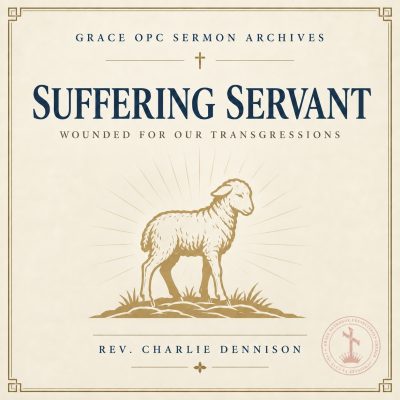
This sermon is from the Rev. Charles G. Dennison sermon archive, part of the “Suffering Servant” series, and was preached at Grace Orthodox Presbyterian Church in Sewickley, PA, during a worship service on Sunday, April 5, 1987.
Tonight we are reading from Revelation chapter 5, and then we’ll be turning to Isaiah 53. in the right hand of him who sat on the throne, a book written inside and on the back, sealed up with seven seals. And I saw a strong angel proclaiming with a loud voice, Who is worthy to open the book and to break its seals? And no one in heaven or on earth or under the earth was able to open the book or to look into it. And I began to weep greatly because no one was found worthy to open the book or to look into it. And one of the elders said to me, stop weeping.
Behold, the lion that is from the tribe of Judah, the root of David, has overcome so as to open the book and its seven seals. And I saw between the throne with the four living creatures and the elder a lamb standing, as it slain, having seven horns and seven eyes, which are the seven spirits of God, sent out into all the earth. And he came and he took it out of the right hand of him who sat on the throne. And when he had taken the book, the four living creatures and the twenty-four elders fell down before the lamb, having each one a harp and golden bowls full of incense, which are the prayers of the saints. And they sang a new song, saying, Worthy art thou to take the book and to break its seals, for thou wast slain, and it is purchased for God with thy blood men from every tribe and tongue and people and nation, and thou hast made them to be a kingdom and priests to our God, and they will reign upon the earth. and I looked and I heard the voice of many angels around the throne and the living creatures and the elders, and the number of them was myriads of myriads and thousands of thousands, saying with a loud voice, worthy is the Lamb that was slain to receive power and riches and wisdom and might and honor and glory and blessing, and every created thing which is in heaven and on earth and under the earth and on the sea, and all things in them I heard saying, To him who sits on the throne and to the Lamb be blessing and honor and glory and dominion forever and ever.
And the four living creatures kept saying, Amen, and the elders fell down and worshiped.”
And then from Isaiah 53, beginning with verse 7, He was oppressed and he was afflicted, yet he did not open his mouth. Like a lamb that is led to slaughter, and like a sheep that is silent before its shearers, so he did not open his mouth. By oppression and judgment he was taken away, and as for his generation, who considered that he was cut off out of the land of the living? for the transgression of my people to whom the stroke was due. His grave was assigned to be with wicked men and with a rich man in his death, although he had done no violence, nor was there any deceit in his mouth.
But the Lord was pleased to crush him, putting him to grief. If he would render himself as a guilt offering, he will see his offspring, he will prolong his days. and the good pleasure of the Lord will prosper in his hand. As a result of the anguish of his soul, he will see it and be satisfied. By his knowledge, the righteous one, my servant, will justify the many, as he will bear their iniquities. Therefore, I will allot him a portion with the great, and he will divide the booty with the strong, because he poured out himself to death and he was numbered with the transgressors, yet he himself bore the sin of many and interceded for the transgressors.
Our God, your word goes forth this day. How many the pulpits, how many the preachers and father that your word would be spoken of aright, and your servants, those whom you’ve called, that they may speak aright. Our prayer is for the truth of the gospel, that it be heard throughout the world. We glory in the fact that your church endures, and that by your power and through the promise of Christ your Son. And Lord, we ask that as it endures, truly it may be fed week by week from the word which you have given. We pray truly that you would raise up laborers for the harvest and that we would see the grand and glorious reaping of the harvest for yourself, for your glory, through Christ. Amen. There are a few things that are as grand. As the description of the Lord on his throne. As you have him portrayed for you. The fourth chapter of Revelation. As you move to that fifth chapter. You are also moved into a circumstance of conflict. or introduced at the opening of that chapter is the scroll, the book written inside and out, and sealed seven times over.
The problem is that there is no one to open the scroll, and possibly you are ahead of me in understanding the significance of that scroll, for you see the scroll is the purpose and the intention, the decree of God. If the scroll remains unopened, the decrees, the plan is without implementation. And therefore, when there is no one to open the scroll, the response of John is utter devastation. the purpose, the plan, the decree of God, his intention with regard to his elect, it will fail. It will not achieve implementation, and therefore John, as he perceives this scene, as he is made one who perceives the realities of heaven, as he is made then a witness of this drama, he is shattered. In the balance is not simply then the plan and purpose of God, but the salvation of the elect.
Where then will that worthy one come from? Who might he be? And as John weeps, there comes the counsel of a heavenly elder who says, stop your weeping now. Behold, the word here is similar to the counsel of another, one earlier, who stood beside the waters in the desert he too said, Behold. The elder in glory in heaven now says as well, Behold.
And he speaks here not of the Lamb, but of the Lion from the tribe of Judah, that root raised up out of David. So John is prepared. He’s prepared for the Lion. the one who will rule, the one who has authority, and the one who has power. He is prepared for that one to slide out into the scene of heaven. But as he looks, in verse six, he sees between the throne and the elders a lamb. This lion is a lamb. a lamb slain as if slain, and yet having all of the appointments of one who has power and authority, seven horns, seven eyes, the seven spirits of God going out from him over all the earth.
Here, then, is the worthy one. who shall break the seals and thus release the decree of God, the plan and purpose of God himself for the accomplishment of that plan to be sure in salvation of his elect. It is certain. As certain as the presence of the land. as certain as the fact that the lamb was slain and that that lamb is resident by the throne and even upon the throne of God.
But what an utterly incongruous image What an utterly incongruous image. The ruler, a lamb. The ruler, a lamb. How inappropriate the figure. For if we were to imagine a leader If we wish to see a lion, then we’ll hold out for the lion. Leadership, rule, authority and power as we understand it. As that after which we have sought, that which we have expected, it comes under the image of lions. It comes hardly under the image and figure of a lamb.
We admire the aggressiveness of a leader. We admire the drive. But when the image of this lamb intrudes, we’re face to face with an image that suggests opposite things. not aggressiveness, not drive, but just the reverse. And rather than an active personality, instead we are face-to-face with one who seems utterly passive.
What an utterly incongruous image. this lion made over in the form of a lamb. We are liable to be offended, offended indeed. We have spoken about the offense that arises out of Isaiah’s considerations in the fifty-third chapter of his prophecy. And truly, as we are face-to-face with this figure out of Revelation 5, similarly, we may be pushed to the point where we are offended as well.
Hardly a leader. Miss Lamb, passivity, that underscored but even more than the fact that he if that were not offense enough we are told that this lamb stands yes we can see in that the power of God to be sure and that subsequent to the fact that he has been slain this lamb has been slain not just passive not just receptive, not just non-aggressive, but this one has given himself over to death. What kind of leader is this? Are not the leaders of the world more interested in saving their lives than losing them? preserving their place in this world, not giving it up, holding on, not surrendering.
But here is the Lion of Judah. And what confusion he showers upon this age. Yet, how appropriate the image, despite its incongruity. How wonderfully appropriate. Thinking back, our minds flying, we take up the figure of the lamb, that lamb that was introduced into the history of God’s redemptive purposes. We spoke of it this morning out of Genesis twenty-two. Isaac prepared for sacrifice, the knife lifted, the voice out of heaven staying the hand.
Then the provision for the lamb caught in the thicket, the substitute, the lamb’s life for the child. We read later on, as God constitutes for himself a nation in Exodus chapter twelve, that on the eve before the departure of the children of Israel from Egypt, there in Egypt, the lamb is slain. The Passover lamb the lamb, once again a substitute for Israel’s firstborn, the blood of the lamb smeared upon the doorposts and the lentils of the houses of Israel, as the angel of death makes his way through the land, dishing out terror. And also, the sacrificial system of Israel and how that sacrificial system was punctuated with the offering of lambs, not just at the feasts, but every day, morning and evening, a lamb was offered as a whole burnt offering before the Lord. Once more, underscoring the substitutionary character of God’s provision for the people But there’s more to the image than just the substitute.
For you see, the Lamb comes as one innocent. The Lamb comes as one unblemished pure. The Lamb is given as full burnt offering, as I’ve already said. And this underscores the fact that in the offering of the Lamb, there is the symbol for a whole commitment. a whole commitment on to the Lord, nothing held back at all. And beyond the innocency and the totality that is symbolized in this lamb, there is the demeanor of meekness and loneliness associated with this beast.
How appropriate the image when we weave together the considerations that come to us out of the history of salvation. In the Lamb, then, the Lord finds an appropriate image. And in his role as the Lamb, the Lord Jesus Christ chooses to portray himself as passive and gives himself over unto death a sacrifice for sin, yours and mine. Well, the appropriateness of the image of the Lamb But how appropriate is the choice of that image in relationship to lordship?
For you see, the elder tells John to expect the lion. And there appears the lamb. And it says, if now the image of the lion The image of that which is symbolic of power, authority, might and strength is overlaid with the figure of the Lamb. This image then of the Lamb ironically becomes expressive of the Lordship which Christ has.
Precisely, precisely in the fact that he is the Lamb, we begin to perceive the power and the sweep, the intensity and the depth of his Lordship. For you see, this Lord chooses, chooses the image of the Lamb. He chooses the image of the Lamb, and that as an expression of His sovereignty. So that, that He is a Lamb, educates us in His Lordship.
It is precisely in his act of giving himself over to death for sin that the character of his lordship is now underscored. For you see, it’s as if worlds are being set over against one another. In this world, lands don’t rule. But the vision that is given of John is of glory, and in glory, lambs rule.
The Lamb of God rules in the world to come, and that is the power, the force, the strength, the might of this use of the image of the Lamb as now it pertains to Lordship and begins to interpret Lordship for us. In the world, he didn’t appear to have any power at all. In the world, he appeared as nothing. In the world, he appears as one that people reject, abuse, scorn, ridicule. He’s one who before his tormentors remain silent, he doesn’t lift his hand against them, he doesn’t break the bruised reading, and he doesn’t extinguish the smoking brand.
It seems in this world, in this age, hardly a law But in the age to come, it is the Lamb, the Lamb who is the Lord. And understand the choices then made by this One who is the Lamb. For in deference to this world’s riches and its prosperity, He makes choices now by which He forsakes them.
In the name of a greater prosperity, in the name of things that endure forever, that last eternally. And that’s the significance, you see, of the sweep of that conclusion to Isaiah 53. If you look at it, verses seven through nine and then ten through twelve, you balance out those passages, you understand that the choices here being made by the servant of the Lord, this one who is the Lamb, is over against the prosperity and the wealth which this world offers in the name of something else altogether. All of this as an exposition of what you find in verse 13 of chapter 52.
Behold my servant, my servant will prosper. What will be his prosperity? Prosperity in this earth? No, he dies. He dies in this world. In this world he is numbered with the wicked in his death. and with the rich as well. So, verses 10 through 12 begin the exposition of the prosperity of the land. Surely the Lord was pleased to crush him, put him to He renders himself a guilt offering there, a reference to his sacrificial character, Dan the Lamb, as it were, taking center stage. But having done that, he will see his offspring. How many children has Christ? How large is house? How many mansions perpendicular? Is there enough room for. He will prolong the day. How do you prolong the days of one. Unless they are prolonged beyond.
To see that for which you live. Not for the things that are temporary and seen here, but those things that are not seen, which only He can give you, the Lamb, who is the Lord. And how it runs on, the good pleasure of the Lord will prosper in you. Would you seek the benediction of God? Where else might you find it? in the one who lives forever, to distribute it to his people. As a result of the anguish of his soul, the Lord will see it, he will be satisfied by his knowledge, the righteous one, my servant, will vindicate, justify, declare righteous. Just so you can tell others in this world you’re right, and not wrong, something far grander, before the throne of God, you declared righteous, just, for the sake of the Lamb who died.
He bears the iniquities of his people. I’ve given him a portion with the great. He’ll divide all the booty, all of the spoil with the strong. He is the one who has triumphed, the Lamb. Ironically, numbered with the transgressors. but in numbering himself with the transgressors, he proves his might. This lamb proved the lion the Lord.
He bears the sins of many, and now he lives to make intercession for such as ourselves. Does a dead man intercede for anyone? No. The prosperity in view in 10 through 12 of Isaiah 53 is an eternal. One beyond this world. So now. Understand the mystery. Of the lion who is the land. What power. power seemingly fit for this world to make us kings here so that we construct? No. Not at all.
This lamb has gone before us. and he becomes our teacher and instructor concerning the true nature of the kingdom and prosperity, true prosperity that lasts forever, beyond death. What way for us, Lord, to our home above, but through the cross of Christ, that Lamb, that Lamb who took away the sin of the world? At what root for us except that root established by the Lord, who is the Lamb? by who has power to preserve us and to grant to us the realities of an eternal prosperity. Though we are counted as sheep for the slaughter all the day long, though our lot in this world may be the worst, may even follow literally the path of our Savior, may we be assured that in all these things we are more than conquerors, through Him who loved us, and that there is nothing in all creation, high or low, visible or invisible, that is able to separate us from the love of God, which is in Christ Jesus our Lord.
The sermon text provided above is derived from the sermon audio recording making use of generative tools. It has not been manually edited. While transcription tools have a high degree of accuracy, the output may include generative textual, punctuation, and/or formatting errors.