The sermon text provided below is derived from the sermon audio recording making use of generative tools. It has not been manually edited. While transcription tools have a high degree of accuracy, the output may include generative textual, punctuation, and/or formatting errors.
Reading of God’s Word. My sermon text this morning is Ephesians 2:11–22, though I will be focusing especially on verse 19. I will begin reading at verse 4 to provide context. So, Ephesians chapter two, beginning at verse 4. You will find the sermon text on page 1,160 in your Pew Bibles. Dear friends, this is the inerrant word of God. Hear it with reverence and awe.
But God, being rich in mercy, because of the great love with which he loved us, even when we were dead in our trespasses, made us alive together with Christ, by grace you have been saved, and raised us up with him, and seated us with him in the heavenly places in Christ Jesus, so that in the coming ages he might show the immeasurable riches of his grace and kindness toward us in Christ Jesus.
For by grace you have been saved through faith. And this is not your own doing; it is the gift of God, not a result of works, so that no one may boast. For we are his workmanship, created in Christ Jesus for good works, which God prepared beforehand that we should walk in them.
Therefore, remember that at one time you Gentiles in the flesh, called the uncircumcision by what is called the circumcision, which is made in the flesh by hands, were separated from Christ, alienated from the commonwealth of Israel, and strangers to the covenants of promise, having no hope and without God in the world. But now in Christ Jesus, you who once were far off have been brought near by the blood of Christ. For he himself is our peace, who has made us both one and has broken down in his flesh the dividing wall of hostility by abolishing the law of commandments expressed in ordinances, that he might create in himself one new man in place of the two, so making peace, and might reconcile us both to God in one body through the cross, thereby killing the hostility. And he came and preached peace to you who were far off, and peace to those who were near. For through him we both have access in one Spirit to the Father. So then you are no longer strangers and aliens, but you are fellow citizens with the saints and members of the household of God, built on the foundation of the apostles and prophets, Christ Jesus himself being the cornerstone, in whom the whole structure, being joined together, grows into a holy temple in the Lord. In him you also are being built together into a dwelling place for God by the Spirit.
Dear friends, the grass withers and the flower fades, but the word of our God endures forever. Let us pray for the Lord to bless the preaching of His word. Our Lord and Father in heaven, we are so thankful that You have not left us in this world without a clear word. We thank You that You have given us Your word. We thank You that it is indeed a lamp unto our feet, a light unto our path, and a guide to our way. We ask, Heavenly Father, that as we consider this portion of Your word this morning, Your Holy Spirit would illuminate Your word to our hearts and souls. We pray that Your word would find a dwelling place in our hearts, and we pray, Lord, that You would set a guard over my lips, that I might speak only that which is faithful to Your word, edifying to Your people, and glorifying to Your holy name. We ask, Lord Jesus, to be present by Your Spirit in the proclamation of Your word this day.
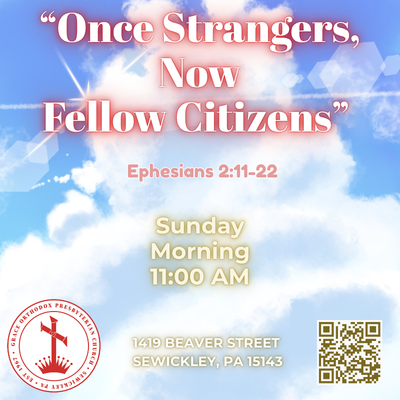
In Jesus’ name we pray, and all of God’s people said. Amen. You may be seated. The title of my sermon this morning is Once Strangers, Now Fellow Citizens, and I would like to encourage the children to listen for four key words. These words are citizens, kingdom, household, and temple. Citizens, kingdom, household, and temple.
Do I really belong? Have you ever found yourself in a situation where you have asked yourself that question? I mean, do I really belong here? Dear ones, one of our greatest needs as human beings is the need to feel that we belong to something greater than ourselves. We all have a natural, God-implanted need to feel connected to one another in community and connected to a reality that transcends our own isolated individual lives. We all long to be part of a story, with a capital S, that transcends our own personal story, with a lowercase s. Now, of course, things such as institutions and organizations, such as community groups, clubs, sports teams, political parties, and yes, of course, families, meet this need in different ways and to different degrees.
However, friends, as followers of our Lord Jesus Christ, we should realize that we, brothers and sisters, are privileged to belong to a reality that is far greater and far more lasting than all of these temporal, common grace, earthly realities. By the sovereign saving grace of God, we are citizens of God’s kingdom. We are members of God’s household.
Through Jesus Christ, we belong to God in a unique way, in a way that the unbelieving world does not belong to God. We are connected in the ultimate sense. We belong to our faithful Savior, Jesus Christ. And in belonging to Him, we belong to His universal church, His Catholic church, in the good sense of that term, His universal church. And the Holy Spirit dwells in us and among us. What a tremendous privilege. Dear ones, nothing less than this spiritual reality of our union with Christ and with the body of Christ can fully satisfy this human craving to belong and to be connected with others in some higher purpose. Through faith in the gospel, we are connected. In Christ, we belong.
Our passage for this Lord’s Day morning underscores and explains all of this by stressing the fact that we who are believers in Christ are fellow citizens with the saints and members of the household of God, as we are told in verse 19. It is to this powerful and instructive passage of God’s word that I would now like to direct our attention. And it is important to understand the context of this passage. You see, Paul is addressing a group of mostly Gentile believers in Ephesus.
And before they had been converted to Christ, the Ephesian Christians to whom Paul wrote had not belonged to God’s covenant people. In fact, the opposite. They were outsiders. They did not belong. They had been pagan, idol-worshipping Gentiles, living outside of the commonwealth of Israel and strangers to God’s covenants of promise, living in this world without hope and without God.
Notice how Paul describes and reminds them of their condition prior to the coming of Christ as Gentiles, prior to their own personal coming to Christ in their conversion. He has already spoken of the fact that we are saved by the grace of God in terms of our individual salvation. He says, therefore, remember that at one time you Gentiles as a whole, you Gentiles in the flesh, were called the uncircumcision by those who are called the circumcision, which is made in the flesh by hands. Remember that you were at that time separated from Christ, alienated from the commonwealth of Israel, and strangers to the covenants of promise, having no hope and without God in the world. What is the condition of those who have never heard the gospel?
Do they have hope of coming to God through general revelation? No, they do not. The Bible makes it clear that God’s revelation in creation and in conscience is sufficient to remove our excuses. It leaves us without excuse, but it does not reveal the way of salvation.
And there can be no greater, no worse condition than the condition of being an outsider, having no hope and without God in this world. That was the reality for these Ephesians before they heard the glad tidings of great joy. In terms of their covenantal status, they, along with the rest of the unbelieving Gentile world, were outsiders to God’s covenant community, God’s household, and more significantly, outsiders to the grace of salvation. They had lived their lives separated from Christ and from God’s covenant people.
But then in verse 13, Paul proclaims, we read these wonderful words: “But now, but now, something has changed. But now, in this moment of redemptive history, after the incarnation and advent of God’s Son, the Lord Jesus Christ, and after the ushering in of the New Covenant era, now that they had heard this gospel and, by sovereign grace, had come to trust in Christ as their Savior, now, as verse 19 says, they are no longer strangers and aliens. But they are fellow citizens with the saints and members of the household of God. Now they belonged. And dear ones, what was true then for these first-century believers in Ephesus is true for us today, if we have trusted in Christ as our Lord and Savior. So let us consider what our privileges and our identity are as those who are now in Christ. As we turn our attention in particular to verse 19, we learn first of all, beloved, that we are citizens of God’s kingdom. We are citizens of God’s kingdom. Verse 19.
So then, you are no longer strangers and aliens, but you are fellow citizens with the saints and members of the household of God. Citizenship can involve many privileges, especially citizenship in a free and sovereign nation. That citizenship implies certain rights and certain privileges, as well as certain duties and responsibilities. But God’s word indicates that while we are citizens of an earthly, temporal, civil reality, our ultimate citizenship is in heaven. As Paul writes elsewhere in Philippians 3:20–21, “But our citizenship is in heaven, and from it we await a Savior, the Lord Jesus Christ, who will transform our lowly body to be like his glorious body by the power that enables him even to subject all things to himself.” In other words, beloved, in this life, we are dual citizens. With a citizenship in the earthly civil realm, yes, but ultimately, beloved, with an eternal citizenship in the heavenly realm.
In our passage for today, Paul reminds his Gentile readers that they share equal heavenly citizenship and standing with their believing Jewish brothers and sisters in the kingdom of God. What does this mean for the church today? What can the church today learn from this passage? Beloved, this means that we—each of us, regardless of our background, whether we come from a church or non-church upbringing, whether we are of Jewish or Gentile ethnic origin—are no longer outsiders or temporary residents. In Christ, we are full citizens who enjoy all the privileges of God’s kingdom. This is emphasized by the two words Paul uses to describe their condition before their conversion to Christ. He says in verse 19, you are no longer what? Strangers and aliens. Strangers and aliens. Let us focus on these two words for a moment. We know that immigration is a significant issue today. What does Paul mean when he refers to strangers and aliens? In Paul’s time, to be a stranger meant to be a complete foreigner, entirely without the rights and privileges of citizenship. On the other hand, in that ancient context, an alien was a non-citizen who lived in a city and thus was granted certain customary rights as a resident, but still did not have the full rights and privileges of citizenship in that city.
And this kind of depiction is a true representation of the Gentile condition before the coming of Christ. You see, before the coming of Christ, Gentiles on the whole were excluded from full citizenship in God’s visible covenant community. Unless, of course, they converted and came to faith in the true God, the God of Israel, and became circumcised, becoming full members of the Israelite theocracy. But they were not fully included until they were fully initiated into the theocratic community. Likewise, before Paul’s Gentile readers came to faith in Christ, they were strangers and aliens in a spiritual sense, for they were unsaved, and therefore separated from the privileges of belonging to God’s people, God’s kingdom. And what was true for them was also true for us before Christ graciously saved us.
Some of you I know were raised in the church and you can never remember a time when you did not know and love and trust and serve the Lord Jesus Christ, where you were not repentant for your sin and trusting in Christ as your Savior. But some of you, I know, can remember a time before you came to Christ. Maybe you were raised in a non-Christian family. You can remember a definite before and after, a definite B.C. and A.D. in your own personal spiritual journey. Now that you are in Christ, you are no longer a stranger. You are no longer an outsider. You belong to God’s people, God’s kingdom.
And that is a privilege. Now Paul focuses on some of these privileges of citizenship in God’s kingdom. What are those privileges? We could spend a lot of time talking about the privileges of belonging to God’s kingdom. There are many passages in Scripture that we could turn to, but let’s focus on two privileges in particular that Paul emphasizes in our passage for today. The first privilege that he mentions is access or introduction in Christ to the very throne room presence of God.
Look at verse 18. He says in verse 18, “For through him, that is through Christ, Christ being the mediator between God and man, through him, we both—Jew and Gentile who believe in Jesus—through him, through Christ, we both have what? We both have access in one Spirit to the Father.” Every word in this verse is rich with meaning and significance. Notice, by the way, the Trinitarian nature of this passage. Paul’s writings are saturated with a Trinitarian consciousness, and we see this clearly in verse 18. Through Christ, we both have access in one Spirit to the Father.
Access to what? We have access to the very presence of God. The word “access” here in the Greek is the same word found in Romans 5. Let us turn to Romans 5 and look at verses 1 and 2, which also address this matter. Paul, having explained the universality of human sin and the wonderful doctrine of justification by grace through faith apart from works, says this in Chapter 5, verses 1 and 2: “Therefore, since we have been justified by faith, we have peace with God through our Lord Jesus Christ. Praise God. God is no longer our enemy. He no longer regards us as His enemies. We are no longer under His wrath. We are objectively in a state of peace with God, through our Lord Jesus Christ.”
Then verse 2: “Through Him we have also obtained what? We have obtained access by faith into the grace in which we stand, and we rejoice in hope of the glory of God.” We have access and a standing in grace. And this access, I would contend, ultimately points to access to the throne room presence of God. We do not see this with the eyes of flesh, but it is a reality, brothers and sisters. In fact, what we are doing this morning is we are gathered together as God’s covenant community in the name of Christ. We are gathered to worship our great and sovereign and triune God.
Christ is present by His Spirit. Angels are present. If the Lord would remove our blindness and grant us spiritual sight, we would see this room filled with supernatural realities, because we have access through Christ to the throne of grace.
In Christ, both Jews and Gentiles fully and equally enjoy peace with God and thus have equal access to God’s presence and grace. This was an astounding revelation in the first century among God’s people. It is a central theme in this section of Ephesians. The unity of Jew and Gentile in the one body of Christ is a central and driving theme in this passage.
Therefore, brothers and sisters, we have access, an introduction in Christ, to the presence of God. The veil has been torn in two from top to bottom. The way into the heavenly holy of holies has been opened to us, and we enter by grace through faith. We commune with our Father in prayer.
What a tremendous privilege this is. Paul also speaks of the privilege of peace and reconciliation with God and with fellow believers. He emphasizes this, especially earlier in this passage in verses 14 through 17. There is much here, and we do not have time to explore all the details of this passage, but let me read these verses again.
Speaking of Christ, Paul writes, “For he himself is our peace, our peace. Through Christ, we are at peace with God, but we are unable to be at peace with one another as brothers and sisters in Christ.” He is speaking here of peace between believing Jews and believing Gentiles who share faith in Jesus, forming one body in Christ. “For he himself is our peace, who has made us both one and has broken down in his flesh—the wall of hostility—by abolishing the law of commandments expressed in ordinances, that he might create in himself one new man in place of the two, thus making peace, and might reconcile us both to God in one body through the cross, thereby killing the hostility.”
Notice that Christ’s saving work tears down what Paul calls the dividing wall of hostility between believing Jews and believing Gentiles. He accomplishes this through his work on the cross. He brings together into one body people from all kinds of different backgrounds.
Many scholars believe that this reference to the dividing wall of hostility refers to the wall that separated the court of the Gentiles in the Jerusalem temple from the inner parts of the temple. If you were a Gentile in the first century and wished to worship at the Jerusalem temple, you were limited to the court of the Gentiles. There were warnings posted on that wall stating that if a Gentile entered beyond this point into the area reserved for Jews or Jewish priests, he would be responsible for his own death. The warning essentially said, “You have only yourself to blame if you lose your life.”
This division between Jew and Gentile was a reality in the ancient world. There was great hostility between Jews and Gentiles. This separation was enforced by the ceremonial law of the Old Covenant. The ceremonial law served to keep Jews and Gentiles apart in many ways.
That law, of course, pointed forward to Christ, and Christ has abolished that law. Even as he has fulfilled the moral law, he has rendered preceptive and penal obedience to the law on our behalf, so he has also fulfilled the ceremonial law. Therefore, by his cross work, he has torn down the dividing wall of hostility between Jew and Gentile. Now, there are many implications that we can draw from these truths, from this passage, but let me mention just a few applications from this text.
First of all, beloved, we learn here that under the new covenant, the visible Church of God is no longer a national theocratic entity as it was under the old covenant. Instead, now the Church of God is an international body. It is an international, universal Catholic reality. We confessed in the Nicene Creed earlier in the service, “I believe in one holy Catholic Church.” We are not referring to the Roman Catholic Church. We are referring to the spiritual unity of all true believers in Christ, the spiritual unity of all the elect throughout the world, from every part of the world, across all ages of human history. This is the kingdom of God. This is the body of Christ.
It is an international reality. And I believe this is especially significant today, when we hear so much about so-called Christian nationalism. Friends, do not worry. I will not enter into politics. We will not discuss the details of this particular issue. I understand that there are different definitions of what this term means, and various nuances are offered. But if someone were to ask me, Pastor Jeff, are you a Christian nationalist? I would answer by saying, actually, I am a Christian internationalist. I am a Christian internationalist because the gospel of Jesus Christ is for all the nations.
Christ redeemed people from every tribe, tongue, people, and nation. In Matthew 28, in the Great Commission, what did Jesus say? He said, go and make disciples of whom? The United States of America? Go and make disciples of all the nations. I am reminded of the scene of heavenly worship recorded in Revelation 5, where the elders and the living creatures praise the Lamb of God. And it says in Revelation 5, verses 9 and 10, and they sang a new song, saying, “Worthy are you, they are praising Jesus, worthy are you to take the scroll and to open its seals, for you were slain, and by your blood you ransomed people for God from every tribe and language and people and nation. And you have made them a kingdom and priests to our God, and they shall reign on the earth.” Christ has redeemed people from every tribe and tongue and people and nation.
Whatever you think about the issue of Christian nationalism, in the church, our primary focus should be on Christian internationalism—spreading the gospel to all nations and all people groups throughout the world. This passage, and also many others like it, makes it clear that there is only one people of God.
Passages like this one clearly refute the serious error of dispensational theology, a theology that many of you know is so pervasive in contemporary evangelicalism. I know many of our esteemed guests today are familiar with dispensationalism and its errors, but some of you here today may be wondering, what is that? What is dispensationalism? In brief, dispensational theology essentially teaches that God has two peoples.
He has an earthly people to whom He has given temporal earthly promises, namely the Jews, and then He has His spiritual people, the church, those who trust Christ as their Savior. But passages like this clearly refute that kind of distorted theology and that distorted approach to biblical interpretation. There are many other passages as well, but notice the emphasis that Paul makes in this passage.
There is one body. There is one body of Christ. Jews and Gentiles who believe in Jesus are full and equal members of that one body. There is one trunk. We as Gentiles were grafted into this one covenantal trunk, but if there is only one trunk and we are part of that, then we are united in Christ.
Another lesson, I think, that we can learn from this passage is that Jewish and Gentile Christians are united in one body. That is, again, very closely connected.
Therefore, I would suggest to you, beloved, that any denomination or any worshiping community that is intentionally structured to exclude one or the other group, or is designed to minister to only one group, is behaving in a manner that is contrary to the Gospel of Jesus Christ, at least in terms of its practical and communal implications.
I am reminded of what Paul did to the Apostle Peter in Galatians Chapter 2. What was Peter doing that was so rebuke-worthy? As many of you know, Peter had withdrawn from table fellowship with Gentiles and was eating only with his Jewish brethren. And Paul publicly upbraided him and rebuked him for that.
You may ask, how does this kind of error show up today? Just to give a few examples, I think of Messianic Judaism. Now, it is a wonderful thing, is it not, brothers and sisters, when a Jewish person hears the gospel and comes to believe that Jesus of Nazareth is the promised Messiah and comes to embrace the Lord Jesus as their very own Messiah, Savior, and Lord. That is a wonderful thing.
But then, for Jewish converts to separate themselves from their Gentile brothers and sisters and worship in communities centered on Judaism rather than on the unity we have in Christ would be an example of illegitimately dividing. Let Jewish converts come and join their Gentile brothers and sisters in the church, the one body of Christ. We could also consider white-only or black-only churches that exclude people of other races from membership or ministry positions. But we need to be careful, brothers and sisters.
The Lord has redeemed people from every nation, and he intends for us to worship together as one body. The worship of heaven will be an international celebration of the glory and grace of God. So we are citizens of God’s kingdom, and next, very briefly, we are God’s household and are growing into a holy temple in the Lord. We are God’s household and are growing into a holy temple in the Lord. We read in verses 19 through 22: Paul writes, “So then you are no longer strangers and aliens, but you are fellow citizens with the saints and members of the household of God, built on the foundation of the apostles and prophets, Christ Jesus himself being the cornerstone. In him the whole structure, being joined together, grows into a holy temple in the Lord. In him you also are being built together into a dwelling place for God by the Spirit.” Again, this passage is so rich we could spend many weeks unpacking all of it, but let me just give you a brief overview.
Let us first focus on the fact that we have been built on the foundation of the apostles and prophets, Jesus Christ himself being the cornerstone. What does Paul mean by the term “foundation”? Is he referring to the persons of the apostles and prophets, or to particular church officers? No. As John Calvin observes, in this passage the term “foundation” undoubtedly refers to doctrine. No mention is made of patriarchs or pious kings, but only of those who held the office of teachers, whom God had appointed to oversee the building up of his church. One important point, brothers and sisters, is that Paul says the church is built on the foundation of the apostles, meaning the apostolic teaching, and the prophets. This could refer to Christian prophets—those inspired to write the scriptures, though not apostles—or it could refer to the Old Testament prophets. There is debate about the exact meaning, but the key point is that the church is built on the apostles, in the plural, and on the prophets. There is no suggestion, nor is it even within Paul’s consideration, that Peter was the first pope of the early church. This idea is entirely foreign to the apostolic way of thinking.
Yes, Peter was the rock. Christ says, “I will build my church.” I believe this refers to Peter’s confession of Christ as the Son of God and Savior. Of course, Peter was the first to preach the gospel on the day of Pentecost. That initial gathering on the day of Pentecost was foundational to the new covenant expression of the church. Nevertheless, the church is built on the teaching of the apostles and on the prophets. And Christ is the cornerstone of the church.
Now, what is the significance of the term cornerstone? William Hendrickson explains it as follows. He says, the cornerstone of a building, in addition to being part of the foundation and therefore supporting the superstructure, determines the alignment of the walls at the corner formed by the junction of two primary walls. It establishes the position of all other stones in the structure. In the same way, in addition to resting in Christ, the spiritual house is shaped by him. To add Calvin’s comments, he says that Paul means that Jews and Gentiles were originally separate, but are now joined together into one spiritual building. Christ is placed at the center of this corner to unite both groups, and this is the meaning of the metaphor. A few takeaways from this. Christ is the cornerstone; the apostles and prophets are the foundation. What do we learn from this? Let us consider some of the implications of Christ as the cornerstone. Here I will present points of application.
First of all, friends, Christ as the cornerstone is the foundation of the church’s stability. In this unstable age in which we live, how does the church remain stable? The church is stable only when it builds its life, doctrine, worship, and governance upon the Lord Jesus Christ and upon God’s inspired, inerrant, infallible, and authoritative Word. Thus, Christ as the cornerstone is the foundation of the church’s stability. Christ as the cornerstone is also the foundation of the church’s direction.
Our Lord directs His church by His Word and Holy Spirit, not by mere human tradition or experience, and especially not by the ever-changing trends of our culture. Christ is also revealed as the principle of the church’s growth. As we are told in verse 21, in whom the whole structure, being joined together, grows into what? This is biblical church growth. What does the church grow into? A holy temple in the Lord. Godly biblical church growth will only come about as the gospel is faithfully preached and as we live lives of faithful discipleship and grateful obedience.
Let me ask you, dear friend, is Christ the source of stability, direction, and growth in your life? Is He your Savior? Have you trusted Him as your Savior from sin, repenting of sin and fleeing to Christ as your only hope of salvation? Receive and rest upon Christ as He is offered to you in the gospel. And the Word of God says that you will be saved. But what about us as a church? Is Christ the source of our stability, direction, and growth as the church?
May God, in His grace, cause us to reflect seriously on this question and to always return to Christ and to the Word. Friends, we are a living temple of God, who dwells among us by the Spirit, as we are told in verse 22. In Him, you also are being built together into a dwelling place for God by the Spirit. What a tremendous privilege. In Old Testament times, God’s special presence dwelt in the temple and earlier in the tabernacle. But the temple and tabernacle pointed forward to Christ, the incarnate Lord. Christ is now the living temple, the divine incarnate Son of God, in whom the Holy Spirit dwells above measure, and together we are a living temple in union with Him.
This passage is very similar to what we read earlier in the service from 1 Peter 2, where Peter writes, “As you come to him, a living stone rejected by men, but in the sight of God chosen and precious, you yourselves, like living stones, are being built up as a spiritual house to be a holy priesthood.”
To do what? To offer spiritual sacrifices acceptable to God through Jesus Christ. And then it goes on to say, “But you are a chosen race, a royal priesthood, a holy nation, a people for his own possession, that you may proclaim the excellencies of him who called you out of darkness into his marvelous light.” Once you were not a people, once you were strangers and aliens, but now you are God’s people. Once you had not received mercy, but now you have received mercy.
Brothers and sisters in Christ, the Spirit of God dwells in us both individually as believers and corporately as a church. We are citizens of God’s kingdom, members of Christ’s body. We are a fellowship of the Holy Spirit. We belong to our triune God and we belong to one another in the eternal family of God. Let us live according to our Trinitarian identity as God’s covenant people. And let us do our part in gratefully sharing the good news of the gospel, so that those who are far away may be brought near and freed from their idols, and may come to know the grace of the true and living God that is offered to them in the gospel of Jesus Christ. And all of God’s people said, amen.
Let’s pray. Oh, Heavenly Father, what great and glorious privileges you have granted to us in Christ and by your Spirit. Lord, you have called us as living stones, united with Christ, the living cornerstone, to be a dwelling place for you, O God, by your Spirit, to offer you spiritual sacrifices of praise, worship, and obedience. Lord, we ask that the truths we have considered today would once again transform us, take root in our souls, and by your Spirit, work out the implications of these truths in our lives and in our churches. We pray all these things, Heavenly Father, in the glorious, majestic, and mighty name of Christ our Lord. And all of God’s people said, amen. Let’s respond to what we have heard by rising and singing, as our closing hymn, number 418, “Arise, O God.”