
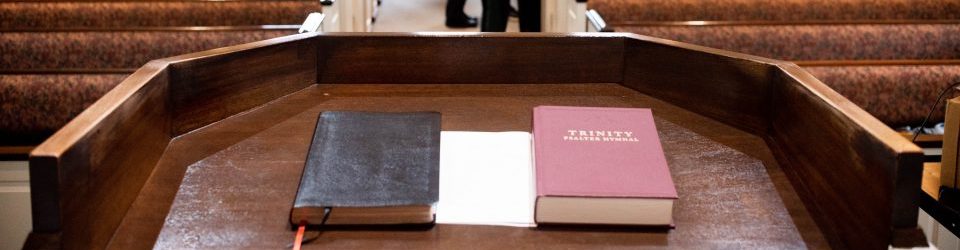

This recording is from the Rev. Charles G. Dennison archive, part of the “Christmas” series, delivered December 24, 1991.
So, that is Gospel, the first chapter. And we begin our reading in verse 16. After Jacob was born Joseph, the husband of Mary, by whom was born Jesus, who is called Christ. Therefore, all the generations from Abraham to David are fourteen generations, from David to the deportation to Babylon, fourteen generations, and from the deportation to Babylon to the time of Christ, fourteen generations. Now the birth of Jesus Christ was as follows.
When his mother Mary had been betrothed to Joseph, before they came together, she was found to be with child by the Holy Spirit. And Joseph, her husband, being a righteous man and not wanting to disgrace her, desired to put her away secretly. And when he had considered this, behold, an angel of the Lord appeared to him in a dream, saying, Joseph, son of David, do not be afraid to take Mary as your wife, for that which hath been conceived in her is of the Holy Spirit. And she shall bear a son, and you shall call his name Jesus, for it is he who will save his people from their sins. Now all this took place that what was spoken by the Lord through the prophet might be fulfilled, saying before, the virgin shall be with child, shall bear a son, and they shall call his name Emmanuel, which translated means, God did us. And Joseph arose from his sleep. It is the angel of the Lord who handed him and took her as his wife, kept her as a virgin until she gave birth to a son, and called his name Jesus.
I think that you are aware that as the New Testament opens up, it is reflecting upon those things that have gone before. Marvelous times that we see in this revelation as scriptures of the New Testament open up, those ties with the Old Testament scriptures. You might note the first verse in the New Testament, which, in fact, calls attention to these times. The book, the genealogy of Jesus Christ, the son of David, the son of Abraham. It is that last name that interests me this evening, the name of Abraham, and particularly the patriarchal period. But we have a tie between the opening chapters of this New Testament era and that patriarchal period, the time of Abraham, Isaac, and Jacob. One of those ties is obvious to us in the manner in which God reveals himself You will recall that the Lord revealed himself in the patriarchal period through angel visitations, through dreams, through visions. And you will note as well here, as the New Testament opens up, there is an abundance of angel visitations, and abundance of dreams and visions, just as there were in that patriarchal period.
So, how appropriate this is. As the people of God in the Old Testament begin to take shape in that older economy, you have this plethora of divine activity. And that activity is manifest through messengers from heaven, through visions and dreams of God’s peace upon His servants. As it was then, as God’s people were being formed, initially, so also now, as they are being reformed, reconstituted. Once more, a plethora of divine activity number of angels, number of messengers from heaven, and God’s even visions and dreams are His black servants.
There’s another connection between the patriarchal period and the period of nativity, for in both of these periods we meet Fathers and sons bear precisely the same names. In the older revelation, previous revelation, we have a Jacob and, yes, a Joseph. We know about that family. to know about that relationship. Well, here, as we read in the genealogy of Jesus Christ, particularly in Acts 16, there is a Jacob, once more, who begets a son named Joseph. In the older economy, the previous revelation Jacob was that fellow who wanted the birthright so desperately that he would stop at nothing to get it.
In fact, it seems that he inspired in every way to grab hold of the birthright that he wanted. In his efforts to gain it, and before he was finally confirmed in it, he experienced rejection and exile. He was the object of God’s grace in the midst of all this, and he was visited by angels, you will recall, as he made one night a rock, his pillow, and dreamt dreams of angels ascending and descending upon a ladder that reached from the earth into the very heavens and to the throne of God. In all this, that Old Testament Jacob matured. He grew in grace. In time, he fathered twelve sons by his two wives and their maids. One of his sons, as you know, was Joseph, a beloved son Child of his relationship with his favorite wife, Rachel. This child who was born of Jacob was an extraordinary child, a unique child.
In fact, he was a dreamer. You may recall that he was called a dreamer by his brother. Could be that you recall some of the content of the dreams he had. For instance, he dreamt of sheaves, the sheaves of his brother, brothers, bowing down before his sheave, his brothers, as you can well imagine, to the best of his dream. But he also dreamed of the sun, the moon, the loving stars. And all these heavenly bodies bow down before Him. Not only His brothers, but His father recognized the intent of this dream and was offended. When we read the account in Genesis, we are indeed struck by the precociousness of this child chosen.
He comes across as an obnoxious rat demon, one that was guaranteed to get out of the skin of his brothers. So we have his brothers reacting violently in their rage, plotting against him, even conspiring to murder. The brothers are unattractive. Joseph himself is unattractive. Many features of Father Jacob are unattractive. But despite the unattractiveness of all these parties, God is graciously willing to work His saving purpose in them and through them. His work in them is sobering in itself. Think of Joseph and what he undergoes. He is humbled by the assault perpetrated against him by his brothers.
He is strengthened by way of the abuse and the injustice, even the imprisonment, that he suffers. But as if that were not enough, even when he is finally exalted to the position of ruler over Egypt and a savior of his father’s household, his father’s household languishing because of the famine, Joseph faces an even further tumult. For while he is exalted as ruler and even ruler over his brothers and his father, he is not that ruler that had been promised and was envisioned. And while he was a savior for his family, delivering them from the devastations of famine, he is not the savior that is promised. This becomes clear in the closing days of Jacob’s life. When he faces death, he convenes his family, his sons gather around him for final blessing.
But the ultimate blessing does not rest on Joseph, where his wife had inspected him. It doesn’t rest on any of his family. It doesn’t rest upon even the master’s sons. In fact, it doesn’t rest upon Jacob’s favorites, be it Joseph or Benjamin, the lines that proceed from them. Instead, the blessing rests upon one of Leah’s sons. The fourth son, the last son of her first cycle of marriage, the blessing rests on Judah.
To Judah, Jacob says, your brothers shall praise you. Your hair shall be on the neck of your enemies. And almost as if he were parodying the dreams of Joseph, he says, your father’s sons shall bow down to you. the scepter shall not depart from Judah, nor the ruler’s staff from between his feet.” So on the road to maturity, there is this humbling at the end which Joseph has to undergo. In the end, Joseph gives way to Jude. Now, as the New Testament opens, and we find once more an explosion of revelation in angel-residents and visions and dreams, We have this other father-son presented to us, this other Jacob and Joseph set before us, poised within the very line of which Jacob spoke, to which Joseph had to give way.
You must remember, this is a tribe of kings. to whom a throne was promised. This plan of Judah has been humbled by some 600 years of tragedy. For it is about that long since any descendant of Judah, any child of David’s line, has sat upon Israel’s throne. If Pope burns for Judah’s line, surely such Pope envisions the restoration of the righter place that belongs to Judah, inherently, the right of place than is what is expected from these who are within the life of Judah. Here is what is claimed properly. Here is what might be boasted in rightly. namely the supremacy that belongs to us since we are of the tribe of Judah.
Yet even this is now tempered by the manner of the child’s appearance. The hope for restoration of rightful place the hope with regard to the claims now fulfilled and enacted, the propriety of the ghost that rises out of Judah’s mind, yet now when the child comes, when the king appears, the manner in which that child appears will temper the attitude and the disposition of Judah’s mind.
No male, no male of Judah’s line will generate a child. The child is miraculously generated within the Virgin Mary, Joseph’s betrothed. There will not even be a host for Judah in the generation of the child. If the Old Testament Joseph must give way to Judah, there is a sense in which the New Testament Joseph must give way too. Whatever post Judah may lay claim to in Joseph is now manicured, chained, limited, bounded by the urgently conceived child. The Old Testament Joseph was humbled by his father’s prophecy. The New Testament Joseph is humbled by the fulfillment of that prophecy by his father in fact. But is Joseph, this son of Judah, coming?
Or is it clear to us that he never was a holy man? Here he is. From that he is telling of the story, Joseph, this son of Judah, is completely without pretense. completely devoid of the main ambition. He is free of the improprieties of improper lusts that we generate in him. Ambitions and hopes and desires that are completely outside come to him.
From Matthew’s telling, Joseph is coming. The Old Testament Jacob may have been a flim flamma. He may have been a huster and a trister from the word go. The Old Testament Joseph may have been an obnoxious brat, but none of this is found in the New Testament Joseph. He appears instead as a willing servant, free of vanity, free of selfish ambition.
Matthew calls him a righteous man. and how that righteousness of this man is proved. It is proved by the fact that this man rumored, not only does not, but rumored in truth on Jesus. This man receives before the figure of Jesus. Jesus is there, Joseph is not, except what he is in relationship to his Father.
Have you ever puzzled over the disappearance of Joseph from the New Testament narrative? Why have things said about him later? Many have conjectured that Joseph died and wasn’t around. This accounts for his disappearance from the stories that follow. Joseph is unobtrusive. He is delivered unobtrusive. He is eclipsed by Christ, who now lays claim to all that Judas ordered and promised. Before John the Baptist says it, Joseph lives in me.
He must increase, for I must increase. But you will note in Matthew chapter 1 that Matthew is not calling Joseph a righteous man because of what he will prove to be. Matthew is making comment upon what Joseph is already, and how that is demonstrated by his actions. But you will note that the sort of righteousness that is attached to Joseph in this opening chapter in the New Testament actually belongs to the era, the administration of Christian discipleship. Yes, it’s true.
This is apparent in how he will give way to Christ, the way in which he is going to be eclipsed by Christ. But it is equally evident here in the way he treats Mary. It is not mere humanitarian sentiment that moves Joseph to put Mary away privately. It is not mere humanitarian sentiment that moves Joseph to put Mary away privately, in an effort to spare her her shame.
Rather, it is an intrusion of the grace that is found in the child, It is an intrusion of the grace that is found in Christ Himself. It is an intrusion of the grace that belongs to the New Testament administration as it already full-blown bestowing its benefit upon this man and working in him. The righteousness here that is coming to expression in Joseph belongs to the new administration found only in Jesus Christ and within his kingdom. For how was it, as far as the righteousness is concerned, that comes to us out of the older administration? The older administration said, no, you don’t put him away privately, you execute him. But Joseph is known by the spirit of the Christ. And how marvelous that spirit expresses itself repeatedly, even in the Old Testament administration.
Abraham interceded for the sins of the plain. Judah interceding on behalf of Benjamin. Moses interceding on behalf of the children of Israel who should have been supporting his father. David offering up himself, whom he pledged in confidence, to destroy Jerusalem.
And now, Joseph, offering himself as it were, so as to be in a position of bearing reproach to where the reproach can be borne by the self. He is a superlative of righteousness, and he’s coming to discretion. a grand element of righteousness. It exceeds even the righteousness of the living. The righteousness is found ultimately nowhere else on the cross. So Joseph, The New Testament Joseph, remarkable Christian discipleship, no less admirable and as willing obedience than that. A man in whom the grace of the gospel and the grace of Christ work.
One who instructs us in the art of being satisfied with our place in God’s encounter. One who instructs us in checking our ambition and in the inappropriate of lusts that rise so easily against us. One who cultivates within us a sense of importance as we, too, are related to Christ. One who teaches us how this pervading righteousness is found by that magnificent glory in the Christ. Joseph would lead us to be ambassadors for the Christ, who is not only born of Mary, but was crucified for our sins and raised for our justification. Praise God.
O warrior, how magnificent your revelation, how whole and complete. All of the ends by time, all of those things that made their imagining to be loose and stray are gathered and put in place. How the administration of Christ, how the coming of Christ’s child, marvelous ministry and materialism, service to the sake of those in need, His death for sinners, His resurrection for the elect. How all of these things then reign together.
Your purpose may be plain to us, Your intention. from before the foundation of the world. O Lord, what great benefit is ours now, not only to see and appreciate these things, but also to live in the wealth of your kingdom. Blessed be your name. We praise you for this salvation of Jesus Christ. Amen.
The sermon text provided above is derived from the sermon audio recording making use of generative tools. It has not been manually edited. While transcription tools have a high degree of accuracy, the output may include generative textual, punctuation, and/or formatting errors.