
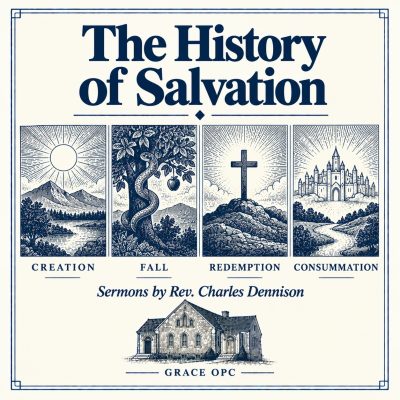
This sermon is from the Rev. Charles G. Dennison sermon archive, part of “The History of Salvation” series, and was preached at Grace Orthodox Presbyterian Church in Sewickley, PA, during a worship service on Sunday, November 11, 1990.
About this sermon
Peter’s faith is heroic before it is mature, still shaped by an earthly, millennial hope rather than true understanding. Jesus corrects it directly at the transfiguration, then turns in chapter 18 to teach the humility that heroic faith still lacks.
Sermon transcript
We will pick up on chapter 17, the opening verses of that chapter. And six days later, Jesus took with him Peter and James and John, his brother, and brought them up to a high mountain by themselves. And he was transfigured before them. And his face shone like the sun, and his garment became as white as light.
And behold, Moses and Elijah appeared to them, talking with them. And Peter answered and said to Jesus, Lord, it is good for us to be here. If you wish, I will make three tabernacles here, one for you and one for Moses and one for Elijah. While he was still speaking, behold, a bright cloud overshadowed them, and behold, a voice out of the cloud, saying, This is my beloved Son, with whom I am well pleased. Hear him.”
And when the disciples heard this, they fell on their faces and were much afraid. And Jesus came to them and touched them and said, Arise, and do not be afraid. And lifting up their eyes, they saw no one except Jesus himself. And then turning to the 18th chapter, the opening verses of that chapter, “…at that time the disciples came to Jesus, saying, Who then is the greatest in the kingdom of heaven? And he called a child to himself, and stood him in their midst, and said, Truly I say to you, unless you are converted and become like children, you shall not enter the kingdom of Whoever then humbles himself as this child, he is the greatest in the kingdom of heaven.
And whoever receives one such child in my name receives me. But whoever causes one of these little ones who believe in me to stumble, it is better for him that a heavy millstone be hung around his neck and that he be drowned in the depths of the sea.
Let’s pray together now. We do call out unto you, our God, for we are zealous for your Church, for the household of faith, and we are zealous for the office of ministry and for the office of the ministry of the Word. And we plead with you, our Father, that in this time You would not leave your people without faithful preachers of the word. And Father, may it be pleasing to you to hear our prayer as we would cry out unto you that your people would not be left destitute. O Lord, we do not ask you for the celebrities, for we have celebrities enough We do not ask you even for the gifted rhetoricians, for we would have them in abundance. We remember Paul, the Apostle, who claimed that he was not gifted in speech, and to many he appeared as offensive. Yet it pleased you to use him powerfully And we would ask Lord for those whom you might use powerfully, powerfully in congregations, in assemblies where your righteous gather so that your people would be fed week by week.
Oh Lord, give your servants good grasp of the things contained in your word. May they have a sense of the movement of the whole as they make their way from Genesis to Revelation. And may they be expert in setting forth the excellencies of Jesus Christ to your people, that your people might always be assured of that gospel truth, namely, salvation is of grace and not of works, lest any man should boast. O Lord, may it also be to the end that they preach for your glory. Lord, glorify yourself in the proclamation of your word, and raise up within us that spirit that would make us anxious to hear the word, so that we would be quick to assemble when your word is to be read and declared. Father, may we be known as a people of your word. We pray these things in Jesus’ name. Amen.
Now, last week we made a great deal out of the miracle of Peter’s confession at Caesarea Philippi, and we have the account of that for us in the sixteenth chapter there in Matthew’s Gospel. Now, I say the miracle, given the background to that confession, the background of that opposition that Jesus faced from many sides, especially from the leaders of the people. A miracle, in fact, against the background of family confusion. And then, as we read of it at the opening of that sixteenth chapter, the background of the disciples’ obtuseness and lack of faith, being an especially block-headed lot they were. So in the midst of that, then, there comes this confession by Peter, and it is nothing but a triumph for faith in the midst of those circumstances. Yes. the disciples’ slow rigidness, the fierce opposition of the Jewish leadership, the instability of the Jewish crowds that gather to hear Jesus, and the confusion and lack of confidence that is evident even in Jesus’ family.
What a miracle it is. This faith, expressed now by Peter, thou art for Christ, the Son of the living God, he says. What but faith? Faith now that comes as miracles. faith that comes by way of revelation from the Father himself, what but faith pierces the walls that bar the sort of zeal that Peter then reflects in his powerful affirmation. Everything is against that affirmation, but yet the affirmation is heard. It is as if Peter were face-to-face with the crushing impact of the impossibility of what he asserted.
How can it be that this one is the Christ? So formidable are the odds, yet this faith catches hold of something. This faith catches hold of something from the words of Christ. It is brought to life by God Himself through His Word and His Spirit, and it is now bold to state the case regardless of the odds. Despite the opposition, Despite all the appearance of things, thou art the Christ, the Son of the living God. Jesus is in retreat, it seems. He’s fleeing Galilee. He’s moved east and north into the territory of Philip. And Peter is bold to stay. Nevertheless, thou art the Christ.
True faith, then, as much as it now appears in this man, Peter, true faith pushes past the predictabilities and the necessities that hem others in. It penetrates the world’s declared impossibilities and confident, rational conclusions. It is not content until it is in the presence of the one who declares, with God, all things are possible. It is one thing for faith to be, shall we say, heroic. It is altogether another thing for faith to be mature. At this point, then, we introduce the but. the acceptive clause. For Peter’s faith, as wonderful as it is, as much as we match it now with revelation from the Father in heaven, as much as it is truly grasped hold of something in those words from Christ, as glorious as it is, his faith is more heroic. than the cure.
We know the overwhelming opposition. We have surveyed the circumstance. We have considered all the obstacles. Yet in this, Peter is not dislodged, he is not wavering. His faith is a gift, just as Jesus says. But there’s a sense to it all that yet this faith is facing but human opposition. and constrictions which this world, this world would place before it. And in facing that human opposition, as magnificent as it is, it remained at this point yet undeveloped and underdeveloped. Immature. It’s a complex matter, this whole issue of faith. Hang with us, then, as we push on.
At this level, Peter’s faith meets the challenge of detractor. such as Jewish leaders, it meets the challenge of ambivalence, the ambivalence of the multitudes. It meets the challenge of that hesitation that is found in the other disciples and the thick-headedness that has most recently been found in them all. But less at this level, risks say, will actually degenerate.
Once at this level, it itself will seemingly be transformed, changed, and it will become a mere confidence in the expansive abilities of human potentiality. the expansive abilities of human potentiality seen in Jesus. What a marvelous figure he is! Why, I can believe in him! What an incredible personality this fellow is! There is a reading of the Messiahship of Jesus Christ that operates nearly on that level. remaining at that level, faith itself becomes a faith in the expansive abilities of human potentiality. Left at this level, then, faith that begins well ends poorly. It becomes a mere heroic optimism. resolute, fierce, determined in all of its assertions against overwhelming odds. But in the end, left at this level, it becomes the substance of that faith professed by motivational engineers. Have you been to an Amway convention? Do you know that Robert Shuler is a regular guest at Amway conventions? He brings motivational messages to all who are assembled. Charles Stanley does the same thing.
Get these boys pumped up! with respect to the realization of your human potentiality, such then being the content of faith. The odds are great against you. Why, you’ve been down and out. You’ve lost a couple of fortunes. Well, don’t give up. Things look bleak But what you need is a good dosage of heroic optimism. Faith will triumph in the end. So you hear the determined, resolute, fierce assertions against overwhelming odds.
Who would have thought? But tragically, And this kind of faith also becomes the substance out of which are spun millennialist dreams and fantasies. Left at this level, such faith then wanders into that realm, constructing for itself optimistic, fantastic dreams for the future. And for none of these, be they Schuller or Stanley or current modern millenarians, from none of them do I hear any denial that Jesus is the Christ. And yet, there is something so sadly, so tragically defective in their faith. In the end, it proves to be immature, if not wrong-headed altogether.
Now there is a tell-tale brand. You know about brands? There is a tell-tale brand for this kind of immature faith, the kind of faith that merely remains at this level, this heroic faith, even this heroic faith. That tell-tale brand is that it thinks in terms of a life preserved and maintained here.
Isn’t that how it is for heroes anyway? No less for heroic faith. Do not heroes save lives? their own and or others for the preservation and maintenance of life here in this world? In the situation Peter faced, it would eventually register this way. Well, boys, regardless of how bleak things look, don’t get down. We’ll lick this thing yet.
But Peter, Peter, what if I die? You see how the passage goes on in Matthew 16? But Peter, what if I die? What if I go to Jerusalem and I die, Jesus? What about your faith now, Peter, if I choose death? I deliberately choose it. What if I choose not to preserve my life in this world, but give it up? What if I choose to lose my life in this world?
Now we’re not talking about apparent improbabilities in the world of men. We’re talking about the utter and absolute impossibilities that pertain to the world of the flesh in its entirety. And Peter is astounded. Peter is astounded. His faith as yet cannot factor this in. Far be it from you, Lord,” he says.
But Jesus will begin his instruction for Peter and for all who would follow after Peter, for all disciples of Christ. Jesus begins his instruction by telling him that true faith, mature faith, see beyond the things of mere men. beyond even those things that religious men savor and delight in. True faith, now mature faith, must push beyond, must grab hold of eternity, of the age to come, of the world of the Spirit, True faith, then, does not count life and this world dear, but is even willing to give it up for the sake of the life that is reserved for us in glory. True faith finds itself ready to deny itself, pick up and carry crosses, follow Jesus into glory. True faith, more than being heroic for the sake of life here, walks away from the bona fide certainties and guarantees of life in this world, and commits itself unto Christ because of Christ. And on the basis of His Word, it grabs hold of the certainties of glory, of those things that lay beyond. Faith is the substance of things hoped for, the evidence of things not seen.
It is a heavenly city to which Abraham presses. It is a heavenly goal to which all of the so-called heroes of the faith listed for us in Hebrews chapter 11 press. Being heroic about it is a start, and it is admirable. But there’s something in all of that that still gets the applause of men.
True faith ends up giving the back of men’s hand. It appears to the world as foolish, but it proves itself of supreme value in God’s eyes, seeing as it does beyond death, beyond even the dissolution, of everything that even an heroic faith may depend on. As yet, Peter’s confidence with regard to Christ is conditioned upon his hopes for an earthly But you will note that Jesus remarks, do not dislodge Peter in his immaturity. Peter has not grown much as we move from the 16th chapter of Matthew into the 17th, as is proved by the experience on the Mount of Transfiguration.
There, as we have read, God reveals the ultimate objective to which Jesus’ mission is directed, the transformation of his body into a glorious resurrection body, sick for eternity. That’s what appears on the top of that mount. And what is Peter’s reaction?
He wants to set up a few booths. Let’s make a few huts here. Tabernacles, landmarks to the event. Certainly, these landmarks will be an inspiration to many. Can’t you just imagine the pilgrimages that people will take to see the tabernacles and the booths? Why, these shrines will prove faithful, prove useful to the sort of faith that I have. None of those who come will deny that Jesus is the Christ, but they’ll come and they’ll see the booth. You can see what’s happening now.
The faith that is blessed by Christ that starts well remains, as it were, fixed in immaturity. And insofar as that immature element is discernible, it is less than admirable. Then there follows the story of the other disciples who are waiting at the foot of the Mount of Transfiguration. They have been dealing with the man with the epileptic son. They are not able to heal the boy. And Jesus tells them there about a faith that seemingly at this point lies beyond their reach.
And this faith, as is made clear in verses 22 and 23, this faith must remain resolute and even joyful. in the face of Jesus coming to mind, his death and crucifixion, grasping as it does the resurrection to glory and the true nature of the kingdom. And as the seventeenth chapter ends with the story of Jesus and Peter and the Temple tax. You can imagine out of this story how it’s possible to conceive.
Of a faith that continues to place the greatest importance upon the institutions and customs that have become peripheral to the interests of the kingdom. Jesus’ words to Peter are, I want you to go pay the temple tax, lest you give offense, lest we give offense. But it’s almost as if anymore, this not giving offense has become a whole, an entire way of religious life. As if the greatest religious responsibility were not to give offense. And our interests lie with those matters that were on the periphery of what concerned Jesus. The religious and the political establishment demanded that tax at that time. Jesus makes his statements in light of the coming of the kingdom and the privileged status now that the servants in the kingdom have.
But lest we give offense to the world, lest we give offense to those who rule and have authority, we do such and such. But then to take the such and such and make that the most important thing and the very center of religious obligations is nonsense and is walking right away from the concern that stands at the center of Jesus’ exposition of true faith. entire orders and approaches to social and moral life have been constructed around considerations like this. We don’t needlessly give offense to the institutions of the world. We don’t flaunt ourselves in front of those who have authority, civil, moral, religious.
We show respect. But we don’t take these peripheral matters, now in light of the coming of a kingdom, in light of the fact that we are the sons of the kingdom, and make them the center of our religious obligation. These things are necessary. Pay your taxes, please, will you? That we are being educated with respect to an entirely different arena. And our faith is being focused elsewhere. We’re not rebels. We’re not anarchists. But we do not turn peripheral matters into the be-all and end-all of our conscious devotion to our God and King. Vote. Please do. Exercise that right. Perform your duty.
But be aware of that to which your Christ calls you with respect to faith. You see an unseen world. beyond the world of civil governments and the moral forces of this creation, perfectly. And finally, as if proof that the disciples as a whole are still operating on the level of that immature faith that Peter expresses, we come to the beginning of the 18th chapter and testimony to the fact that they have not grasped Who’s greatest? Can you imagine Peter being blessed by Christ, parading around in the midst of the twelve?
I got it right. I answered the question. Can you imagine Peter after Jesus has said to him, you take the fish you find, you take the money you find in the fish’s mouth, down and pay the temple tax for you and me? Peter comes out, you see, he paid it for you and for him and me. Peter’s feeling pretty good about himself. Is it not natural that there should be an argument that now arises in the midst of the twelve? Well, who then is going to be greatest? Why not me? Why not the rest of us? Peter probably isn’t doing any better than the rest of the disciples at that point.
Jesus sits in the midst of a child and gives them instruction with regard to humility and other dependents. So despite our cleverness, despite our wit, despite what we might think of ourselves, in the end we are but children, waiting in faith upon our Father, who is going to give us the riches of the kingdom.
And our eye, I say, is trained upon those things, and we live for them and by them. Oh yes, your confession with Peter is, thou art the Christ, the Son of the living God. But your confession is mature. Even though he dies, even though all of the goods of this world be removed from me, even if I have nothing, even if this world is dissolved, I believe. I know that my Redeemer lives. And at the last he shall stand up upon the earth, and in that day I with my eyes shall behold him.” Amen.
The sermon text provided above is derived from the sermon audio recording making use of generative tools. It has not been manually edited. While transcription tools have a high degree of accuracy, the output may include generative textual, punctuation, and/or formatting errors.