
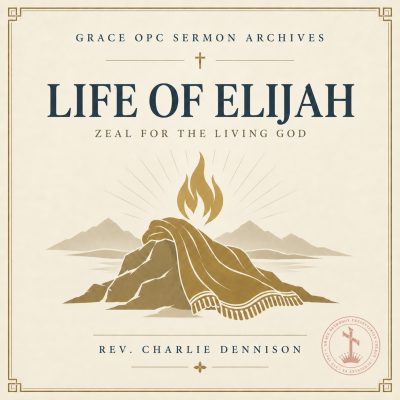
This sermon is from the Rev. Charles G. Dennison sermon archive, part of the “Life of Elijah” series, and was preached at Grace Orthodox Presbyterian Church in Sewickley, PA, during a worship service on Sunday, September 4, 1988.
About this sermon
Verse 1 gives Scripture’s first explicit reference to heaven, a destination hinted at before only in Enoch’s disappearance and the mystery of Moses’ body. God takes Elijah up bodily, the clearest picture yet of where the whole story is heading. Preaching that loses sight of heaven misses the point of the text.
Sermon transcript
He said, yes, I know, be still. And Elijah said to him, Elisha, please stay here, for the Lord has sent me to Jericho. But he said, as the Lord lives and as you yourself live, I will not leave you. So they came to Jericho, and the sons of the prophets who were at Jericho approached Elisha and said to him, do you know that the Lord will take away your master from over you today? And he answered, Yes, I know, be still. Then Elijah said to him, Please stay here, for the Lord has sent me to the Jordan. And he said, As the Lord lives, and as you yourself live, I will not leave you.
So the two of them went on. Now fifty men of the sons of the prophets went and stood opposite them at a distance, while the two of them stood by the Jordan. And Elijah took his mantle and folded it together and struck the waters. They were divided here and there so that the two of them crossed over on dry ground.
Now it came about when they had crossed over that Elijah said to Elisha, ask what I shall do for you before I am taken from you. And Elisha said, please let a double portion of your spirit be upon me. And he said, you have asked a hard thing. Nevertheless, if you see me when I am taken from you, it shall be so for you, but if not, it shall not be so.”
Then it came about, as they were going along and talking, that, behold, there approached a chariot of fire and horses of fire, which separated the two of them, and Elijah went up by a whirlwind to heaven. And Elisha saw it and cried out, my father, my father, the chariots of Israel and its horsemen.
And he saw him no more. Then he took hold of his own clothes and tore them into pieces. He also took up the mantle of Elijah that fell from him and returned and stood by the bank of the Jordan. And he took the mantle of Elijah that fell from him and struck the waters and said, Where is the Lord, the God of Elijah?” And when he also struck the waters, they were divided here and there, and Elisha crossed over. And when the sons of the prophets who were at Jericho opposite him saw him, they said, the spirit of Elijah rests upon Elisha.
And they came to meet him and bowed themselves to the ground before him, and they said to him, There are with your servants fifty strong men. Please let them go and search for your master. Perhaps the Spirit of the Lord has taken him up and cast him on some mountain or into some valley.” And he said, “…you shall not send.” But when they urged him until he was ashamed, he said, “…send.” And they sent there for fifty men and they searched three days, but did not find him. They returned to him while he was staying at Jericho, and he said to them, Did I not say to you, Do not go?
Our father, we would have your word. Lord, there are the words of men, and how those words are multiplied, and how men with their words clamor for our attention and even for our hearts. But there is that word that gives life, that word that is able to change the heart, that word that literally brings into reality that which was not imagined or thought of before. We rejoice, our God, in your word and in the power that that word has had upon us, for we have become the people of the word. Truly by your word we have been established, by your word we are sustained. Let us therefore give heed to that word, treasure it in our hearts, live by it in our lives. We pray this for the sake of Christ Jesus, that one who is the living word, that one who faithfully and infallibly exegetes the word, by the Spirit. Amen.
Now our messages on 2 Kings 2 will take us a little bit of time, but I want to make some observations for you tonight, which will be well for us to keep in mind as we move through this very, very important chapter. And basically, I will confine myself to comments on the first verse. I know you’re all a little distressed. The first verse, you say? We’ve become accustomed to your rather extended messages on Sunday evening, and you’re going to preach for that length of time on merely one verse? Well, hopefully this will serve as introduction for us as we move through the chapter as a whole. It cannot be disputed, you are here involved with one of those very important and quite strategic chapters in the Old Testament. I think that’s obvious to you.
You have the figure of the great Elijah, you have also the figure of the great Elisha. you have the story here of the changing of the guard but there have been many stories of the changing of the guard in the Old Testament but of all those stories this stands out and of course the reason why it does is plain we have fiery chariots We have fiery horses, we have a man literally lifted up as by a whirlwind and swept off to heaven.
And there has never been anything like this before in the pages of scripture. whatever other considerations we can make with regard to the figure of Elijah and his place in the history of redemption. We think of him as that strategic figure in the story of the northern tribes of Israel, the kingdom associated with it. And what is transpiring there as wickedness increases and God’s wrath is being revealed. That of course, not irrespective of God’s grace and mercy, which he repeatedly points out for the instruction of those who will yet survive, be it a remnant in the north, or be it Judah to the south, or be it the church of Jesus Christ that will arise later on. There is the importance of Elijah in the greater scope, the more extended scope of the history of redemption.
For we understand him as the great forerunner, that one who comes before. And even here we have been able to discern something of the pattern of that forerunning that will receive its consummate fulfillment in the person and work of John the Baptist. A forerunner of the King, a forerunner of the promised Messiah.
So all of these things conspire as we look at this chapter to convince us again of the importance of what we read here. and those things that are taking place. All of this about to be heightened for us beyond what anyone in the Old Testament could have imagined. So focusing faith, so instructing the faithful as to bring them to a new level of devotion and understanding with regard to their pilgrimage before God. the first verse, the elements. The way in which we are introduced here to the story of the departure of Elijah is remarkable in itself.
First of all, from the way in which this first verse is written, it seems that there is a general knowledge with regard to the fact that Elijah is about to depart. This is a revelation that has been sent out seemingly to a wide range of those who were the agents of revelation in the northern districts of the promised land. The plan for Elijah’s departure is something that has been revealed generally to not only the prophet Elijah, but also to Elisha, who is a disciple of Elijah, and even beyond those two, to the prophetic community generally. Everybody seems to know that this is going to take place. as they move through their circuit, from Gilgal to Bethel to Jericho, it seems that the community of prophets in each of those locales is familiar with what is about to take place.
And at least the prophetic communities are abuzz with the revelation. But as we move through this second chapter, it also becomes apparent that the two figures that are mentioned there in the first verse, namely Elijah and Elisha, are the only ones who really grasp the significance of that revelation that has been given. Now, how might we focus the significance of the revelation. Well, the significance of this revelation is focused by what we read in that first verse.
Elijah is about to be taken up by a whirlwind to heaven. And there it is. To heaven. To this point in the story of salvation, the ultimate destination has not so remarkably been spelled out for the people of God. And it hasn’t been spelled out in the way in which it will be spelled out here. So it’s almost as if with what is taking place here, something remarkable is being communicated to the people of God with regard to the ultimate destiny of those who trust God and follow him. All right.
The plan is generally disseminated. from Elijah, maybe Elisha, to the community of the prophets. But as we move through this chapter, it becomes clear to us that Elijah and Elisha are privileged in their understanding of the significance of that revelation. Now that Elisha stands over against the community of the prophets is proven to us, not only by his attitude as they move through the circuit of the cities, Gilgal to Bethel to Jericho, but also at the conclusion of that portion which we read this evening, verses sixteen through eighteen. You note what the prophets want to do? Those prophets in Jericho representative of the other community of prophets in the land of Israel at that time, they want to send out a reconnaissance mission to search for the missing body of Elijah.
Now is it beginning to grip you that significance of what is transpiring here, that which then is seemingly unique To this point in the history of the salvation of God’s people, the significance, in fact, of those words in that first verse, to heaven. To heaven. The assertion that Elijah is going to heaven The fact that he is taken up and swept off to heaven in his body is an event that pushes forward the history of redemption and also the comprehension of the people of God with regard to their ultimate end.
For this event further expounds that which took place quite a bit earlier in the story of God’s economy with this world. Do you remember what happened to that seventh from Adam in Genesis chapter 5? The one who was named Enoch? We are told in the 24th verse of that fifth chapter of Genesis that he walked with God and he was not, for God took him.
It’s very mysterious language. How did people understand it then? Was there anyone there to observe what took place? It doesn’t seem that that is so. The revelation merely was given. He just disappeared one day. We don’t know where he went. God took him. He was gone, but now Elisha is a witness to that which took place. There may yet be mystery surrounding the events, but we know so much more.
This one Elijah is whisked away in the body, think of it, in the body to heaven. Of course, maybe you’ve noticed other parallels from what has gone on formally in the history of salvation. Not just Enoch VII from Adam, but you recall the story of Moses and the conclusion of his life. For this one also knew, by revelation from God, that his days were coming to an end, that he was going to depart. There are many elements in this story, in the second chapter of 2 Kings, that also remind us further of Moses and his administration. Think of the parting of the Jordan, for instance. But in thinking about those things, we also are drawn to Deuteronomy 34, and the account of Moses departure from this world. He is commanded to go up on a mountain. Joshua can only go so far. God takes over. He prepares a grave for Moses. Moses dies. Yes, Moses dies. His body is buried by God And yet in that story we are taught that there is yet a reward for this one, Moses, who led the children of Israel through the wilderness.
It is Elijah then, in this story of Elijah, that we then perceive the perfection of our eschatological hope. The perfection of our hope, namely the glorification of the body. Enoch was clothed in mystery. Moses dies, is buried by God. The body rests yet to be raised.
But in Elijah, we perceive the perfection of that which God intends for us, and that in the full view of Elisha, who shall in fact communicate it to others. Moses is subjected to physical death. and that appropriately for he is the one in whom we see the law, the one whose administration is characterized by the law, and the law appropriately ends in death, and the images of death abound. But then come the prophets and the vision of hope, and at the end And at the heart of that vision of hope is the resurrection, or the translation of the body into glory. Not just the soul, as it was with Moses, to participate in that reward. a reward far more excellent than even the land of Canaan, but now the body itself, our hope focused in that, the body itself participating in a world above which here is called Heaven.
To this day, the prophets abound. The servants of the word abound, but they still don’t see it. They don’t understand that that was the focus, the intention, the goal, the hope. I fear, I fear, that many a prophet in our own day, if we can so call them, many a bearer of the word, many a preacher, many who would bear office in the church would still be sending out reconnaissance missions to find the lost body.
Why? Because, you see, the whole matter of heaven itself remains so utterly incomprehensible to them. They can only see so far. They only perceive. things, from a certain vantage point, from a certain point of view. They still live, as it were, in an administration of the earth, and they don’t seem to be able to be freed from that. As well-intentioned as they may be, the perspective is still one of this earth.
So much Is this the intention of God, that it focuses the whole matter of faith for the community of faith? What do you think Hebrews 11 is all about? How does the Jew, or how does that Christian who has his eyes so trained and so focused upon this earth, read and understand Hebrews 11?
He can’t do it. He cannot do it. What is the focus of faith in that chapter? Faith is the substance of things hoped for, the evidence of things not seen. Why is it that Abraham goes out? Because he hoped for a better piece of ground in this world? No, we are told he is looking for a better country and a better city, whose architect and builder is God, one that is above, one which only faith can see, one which only faith can appreciate. One which faith knows will be the eternal habitation of those who do in fact believe and live by faith.
Do you see how monumentally significant this chapter is? The body goes to heaven. It doesn’t stay here for some sort of resurrection later on. A resurrection like unto what Mary and Martha expected in the days of Lazarus and Jesus. One in which the dead would be raised to walk around on the earth some more. No! The body goes to heaven. And that always was the goal.
But the deception of Satan and the illusion that intrudes is And that is the ultimate, permanent, and only purpose of the people of God. He is a lie. He is not true. And insofar as the Church embraces that lie, she will extend herself to the world not really understanding it. not first of all giving up the world for heaven, and the others incapable then to serve in the world for the God who has called them out of the world.
You have to start where Elijah ends. That’s the message. You have to begin there. That’s the first word of the gospel. Eternal life. You have to start with eternal life and see the life that you have now in the light of eternal life. Then you’ll understand life. If you start anywhere else, you won’t understand it. You don’t have to argue if you do.
But I do have to remind you. And the reason that I know that I have to remind you is because I have to remind myself. And you and I, we leave the same table. I have to be reminded and you have to be reminded we have to be taught by Elijah Elijah we have to be taught by his savior who comes to make plain all that was transpiring in the life of his children We have to be reminded by our Savior’s death, and specifically by our Savior’s resurrection.
For that’s the goal. That’s where you’re headed. And that is your hope. Then ultimately, not something that belongs simply to a prophet in the 9th century before the coming of Christ. that belongs to you. For there will be a day when there will be the sound, the incredible sound of a foreign language. And you, in your body, will be translated from this world It is true. It is true. In every aspect of your life, you’re getting up in the morning, you’re going to bed at night, you’re going off to work, you’re applying yourself to your tasks, you’re relating to one another, spouses, parents, children, employers, employees, all is seen differently, understood quite differently, in light of the fact that you are destined to be raised in their body. And only Christianity is saying it. Judaism isn’t saying it. Islam isn’t saying it. None of the religions of the East are saying it.
Here is the message. so wonderfully and hopefully illustrated for you from the pages of the Old Testament well then our hope it doesn’t make you useless in this world it makes you supremely useless as useful as Elijah and Elisha. And those servants, the lives of whom we read in the pages of the New Testament. Father, we will have to be taught again and again, instructed well, so that our gaze is not distracted, so that we understand, comprehend, grab hold of the fact that our destiny is heaven. Not just that our souls may be brought there, but that our bodies and our souls may be brought to heaven. And we live there in heaven, in glory, in your presence, and in the presence of the Lamb, the one who has purchased for us our place above, so that we might live in yours and in his presence, and that perpetually. Train us, Lord, then, with this vision that all of our moments and our times might be lived in light of that glorious revelation so wonderfully, fully expressed in the death and resurrection of Christ our Lord.
The sermon text provided above is derived from the sermon audio recording making use of generative tools. It has not been manually edited. While transcription tools have a high degree of accuracy, the output may include generative textual, punctuation, and/or formatting errors.