
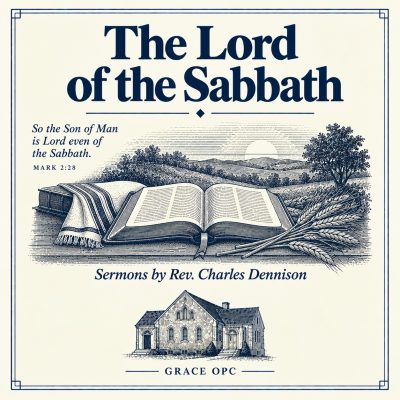
This sermon is from the Rev. Charles G. Dennison sermon archive, part of the “Lord of the Sabbath” series, and was preached at Grace Orthodox Presbyterian Church in Sewickley, PA, during a worship service on Sunday, April 22, 1990.
About this sermon
Christ’s Sabbath walk through the grainfields carries rich harvest imagery. The Lord harvests his grain, his people harvest the Word by faith, and in the end the cross harvests Christ himself. That depth of servanthood compels us to follow him into the house of God.
Sermon transcript
If also to those who were with him. And he said to them, The Sabbath was made for man, not man for the Sabbath. Therefore the Son of Man is Lord also of the Sabbath. And he entered again into the synagogue. And there was a man there who had a withered hand. And they watched him, whether he would heal him on the Sabbath day, that they might accuse him. And he said to the man who had the withered hand, Stand forth. And he said to them, Is it lawful to do good on the Sabbath days, or to do evil, to save life, or to kill?
But they remained silent. And when he had looked around at them with anger, being grieved at the hardness of their hearts, he said to the man, Stretch forth your hand. And he stretched it out, and his hand was restored, whole like the other. And the Pharisees went out and immediately took counsel with the Herodians against him, how they might destroy him. Closing.
O Lord, there is a harvest of your word, and your people are fed, and not in this place alone, but throughout the world. And Lord, may we, your people, be appreciative to the depths of our hearts for that which we receive. And may we understand afresh that you, by your word, preserve us in our lives and nourish us truly. We pray this through Christ. Amen.
The fields in Palestine. The fields stand ready. The harvest time has come. But in Israel, on this day, the grain from the field will not be gathered. It is the Sabbath. But even though on this day, this particular day, the grain from the field will not be gathered, there is nevertheless a harvest. It is a different kind of harvest.
For the people of the Lord are his grain, his harvest gathered on the Sabbath. On the Sabbath, the Lord gathers his grain into his granary. They come into the assembly of the Lord. And in this circumstance, in this setting, into the synagogue. You note where Jesus is headed. Verse 1 of chapter 3. He moves through the field to the synagogue.
God is at work collecting His crop, a crop for Himself, on this day, His day, the Sabbath day. But the people, God’s people, are not His only harvest in this setting. For there is another type of harvest that is reaped. These people will themselves be fed from a harvest, a harvest from the Word, made with spiritual grain. On the Sabbath, then, the Lord’s people do not harvest from their fields. They harvest from their faith. On the Sabbath, the Lord’s people do not harvest for gain. They harvest for God.
The other nations may well work their fields today for the grain. They may well set out into their fields worrying about the possibility of lost opportunities, anxious about daily provision, concerned about catching the market at its peak. But in Israel, there is reaping of a different sort on the Sabbath. Israel reaps from the Lord a harvest from His Word today.
For these people are instructed that they do not and that they must not live by the bread of this creation alone, but by every word that proceeds out of the mouth of God. On this particular Sabbath day in Israel, Jesus and His disciples are walking through a field of standing grain on their way to the synagogue. It is a most remarkable scene. Consider it.
For who is this one who walks through the field on His way to the synagogue? He is none other than the one who made the field. He is none other than the one responsible for the grain and for the harvest. If the people of God are as a harvest themselves, gathered by God on His Sabbath, then Jesus, as He moves through this grain field, is also like grain, becoming, as it were, part of the harvest. He, too, the one so great, is now made one with His people.
He, as it were, is gathered with them into that granary, the worship assembly, the synagogue that stands on the far side of the field. Think once more about who this is. Who moves through the field on his way to church? Is he not the one who is to be truly honored, even worshiped in the synagogue? But today, on this Sabbath, he will be numbered among those who make their way to worship. And he too will pay homage; he too will worship with all God’s people as one with them. But not only is he like the grain of the harvest, like all other children of Israel.
He will be fed on this Sabbath from the harvest of God’s Word, which consists of spiritual grain. Is it not true that this one is the very center, the kernel, the substance of that Word which will be declared and proclaimed once he arrives at the synagogue? Yet on this Sabbath day, the one who is the Word itself is as one in need of the Word, for so he has made himself to be.
For our sake. If the children of God must walk by faith, then this one who has cast his lot with them will also walk in faith. He will share their humanity, and he will be judged by the same standard that judges them. And as it is not fit that man should live by bread alone, but by every word that proceeds out of the mouth of God, so it shall be for him. Jesus on the Sabbath is harvested from God’s field and gathered into his granary for the corporate worship of God. And Jesus on this Sabbath will be fed with the spiritual increase of God’s Word that comes to all God’s children.
This one who is none other than God. This one who has the title Son of God, this one who is called Lord, appears as a servant. He is servant of and subject to God, as God’s children are. And as God’s children are subject to and servant of God’s commands, so Jesus now appears to be. He who gave the commands to begin with. How marvelous! How marvelous His humility! How magnificent this chosen route, this humiliation. You can see the cross of Jesus in Jesus as He walks through grain fields on the Sabbath day.
For will He not humble Himself even to the point of death in His identification with His people, that His love might be manifest and they might be saved? Who then, who are called to be servants of and subject to God’s commands, find in Him one who was servant of and subject to the will of God and God’s commands.
But as we take stock of ourselves, do we not continue to be gathered as God’s harvest into His granary, His church, week by week, for the purpose of corporate worship on the Sabbath? Do we not continue to be fed, Sabbath by Sabbath, from the Word, that bread which God has prepared for us? At your Savior once again.
Jesus in the fields on the Sabbath is preaching to you His servanthood. In those fields, as it were, proving to you that servanthood which is at the very center of what He is. And if He, the Lord, so behaved and so submitted Himself, how much more we, that we might be servants indeed. Jesus in the field on the Sabbath is not only on His way to the synagogue in order to worship the Lord there.
He is out in front of His disciples. He is leading them in their service to God. How will they follow? We know how they follow—behind Him, their destiny, His destiny, they then gathered as He was gathered unto the assembly for the corporate worship of God, that they, in fact, might be fed.
But what of us? Are we not also following Jesus today? Is not Jesus still moving through the grain field, and are you not moving behind Him? And is not the destiny on this Sabbath day, God’s house of worship, where you might be fed? A true spiritual harvest from the Word. And if the Lord Himself in Christ has set the pattern, how can you say no?
I will not go. I will not follow. I will not obey. I will not submit. I will not be a servant as He was. But have you not said no? And that is why you are here. Did you know that you were following Jesus when you came here today? And do you not understand that as He demonstrated servanthood for your sake, now you are manifesting servanthood for His sake?
Consider the magnitude of that servanthood. When we consider its immensity, what joy is ours! Can it be a burden for us to follow behind Him and to be where He is? What joy there is for us! Since this One we follow in His servanthood to God has kept God’s commandments and has proved Himself a servant for us to the uttermost, giving Himself for us, even for us who have failed to keep His commandments as we are. And therefore, what the commandment itself alone, weak as it was through the flesh, could not do, God did, sending His own Son in the likeness of sinful flesh, and as an offering for sin, condemning sin in the flesh, that the very requirement of the commandment might be fulfilled in us. So that we might in Him have the perfect fulfillment of all of that Sabbath beatitude. Is your Lord unhappy on His way to the assembly? Is your Lord grieved that He has to go, that He has to surrender the time? Is your Lord grieved that, yes, there is this commandment, this requirement that God expects fulfilled?
It is a joy, a delight. Jesus moves happily through the field. Not that He does not meet some who are sorrowful along the way. How great is our joy! For the joy of our Lord has become our joy. Not that we are perfect, not that we do not stumble and fall, not that we do not struggle with our passions and the tendencies of our hearts. But we have in Jesus Christ the triumph of our God with respect to all the commandments, and a delightful service. And it is to Him that we are joined, and into Him that we have been incorporated. So it is not merely the fact that you followed Jesus on your way to church today. You have been incorporated into Him. And His joy is made your joy. Your sins are forgiven. The violations of the commandments are laid aside because of His sake. He has taken them upon Himself so that you might go free. If worshiping God, even apart from our sins, should be a joyful occasion, how much more now that our sins have been removed? Will you, if in your heart you are not following Him, gladly join the band of His disciples today? And if your conscience troubles you about the Sabbath or about God’s commandments, will you turn to your Savior and find in Him not only forgiveness, but also power to walk in the Spirit as you follow your Lord into the assembly for worship and into His church on the Christian Sabbath?
Let us pray. O God, may our delight show itself. May it not be grounded in pride. May it not be the product of arrogance or haughtiness. But may it be, Lord, the product of Your grace, that we, not thinking of ourselves more highly than we ought, think highly of Your Son. The one who was made a servant for us, the one whose servanthood means our salvation, the one whose death and resurrection means our joyful celebration of Your goodness, and that especially on the Sabbath, which You have ordained and established. We pray this through Christ, the Son of Man, the Lord of the Sabbath. Amen.
The sermon text provided above is derived from the sermon audio recording making use of generative tools. It has not been manually edited. While transcription tools have a high degree of accuracy, the output may include generative textual, punctuation, and/or formatting errors.