
The sermon text provided below is derived from the sermon audio recording making use of generative tools. It has not been manually edited. While transcription tools have a high degree of accuracy, the output may include generative textual, punctuation, and/or formatting errors.
Well, friends, please remain standing for the reading of God’s Word. We finally return this Lord’s Day morning to our consideration of the book of the prophet Isaiah. And today we are in Isaiah chapter 42. I’ll read verses 9 through 17. That is my sermon text for today. Isaiah chapter 42, verses 9 through 17. You’ll find that on page 716 in your Pew Bibles. So this is the word of God, let us hear it with reverence and awe, beginning at verse nine.
Behold, the former things have come to pass, and new things I now declare. Before they spring forth, I tell you of them. Sing to the Lord a new song, his praise from the end of the earth. You who go down to the sea and all that fills it, the coastlands and their inhabitants. Let the desert and its cities lift up their voice, the villages that Kedar inhabits. Let the inhabitants of Selah sing for joy. Let them shout from the top of the mountains. Let them give glory to the Lord and declare his praise in the coastlands.
The Lord goes out like a mighty man, like a man of war. He stirs up his zeal. He cries out, he shouts aloud. He shows himself mighty against his foes. For a long time I have held my peace. I have kept still and restrained myself. Now I will cry out like a woman in labor. I will gasp and pant.
I will lay waste mountains and hills and dry up all their vegetation. I will turn the rivers into islands and dry up the pools. and I will lead the blind in a way they do not know, in paths that they have not known, I will guide them. I will turn the darkness before them into light, the rough places into level ground. These are the things I do, and I do not forsake them.
They are turned back and utterly put to shame who trust in carved idols, who say to metal images, you are our gods. Dear friends, the grass withers and the flower fades, but the Word of our God endures forever. Let’s pray for the Lord to bless the proclamation of His Word. Our gracious Lord and Father in heaven, As we consider this portion of your God-breathed, inerrant, infallible word, we pray that the spirit by which you inspired this word would illuminate our minds and open our hearts to behold wondrous things from your word. Lord, we ask that we would tremble at your word. We pray that you would give us the grace to take this word to heart, to see its relevance and application to our circumstances and our situation today and the situation in the church. And we would ask, Lord, that you would cause much spiritual fruit unto sanctification and holiness to be produced through this portion of your word that we take to heart today. And once again, Lord, we ask that you would set a guard over my lips that I might only speak that which is faithful in your sight and in accordance with your word.
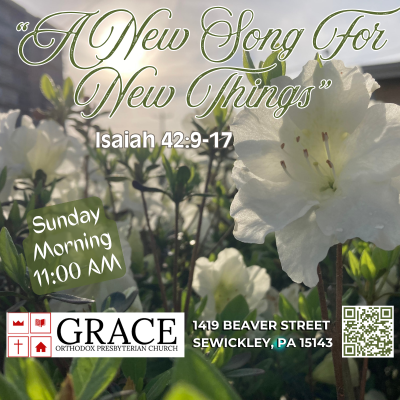
We pray these things in Jesus’ name and all of God’s people said. Amen. You may be seated. Title of my sermon this morning is A New Song for New Things, and I wanna encourage our children to listen for these three key words, the words new, judgment, and deliverance.
Well, dear friends, if you are a member of the Orthodox Presbyterian Church, as many of you this morning are, or if you are considering membership in the OPC, then one of the things that I would strongly encourage you to do is to study the history of the OPC, the history of our denomination.
And if you have studied the history of the Orthodox Presbyterian Church, then you know that one of the major issues that led to the formation of our denomination was a deep concern for missions, a deep concern in particular to preserve the integrity of the church’s missionary endeavors, to preserve those missionary endeavors from the influences of theological liberalism and doctrinal compromise. and to send out into the mission fields of the world faithful Bible-believing missionaries, missionaries who would preach the gospel of Jesus Christ without apology, without compromise, missionaries who would proclaim Jesus Christ as the one and only Savior of sinners, calling all people everywhere to repent of their sins and to turn to Christ alone in faith as their only hope of salvation. And so our denomination was founded out of a concern for missions.
But that ought to lead us to ask the question, what is the ultimate goal of gospel missions? Why is it that we are so concerned, though we be a small denomination, why are we concerned to send out missionaries to many places, not only throughout this country to plant new churches, but also to send missionaries throughout the world to proclaim the gospel where the word of Christ has not yet been heard.
What is the goal in that, the ultimate goal in that? Well, some would answer that question by saying that the ultimate goal of Christian missions is the salvation of precious souls from the wrath of God that they deserve for their sins. Now certainly the salvation of souls is one of the highest priorities of gospel missions. One of the driving factors in gospel missions is to reach lost souls with the good news of Jesus Christ, the glad tidings of great joy so that they might be rescued from sin and death and hell. but is that really the ultimate priority in gospel missions? Well, friends, our passage for this Lord’s Day morning, a prophetic passage that pulsates with a missionary undercurrent, a passage that exhibits a missionary thrust, this passage, by implication at least, reminds us, friends, that the ultimate goal of missions is not the salvation of souls, as vitally important as that is. The ultimate goal of missions is to praise and worship God.
It is the glory and praise of Yahweh, the God of Israel, the God who saves. Now, I would remind us of the context and setting of our passage for this morning. And you will recall, if you’ve been following this series, you’ll recall that our passage for today is situated within a section of the book of the prophet Isaiah that has introduced us to a figure that Isaiah describes as the Lord’s servant, the servant of the Lord. We have that figure brought up again at the beginning of this chapter, in chapter 42, verses one through four. where the Lord through Isaiah says, He will not cry aloud or lift up his voice or make it heard in the street. A bruised reed he will not break, and a faintly burning wick he will not quench. He will faithfully bring forth justice. He will not grow faint or be discouraged till he has established justice in the earth, and the coastlands wait for his law.
Now friends, as I’ve pointed out in a past sermon, sometimes this servant of the Lord figure that we find here in this latter section of Isaiah, sometimes this figure is clearly referring to Israel, to God’s covenant people corporately considered. And so, for example, we see that back in chapter 41, verses 8 through 10, where the Lord makes it very clear that the servant figure in that context is referring to Israel. If you go to chapter 41, let me just read verses 8 through 10. Isaiah writes, but you, Israel, my servant, Jacob, whom I have chosen, the offspring of Abraham, my friend, you whom I took from the ends of the earth and called from its farthest corners, saying to you, you are my servant. I have chosen you and not cast you off. Fear not, for I am with you. Be not dismayed, for I am your God. I will strengthen you. I will help you. I will uphold you with my righteous right hand.
So clearly there in that passage, the servant of the Lord is a reference to God’s covenant people, Israel. However, at other times, this servant figure appears to be referring not to God’s people corporately considered, but seems to be referring to a specific individual.
In particular, it is a reference to the promised Messiah. That seems to be clearly the case here at the beginning of chapter 42. And it will also, as we will see, it’ll also be the case in that famous suffering servant passage of Isaiah chapter 53. And the church has rightly throughout its history understood the suffering servant figure of Isaiah 53, that that is a prediction, a messianic prophecy predicting the sufferings of our Lord Jesus Christ on the cross of Calvary. And so I bring all of this up to remind us of the context here, because what all of this means, my friends, is that our passage for today is to be understood as ultimately pointing to and predicting the spiritual realities that were to come in this Messianic New Covenant era, this era in which we are blessed to live. after the coming of Christ. And therefore, this passage is ultimately fulfilled in our Lord and Savior Jesus Christ and in the new covenant age that he has ushered in by his glorious redeeming work.
And so as we approach our text for today, the first thing I would draw your attention to is what we learn in this passage. about the new things of the new age calling for a new song. And that’s the first main point in your sermon outline. We consider here, beloved, the new things of the new age call for a new song. Verse nine, Isaiah writes, behold. Children, what does that word behold mean? That means this is important. Pay attention, listen up. Behold what?
The former things have come to pass, and new things I now declare. This is a pivotal passage. God is saying, I’ve declared former things, and they have come to pass, but now I declare new things. Before they spring forth, I tell you of them. Now that raises a lot of questions. If you’re a good Bible reader, you will read passages like this and ask yourself questions like, well, what are the former things? What are the new things? What does it mean for them to spring forth? What is Isaiah talking about here? Well, let’s start with the former things. Isaiah or the Holy Spirit through Isaiah says, the former things have come to pass. What are these former things that Isaiah is referring to here?
Well friends, most likely he is referring to the things that the prophets had predicted in the past and which had already come to pass. He’s referring to past prophecies that have already been fulfilled in the sovereign providence of God. And he brings up the former things to set the stage for the new things that he’s about to declare, these new things that have to do with the promised messianic servant of the Lord. And so the point here that Isaiah seems to be making is that, look, if God through his inspired prophets, like the prophet Isaiah, if God through his prophets in the past had accurately predicted events that ended up coming to pass in due time, then certainly the new things that he now declares through his prophets, like Isaiah, were also surely to come to pass.
But what are these new things? He says, the former things have come to pass and new things I now declare to you. What are these new things? Some commentators would say, well, you know, Isaiah is referring to the things having to do with Israel returning from their 70 years of Babylonian exile. But does that exhaust these new things that the Lord has in mind here, that he’s communicating here?
Well, no, I would suggest not. Because in this context, these new things are things having to do with the Lord’s messianic servant. Things pertaining to and leading up to the new covenant age. things such as the return of God’s people from their Babylonian exile into the promised land. Yes, that would certainly set the stage for the eventual coming of the Messiah, but the ultimate new things would include such things as the coming of Jesus, God’s messianic servant, and the new covenant age that he would usher in by his obedient life, his atoning death, his glorious resurrection from the dead, and by the pouring out of the Holy Spirit on the day of Pentecost.
And he says in verse nine, before they spring forth, I tell you of them. Now, I want you to focus in, hone in on that language of springing forth. This is actually agricultural imagery. Isaiah’s very gifted through the inspiration of the Spirit, he’s able to communicate in a way that would really resonate with his contemporaries. Before they spring forth, I tell you. What is this talking about?
Well, as Dr. E.J. Young explains, these new things are compared to plants whose seed is still in the earth and has not yet appeared above ground. Even before the first trace of these world events could be discerned in world history, Isaiah caused his readers to hear them. See, what he’s about to prophesy and predict, these new things of the new covenant age, these are not things that, you know, sort of like a gifted prognosticator who could kind of see the times, read the times, and kind of project into the future where the general trends may go, no. No, he can see these things before there’s even a hint of them. Why? Because Isaiah speaks through the spirit of prophecy. The Holy Spirit inspires him or carries him along so that he he predicts these future events. And that’s an important thing.
One of the things that we notice throughout the book of Isaiah, but also including this final section of Isaiah, is there’s an anti-idolatry polemic that kind of goes on throughout Isaiah. And sadly, the people of God in Isaiah’s day, many of them were going after the false gods, the idols that were worshiped by Israel’s Gentile neighbors. They were abandoning Yahweh, their God, the true and living God, to go after false gods. But Isaiah reminds them, these false gods, they can do nothing, and they can’t really predict the future.
You see, only the true and living God can predict future events and predict those events in great detail as we will see in a few chapters from now where Isaiah actually mentions great King Cyrus who, when Isaiah gave this prophecy, Cyrus had not even arrived on the scene of human history.
Why is he able to do that? Because he is guided and inspired by the spirit of prophecy. And friends, this teaches us that only the true and living God can predict the future in great detail. Why? Well, as we’ve been learning in our adult morning instruction class, the Lord is the eternal one.
He is the infinite one. He is the omniscient one, and he is sovereign over the future. The reason that he can predict future events in great detail is because he’s beyond time. He’s beyond the bounds of time and he is sovereign over time. He can know the future in great detail. He can predict the future in great detail because he has sovereignly planned everything whatsoever that comes to pass. And this is in sharp contrast to the false gods and idols worshiped by Israel’s ancient Gentile neighbors, whose so-called prophets could only predict the future in vague and ambiguous language.
You know, one of the things that’s popular today is people will often consult psychics. Right? And if you go to a psychic, they’ll try to learn something about you and they might make predictions that seem like, wow, this psychic really gets it. They really have keen insight but usually the predictions they make as they stare at their crystal ball or whatever they do are, you know, they’re obviously charlatans and phonies and they’re, predicting things based on guesswork, based on, and their predictions are often ambiguous, sort of like if you consult your horoscope. It’ll say very generic things that could apply to many different circumstances. But the true prophecies of God, the true prophets of the true God are able to predict future events in great detail because God owns the future.
He is Lord of the future, and he is now declaring new things that are yet to come. And what is the result of these new things, these things having to do with the promised messianic servant of the Lord? What will the result be? The result will be a new song. As it says in verse 10, sing to the Lord, sing to Yahweh, Israel’s faithful covenant-making, covenant-keeping God. Sing to the Lord what? A new song.
You see the pattern? God does new things. He performs new acts of salvation, the culminating acts of salvation in the person and work of the promised Messiah, the messianic servant, our Lord and Savior, Jesus Christ. And the result will be an explosion of new praise.
It will be a new song. But new in what sense? John Calvin comments that by new, he, Isaiah, means an excellent, beautiful, and elegant song. Not one that is ordinary or common, but a song which may arouse men to admiration as relating to the extraordinary grace of God of which there had never been so remarkable an example. New is here contrasted with what is ordinary, and thus he extols the infinite mercy of God, which was to be revealed in Christ, and which ought therefore to be celebrated and sung with the highest praises.
But friends, by implication, such new songs would be songs suitable to the new things of the Messianic era. the new things which Jesus our Lord and Messiah would accomplish by his redeeming work. Now it’s interesting. If you’re a careful Bible reader, one who seeks to not only read intensively into the scriptures, but one who seeks to get the big picture and to see the patterns, the overall patterns of scripture. If you read your Bible carefully and broadly, one of the patterns that you will notice throughout the redemptive history recorded in Scripture is that the new saving acts of God lead to new songs of praise. And let me just give you a couple examples. One obvious example is what God did for Israel. God, you recall, had rescued his enslaved people, Israel.
He had raised up Moses to be the mediator of the old covenant. And Moses and Aaron, they went to Pharaoh. They performed the Lord’s mighty signs. God poured out mighty supernatural plagues. upon Pharaoh and the Egyptians. And he rescued his people by a mighty hand and an outstretched arm.
He split the Red Sea and he led his people through the Red Sea on dry land. And children, what happened to the Egyptians when they tried to follow the Israelites and overtake them in the Red Sea? What does God do? He closes the Red Sea over them. He rescues his people by his grace. By his mighty, gracious intervention, he delivers his enslaved people, he rescues them, and he judges their enemies, the Egyptians, by drowning them in the Red Sea. And what is the result of that? How do the people of God respond as they cross the Red Sea and they see the bodies of the Egyptians floating in the water?
We’ll turn to Exodus 14, verse 30. Exodus 14, verse 30. And I’ll read through chapter 15, verse one. It says this, thus the Lord saved Israel. Israel didn’t save itself. There’s grace in the Old Testament too. The Old Testament does not teach salvation by works. God saved and rescued his people by his grace.
Thus the Lord saved Israel that day from the hand of the Egyptians. God was even mightier than the mighty Egyptians. He rescued them from the hand of the Egyptians. And Israel saw the Egyptians dead on the seashore. Israel saw the great power that the Lord used against the Egyptians.
So the people feared the Lord and they believed in the Lord. and in his servant Moses. And then it goes on to say, then Moses and the people of Israel sang this song to the Lord saying, I will sing to the Lord for he has triumphed gloriously. The horse and his rider he has thrown into the sea. And what comes, what follows is this glorious song of Moses celebrating the mighty redemptive acts of God in rescuing his people from their slavery in Egypt. And then Miriam, Moses’ sister, the prophetess, takes up a song as well. If you go to verses 20 and 21, it says, then Miriam the prophetess, the sister of Aaron, took a tambourine in her hand, and all the women went out after her with tambourines and dancing, and Miriam sang to them, sing to the Lord, for he has triumphed gloriously, the horse and his rider he has thrown into the sea. A new mighty act of redemption and deliverance resulted in an explosion of new praise to God.
We see that also in the days of David. David, who had suffered so much persecution under the hands of Saul, in that suffering, he was, to some extent, a type and picture of the sufferings of Christ. But David, eventually, the man after God’s own heart, God raised him up to the theocratic throne in Israel. God raises up David as his theocratic anointed king. God does a new thing among the people of God in the days of David.
And what is the result? Well, the result is there is an explosion of praise as David, the sweet psalmist of Israel, organizes the Levitical choirs, organizes the temple musicians. The temple wasn’t built at that point, but But David makes preparations for the building of the temple, which his son Solomon would accomplish. And there is an explosion of praise as he organizes the temple musicians, and as David, under the Spirit’s inspiring guidance, leads him to write many God-breathed songs that are now a part of the Book of Psalms.
God does a new thing. And there is a new song, an explosion of praise. Since this is the pattern, since this is the case, beloved, we would expect that God’s greatest act of redemption, the greatest new things that he would do in the person and work of Jesus Christ in particular, the sending of his eternal son in the flesh to die for our sins and to rise from the dead to secure the gift of eternal life for those who through sovereign grace believe, we would expect that those new things that were accomplished in Christ. would likewise result in an explosion of new songs, Christian songs, a new covenant hymnody suitable to the new things God has accomplished in our new covenant age. And so it says, sing to the Lord a new song, a song suitable to the new things of grace that God was about to accomplish in Christ, the servant of the Lord. His praise, verse 10, his praise from the end of the earth, you who go down to the sea and all that fills it, the coastlands and their inhabitants.
Now notice here, Isaiah has sometimes been called the evangelical prophet. I think that’s a good designation for him. Although the evangel, the gospel is found in all of the prophets, it is wonderfully highlighted in Isaiah’s writings. And Isaiah anticipates, through the spirit of prophecy, he anticipates a time in redemptive history when the Gentiles will be joining in with God’s ancient people. to worship and praise God because of the work of the messianic servant. You see, the coming of Christ and the spread of the gospel to Gentile lands calls for universal praise among all of the nations of mankind. And that’s basically the point that is made in verses 11 through 12 as well.
It says, it mentions the coastlands and their inhabitants, These are Gentile inhabited areas. And then it goes on to say, let the desert and its cities lift up their voice. The villages that Kedar inhabits, let the habitants of Selah sing for joy. Let them shout from the top of the mountains. Let them give glory to the Lord and declare his praise in the coastlands. Let God’s praises be declared. Let the nations join in on this new song, celebrating the new things of God.
And these different designations, these different areas and people groups. You’ve got the coastlands in verse 10, the desert in verse 11, the villages that Kadar inhabits. Many commentators believe that this is probably a reference to the Bedouin tribes. The habitants of Sela, in other words, those who dwell in the rock. Some would identify the inhabitants as being in the area known today as Petra.
These would be areas and peoples who were familiar to Isaiah’s contemporaries, but they were areas populated by Gentiles. So Isaiah envisions a time when Gentiles will be engrafted into the people of God. and will join in the new song. But the point in Isaiah using this language, language that was not familiar to us, but was very familiar to his contemporaries, the point of using this language is that the new things that God is going to do in Jesus, the promised Messiah, will be reason for the nations of humanity to join in on this new song of praise to God.
This new song will be sung by a new people of God, Not a people who replaced the old people. This is not replacement theology. This is expansion theology. This is God adding Gentiles into the one trunk, adding the branches of the Gentiles into that one covenantal tree. And that would include you and me, brothers and sisters.
Now, I wanna make a couple takeaways before we go on to consider the latter section of this passage, verses 13 to 17. First of all, some of you may be scratching your heads and thinking to yourself, well, does this passage address or speak to either directly or by implication the whole issue of exclusive psalmody?
As many of you know, we in the OPC do not, as a whole, hold to exclusive psalmody, though there have been voices in the Orthodox Presbyterian Church that have held to exclusive psalmody, and if you’re not familiar with that, that’s the idea that we should only sing the inspired psalms of the Bible. You know, God’s already given us a hymn book, it’s called the Book of Psalms, so we should limit our singing of praise to God’s inspired songs. And there have been great minds in the church that have held that view. For example, the late Reverend G.I. Williamson held that view, Dr. John Murray held that view, and so forth.
However, let me suggest to you, brothers and sisters, that while this passage does not directly address the issue of exclusive psalmody, the position of exclusive psalmody is really hard to fit in to what is being spoken here in this passage. I believe, beloved, that the position of exclusive psalmody is deficient from a redemptive historical perspective, as we see by implication from passages like this one.
You’ve seen the pattern. God does a new thing. And there’s an explosion of new songs in praise to God. Now, some would say, well, wait a minute, Jesus is in the Psalms. Yes, he is. But he’s there by anticipation. He’s there in shadow and type. We can sing the old songs as new songs to the Lord because we sing them in light of Christ who has come.
But are we to imagine that with the coming of Jesus, we are to limit our praise only to those words that express and reveal Christ in Old Covenant shadow language? May we not sing the actual name of Jesus and speak of his atoning death and resurrection and the glories of the new covenant in our worship song.
Beloved, I would suggest to you that passages like this one are, and we love our exclusive psalmody brothers and sisters. They are fellow travelers on the reformed way and we have good fraternal relations with them and we too love the psalms. And we are inclusive psalmist. We do sing the Psalms. We sing them from a messianic new covenant perspective, but certainly we may also sing new songs of praise that reflect new covenant realities. But speaking of new songs and new things, this passage directs us to the fact that in Jesus, the promised messianic servant, God has done new things. And what does that mean for you and for me? What does that mean for us as the church?
Well friends, the old world in Adam is still very much a reality. We are still in the midst of this present evil age. We still feel the effects of the common curse. We suffer. God’s people suffer. We struggle. We get sick. We die. These are the effects of living in the old world in Adam, and that is still very much a reality. But understand, my friends, that in principle, this old world in Adam is on its way out. This present veil of tears is only temporary. It’s on its way out. a new day is coming, a new world is coming.
And in Christ, God is able to give you and me a brand new life. If you’re watching, listening through the internet, or if you’re here this morning and you’re thinking, I am just so burdened by sin, I’m just so entrenched in my sin, I’m so guilty, there’s no way that I could ever have a new life. God is making all things new. God has done new things in Christ and God can make you a new person. He can give you the new birth and grant you new life.
I’m reminded of what Paul writes in 2 Corinthians 2 verses, I’m sorry, 2 Corinthians 5 verses 17 through 21. Here are these verses. He says, therefore, if anyone is in Christ, if anyone is in Christ, whatever your background, whatever sins in your past, if anyone is in Christ, he is a new creation. The old has passed away. Behold, the new has come. All this is from God.
It’s not something that you do. It’s not about you picking yourself up by your own bootstraps. Christianity is not a religion of, is not a performative religion. It’s a religion of grace. All this is from God, who through Christ reconciled us to himself and gave us the ministry of reconciliation. That is, in Christ, God was reconciling the world to himself, not counting their trespasses against them, and entrusting to us the message of reconciliation. Therefore, we are ambassadors for Christ, God making his appeal through us. We implore you on behalf of Christ, be reconciled to God. For our sake he made him to be sin who knew no sin, so that in him we might become the righteousness of God.
Is there new life available? Is a new life possible for you, dear sinner, for me? Yes, Jesus makes it possible. He is the perfect, all-sufficient Savior. God in Christ, his messianic servant, has announced new things. and you, by his grace, may receive new life. Call upon his name today, rest in him for his salvation, and he will make you new.
But finally, as we wrap things up, and I know we have a number of verses to look at, but I’ll try to speed things up a little bit. We read next of God’s new acts of judgment and deliverance. God’s new acts of judgment and deliverance. After the explosion of praise and the singing of the new song that results from God doing new things, it says in verse 13, the Lord goes out like a mighty man.
Like a man of war, he stirs up his zeal. He cries out, he shouts aloud, he shows himself mighty against his foes. Here the Lord, Yahweh, is presented as a mighty man, a man of war, and he’s the divine warrior who fights against his enemies, who fights against all his and our enemies, and who delivers us in his grace. This depiction of God as the divine warrior is also found, and I already referenced this, but if you go back to Exodus 15, Moses writes, I will sing to the Lord, in verses one to three, I will sing to the Lord, for he has triumphed gloriously, the horse and his rider, he has thrown into the sea, the Lord has fought against them, he’s thrown them into the sea.
The Lord is my strength and my song, and he has become my salvation. This is my God, and I will praise him, my Father’s God, I will exalt him. And what is this God like? Well, notice how verse three describes him. The Lord is a man of war, the Lord is his name.
E.J. Young writes, now at last, the seed of the woman will bruise the serpent’s head. Now the great battle of the ages is to take place. The times of this ignorance have passed and the fullness of time has come. God will send forth his servant to do his will in delivering his people. And this action is here represented by the prophet as a coming forth to battle. God the warrior challenges the evil one and fights the fight that will save his own. And this he does through the work of his servant.
So God stirs himself up to go forth to deliver his people and to judge his enemies when the time is right. Verse 14, the Lord says, for a long time I’ve held my peace. God’s people have been suffering persecution and oppression. The wicked have been prospering. This has been an age-long dilemma for the people of God. Why do the wicked prosper and why do the righteous suffer?
And it sometimes feels like God doesn’t even notice. But the Lord does notice. Verse 14, for a long time I’ve held my peace. He had holy and wise reasons for restraining himself, for not directly stirring himself up to direct action. He says, I’ve kept still and restrained myself, but that’s about to change.
Now I will cry out like a woman in labor. I will gasp and pant. What a tender picture. The Lord is depicted as crying out like a woman in labor. He has a nurturing care for us, his people. He notices, he cries out, he stirs himself up to act. This teaches us, beloved, that God’s forbearance and long-suffering toward his enemies will not last forever. And his self-restraint in the face of his people’s sufferings, that self-restraint will come to an end. When the right time comes, he will rise up and he will act swiftly with intensity.
Now what does it mean when Isaiah says, for a long time I have held my peace? What long time is he referring to? Is he referring to the time of the Babylonian exile, that 70 year period of time? That certainly was a long time, basically a lifetime. Or is he referring to the entirety of the ages preceding the coming of the messianic servant?
Well, both views are possible, though I lean toward the latter view. I think the context supports the latter view. He’s saying, I’ve held my peace for a long time, for all of the ages of human history, up until this time. But now, he’s going to stir himself up to act. And how is he gonna act? Look at verses 15 and 16.
I will lay waste mountains and hills. They’ll flatten the mountains and the hills and dry up all their vegetation. I will turn the rivers into islands and dry up the pools. And I will lead the blind in a way that they do not know. In paths that they’ve not known, I will guide them. I will turn the darkness before them into light, the rough places into level ground.
These are the things I do and I do not forsake them. God has promised, I will never leave you nor forsake you. Sometimes in the history of redemption, it seems like God has abandoned his people, given them over to their sin without remedy, but God says no. I do not forsake them. If you belong to him, he will never leave you nor forsake you. And here in these verses, a total transformation and metamorphosis of nature is depicted, a radical change that will remove all obstacles that get in the way to his people’s deliverance.
And the Lord says that I will lead the blind and shine the light before them. Who are the blind he’s referring to? Well, later on in this chapter, he refers to his servant people, Israel, as blind. Verse 18, hear you deaf and look you blind that you may see.
But some have suggested that this is referring, in a sense, to all of us. You see, God’s ways are so counterintuitive, so inscrutable, so beyond our understanding that we are like blind men before him. Even the most enlightened of us and the most spiritually mature among us are like blind men before him. Understanding that, because our understanding is so limited. And yet, in spite of our ignorance and blindness, he leads us in the right way, blind though we be.
As we are reminded in chapter 55, verses eight and nine, the Lord says, for my thoughts are not your thoughts, neither are your ways my ways, declares the Lord. For as the heavens are higher than the earth, so are my ways higher than your ways, and my thoughts than your thoughts. So if you’re struggling with trying to figure God out, maybe rest, stop that struggle. You’ll never figure him out, but understand that if you are in Christ, he is working all things together for your good.
But this passage closes up with a warning in verse 17. They are turned back and utterly put to shame, who trust in carved idols, who say to metal images, you are our gods. God was going to act in mercy and deliverance for his people, but he’s also going to stir himself up to act in judgment against those who persist impenitent in their sin. John Calvin writes of this verse, the Lord will be a leader to his own people, but on the other hand, they who worship idols shall be ashamed. As if he had said that here the Lord gives us a choice, either to be saved by his grace or to perish miserably, For all that place their hope of salvation in idols shall perish.
But they who trust in the word of God are certain of salvation. Because though they often are heavily afflicted, yet he will not allow their hope to be put to shame in the end. But by the result will prove that he did not in vain lay down this distinction. Dear friends, God has done a new thing in Jesus Christ. Through Christ, the eternal salvation of those who trust him is absolutely secured.
But for those who persist in rejecting Christ and who persist in trusting in idols, they will be put to shame and utterly destroyed. And those idols can include the idol of self-righteousness, Thinking that, well, I’m going to heaven because of what I do. I made a decision for Christ. I pray to sinner’s prayer. I walk denial. I read my Bible. I pray, I go to church. Those are all good things.
But you know, are you trusting in what you’re doing or trusting in what Christ has done for you? You don’t have to perform for God if you’re in Christ. He’s already done the performing for you. Do you rest in Him or do you rest in the idol of your own self-effort? Dear listener, trust in Christ today and join us in singing a new song for the new things God has done for us in Christ. And in closing, hear these words of promise and warning in John chapter three. These are familiar words, but hear them again, beginning at verse 14.
And as Moses lifted up the serpent in the wilderness, so must the Son of Man be lifted up that whoever believes in him may have eternal life. For God so loved the world that he gave his only son, that whoever believes in him should not perish, but have eternal life. For God did not send his son into the world to condemn the world, but in order that the world might be saved through him. Whoever believes in him is not condemned. But whoever does not believe is condemned already, because he has not believed in the name of the only Son of God.
And this is the judgment. The light has come into the world, and the people loved the darkness rather than the light, because their works were evil. For everyone who does wicked things hates the light and does not come to the light, lest his works should be exposed. But whoever does what is true comes to the light, so that it may be clearly seen that his works have been carried out in God.”
And all of God’s people said, Amen, let’s pray. Heavenly Father, we thank you for the new things you’ve done for us in Jesus and we pray that you would fill our hearts and souls and our mouths with new songs of praise in adoration for all that you’ve done for us in Christ. For it is in his name that we pray and all of God’s people said, amen. Let’s close our worship today by rising and we’ll sing him 381, blessing and honor and glory and power. Let’s rise and sing together 381.