
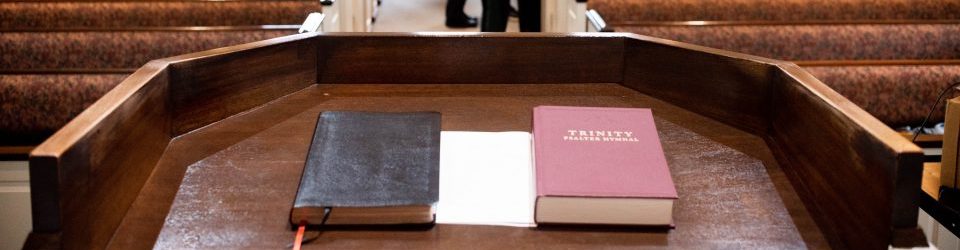

This sermon is from the Rev. Charles G. Dennison sermon archive, part of the “Christmas” series, and was preached at Grace Orthodox Presbyterian Church in Sewickley, PA, during a worship service on Sunday, December 31, 1978.
But there will be no more gloom for her who was in anguish. In earlier times he treated the land of Zebulon and the land of Napoli with contempt, but later on he shall make it glorious by the way of the sea on the other side of Jordan, Galilee of the Gentiles. The people who walk in darkness will see a great light. Those who live in a dark land, the light will shine on them.
Let us pray briefly. Father, it is not eloquence, it is not style, it is not even the sound of one’s voice that makes the word compelling. It alone has its own compulsion. for it is the word of the Spirit, the word of the Christ, the word of the living God. Today it is important that we hear this word, for the overtures of the word are serious, and the matters contained in it are matters of life and death. We beseech you then, in godly fear, that we might hear and that we might obey And that, Father, in everything we might exalt you, the one who is glorious indeed, through Jesus Christ. Amen. It was a great reign.
The kingdom flourished under Uzziah. and the kingdom flourished under Jotham, his son. But now Ahaz has ascended the throne, and troubles have come. Ahaz is king in Jerusalem, in the midst of the two southern tribes, Judah and Benjamin. To the north there is Syria, And Syria is led by Reza, the son of Ramallah, whose throne is set in Damascus. He has taken up cause with the king of Samaria, the capital of the ten northern tribes, and they’ve made their assault upon the south.
Ahaz is looking for help. It’s the message of Isaiah that help is found in trusting God, and that our fears can only be taken away if we see and understand that the promise of God is to be with us, his people. and thus the significance of the name Immanuel, God with us. The glorious message of Isaiah to Ahaz and to the southern tribes, trust in God. But Ahaz can’t trust in God, for he doesn’t believe in God.
He has rebuilt temples for idol worship. He has refurbished the groves. He has again established the high places, so that the people themselves are being led away into false worship and idolatry. Ahaz is breaking covenant with God, forsaking the word of the Lord.
And when he looks for help, he does not look to heaven, rather he looks to the northeast. For there’s an upstart of a kingdom just beginning to develop on the Euphrates. Its capital is Nineveh. The king of Nineveh has a name that’s a real mouthful, Tiglath-Poleser. He looks to the Assyrians to help him against the alliance. They will be able to stay the threat.
I suppose that the events of this last week have finally brought about the culmination of things that we have feared for a long time in our own nation. Now I don’t want to be so foolish as to match up one-on-one the events that took place in Judah and Israel, and those things that are taking place in our own day, but there is the matter of wisdom. Do we actually believe that China is a reed upon which we can lean? What are the reasons that we give for the alliance which we have struck?
Is it righteousness? Or is it profit? Is it the sinking dollar? Is it the prospect The prospect of an incredible resource of cheap labor. Is it entering into the balance of trade and the balance of power? And what some analyzers of the modern corporate scene have called gamemanship. There’s wisdom in the Word. And it should be wisdom that we apply to the situations at hand. Well, that’s the historical background at least.
We have the last days then of the northern tribes. We have Jerusalem perched upon her mountain and she thinks that she’s unassailable, unable to be touched. We have the alliance of Syria and Israel against Judah. And we have Judah turning not to the Lord, but to the upstart kingdom of Assyria for help. In the midst of this, Isaiah has a message to speak. And his message has meaning on the background of hopelessness.
You see, the ten northern tribes had leaned upon Assyria for their aid, but they found that in the game of power politics and international intrigue, Syria was not reliable. It could not protect it against the onslaught of Assyria and Tiglath-Balazer. The ten northern tribes fell. and they fell in an irretrievable way. What is it like to live without hope? Can you imagine utter hopelessness, absolute despair? Have you ever thought of suicide? We have an example of hopelessness in our own most recent history.
The effect of Jonestown is beginning to wane, but I believe that the question that remains to be answered with regard to that event is, how can nearly a thousand people reach a state in their mind, collectively, in which they completely abandon all hope in this world? I think that for Americans, that’s what makes Jonestown incomprehensible. An American without hope? I can’t understand such a thing. The background of this portion of scripture that we’ve read this morning is hopelessness, utter hopelessness.
And Isaiah is playing upon the lesson in hopelessness that Judah should learn from the events that have transpired in the ten northern tribes. The lesson of the ten northern tribes is one that leads us into the depths of complete and utter despair. For here are ten tribes that were destroyed, literally destroyed, by the Assyrian army and led away captive in such a manner that their identity has been completely lost to history. That’s as if history has devoured them and there’s no trace of them left anywhere. Now, of course, we do have the modern theory that the nation of Britain is comprised of the Ten Lost Tribes of Israel and the modern cult of the British Israelite-ish movement, and we also have the belief of the Mormon Church that the Ten Lost Tribes were the Aztecs and the Incas and the Mayas and the American Indians, and therefore they hold them in great respect and honor. But these constructions are mere fables, not true. The lesson of the ten northern tribes is a lesson in hopelessness and utter despair. And that is what is being described at the end of chapter eight. He’s describing the fate there of the ten northern tribes as they have been led into utter distress, darkness, and bloom of anguish.
They have been driven away into darkness, and you should read that as utter darkness, no light at all. The darkness and the anguish and the gloom that is in view here is literally, in the mind of the writer, the disappearance into death, the dissolution into nothingness, so that nothing is left and you are forgotten.
It is the ultimate judgment of God. This lesson then is given to Judah, the southern tribe, so that there would be no thought at all that God’s work and word and his judgments are idle threats. It’s on the background of hopelessness that the word of grace is given. And thus begins chapter 9. The correspondence in the mind of Isaiah is simply this, as with the ten northern tribes, so with Judah. except that with Judah now there is the word of grace, but that word of grace should always be measured by the seriousness of the threat of the lesson of the ten northern tribes, the threat of nothingness, the threat of extinction, the threat of the doom and darkness and gloom of irretrievable death. their experience in the future, as Isaiah foretells, will be one of being led away into exile, into captivity, much like the ten northern tribes. They are not permitted to think of that exile in any other terms than a descent into death from which there is never any hope of ever coming to life again, except by the promise of God.
And that is where the hope, the hope of Isaiah resides, that though it is true that Judah shall be led away in conformity to the judgment that had been meted out upon Israel, there will be that message that God Himself, by His power, will make again glorious that land that has been desolated. He will bring them back from the other side of the Jordan, and there, in Galilee of the Gentiles, the glorious light will begin to shine. It is that light that begins to appear when the Jews return from Babylon to be sure, when the remnant is returned to the land, but it is culminated only when the light of the glory of the gospel of Jesus Christ appears in those northern calves. in those counties which were thought by every Jew to be thoroughly and completely desolate and worthless, to the extent that it had become a proverb in Israel to say these words, can any good thing come out of Nazareth? Does any prophet come from Nazareth? The scene of the glory of God will be the scene that he himself has made desolate to show to you that it is only by the power of God that there can be a reversal of all of these things that seem to have led into complete and utter despair.
In the middle of the message of doom and gloom, Isaiah preaches the message of Christmas promise. Only God can deliver, and there is no hope but in Him. The point is that dead men and women do nothing. Their condition is hopeless except God act. There is no light except God say, let there be light.
And that light shines in our hearts. Here begin the contours of gospel faith as well. not merely Christmas promise, but gospel faith. For you see, it is only those who hear the word of promise that survive. Habakkuk in his prophecy When he is reflecting upon these events, the devastation of the Babylonian army, the leading away of the people in the captivity, says, he that lives by faith shall be justified. The just man shall live by his faith. Even here, gospel is being preached. Even here in Isaiah, 700 years before the coming of Christ, the message is being proclaimed.
He who holds on to the promise of God by faith, though he descends into hell, though he goes down into a pit from which there is no rescue, though he goes into utter darkness and gloom, The man who holds on to faith will be raised up, will be resurrected, and the light will shine upon him. It will be by the act of God and him alone, so that you should not boast in yourselves. There are important things for us to say at this time of the year in light of what Isaiah says.
We all know the Christmas spirit, how it has been secularized and how every aspect of Christ himself has been excised from it. I think on the one hand the Christmas spirit says something like this, well, people are really good after all. And Christmas time is a time for believing the best about your fellow man. Because, after all, people are good.
They are not. But you see, it’s not our custom to send Christmas cards, nor is it the custom of Hallmark or any other card company to produce Christmas cards that say, repent because if you don’t repent, you’re going to hell. That wouldn’t be very good business, I guess. But that’s the message, you see, of Isaiah. That’s his Christmas card. That’s the kind of message he’s handing out to Ahaz and the people of Jerusalem in his day. What is awaiting you is exactly what’s taken place to the ten northern tribes. Unless you believe in the promise of God, you will share their fate.
I think on the other hand, the Christmas spirit says, well, God, if there is a God, must be nice. If he looks like anything, he looks like Santa Claus, except he has white sheets on instead of a red suit. And after all, God loves us regardless of what might be true of us.
And I think that this comes from a loose understanding of what the angels say when they visited the shepherds. You know how that passage has come down to us. Glory to God in the highest and on earth, peace, goodwill toward men. This is how that passage should read. living to God in the highest and on earth peace among men with whom he is well pleased.”
The spirit of Christmas is not that God loves us anyway, regardless. The message of Christmas is God keeps covenant for the sake of those who believe. And that’s why you see in Isaiah’s prophecy there in the eighth chapter, he has spoken about the law and the testimony, and those who have given themselves to the law and the testimony of God, that being the focus of their faith and their commitment. Less and less people in our world understand this kind of Christian and Christmas greeting.
The seriousness of sin and its threat. The call for faith. The firm assurance and promises of God. A God who alone is able to deliver us from the pits of hell and death. Let’s learn to rejoice with that kind of background in mind, for having seen that we have been rescued from utter despair, death of an irretrievable kind, let us praise our God and his Father in heaven, we thank you for the ministry and the work of Isaiah the prophet, who preached the gospel to his own generation. We rejoice, Lord, in your calling of him and the sealing of his ministry in the temple, when he had the vision of the great glory of God and his Messiah. We pray now, Lord, that as he confessed that he was not worthy a man of unclean lips who dwelt in the midst of a people of unclean lips, that we too would receive of you your cleansing and sanctifying ministry, so that we, our God, might stand with him, receptive, having humbly believed the message of judgment with regard to ourselves, and embraced the message of deliverance through the arrival of the Messiah, the Lord Jesus Christ. We pray these things now, in Jesus’ name, Amen.
The sermon text provided above is derived from the sermon audio recording making use of generative tools. It has not been manually edited. While transcription tools have a high degree of accuracy, the output may include generative textual, punctuation, and/or formatting errors.